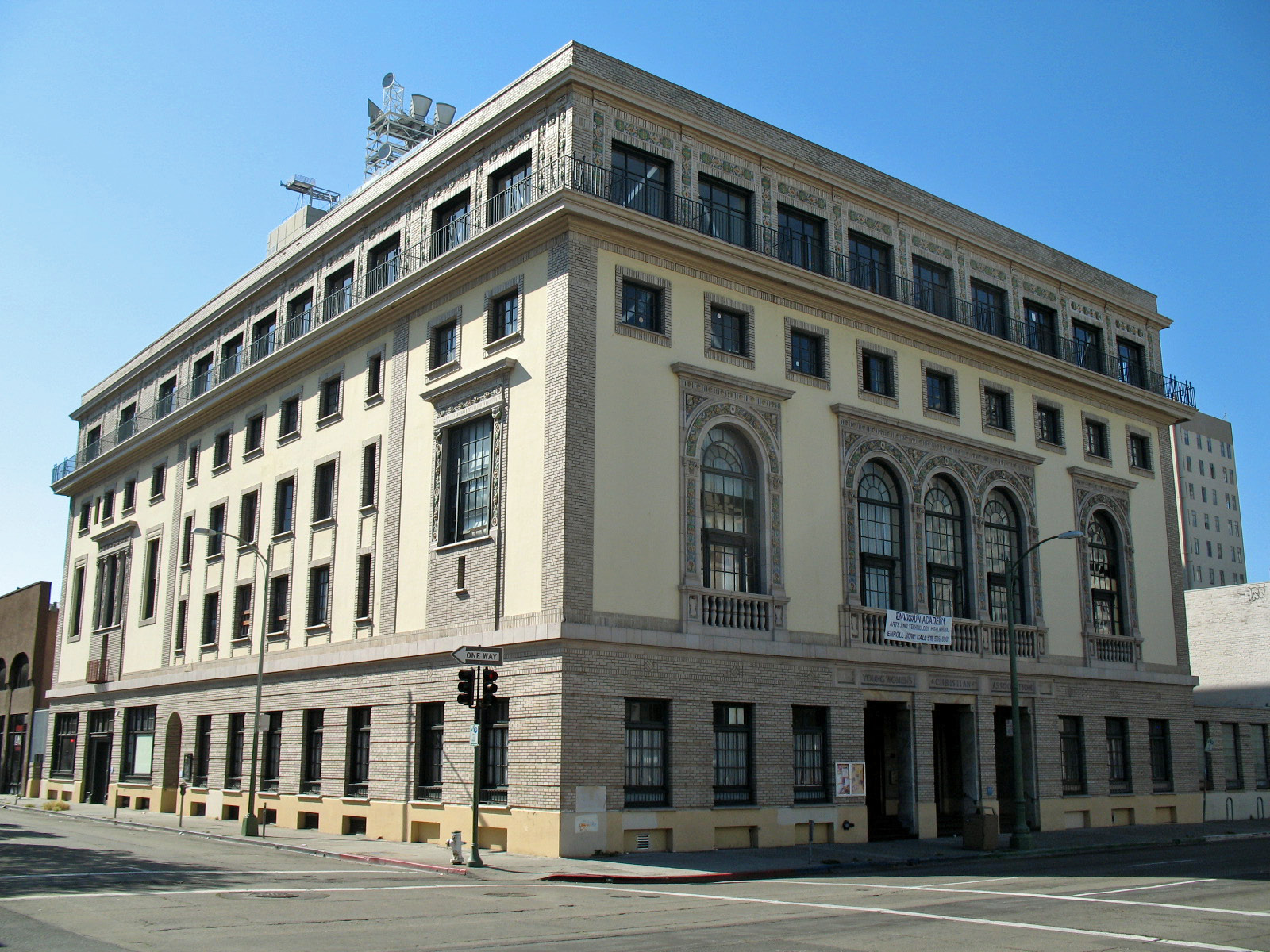
YWCA Building (Oakland, California)
The cornerstone reads "DEDICATED TO NOBLER WOMANHOOD." It has been there since 1915, carved into the brick at the base of a building that Julia Morgan designed for the Young Women's Christian Association of Oakland. More than a century later, the building still stands on Webster Street, though the women sleeping upstairs are no longer small-town transplants seeking respectable lodging in the big city. They are tenants of a co-living startup, or students at a charter school that occupies the lower floors. The mission carved into that cornerstone has outlived every organization that tried to fulfill it, and the building itself - with its Corinthian columns, Palladian windows, and terra cotta foliage - keeps finding new reasons to exist.
Sorority Sisters and a Shared Purpose
The story of the building begins with a friendship and a shared conviction. Grace Merriam Fisher, president of Oakland's YWCA chapter, knew Julia Morgan from their days in the Kappa Alpha Theta sorority at UC Berkeley. When the YWCA needed a new headquarters, Fisher turned to the most prominent female architect in California - a choice that was practical, political, and personal all at once. Morgan was already designing the YWCA Asilomar Conference Grounds on the Monterey Peninsula for Phoebe Hearst, and she would go on to complete numerous other YWCA projects across the state. The Oakland commission fit a pattern: organizations dedicated to women's advancement hiring a woman architect to shape the spaces where that advancement would happen. H.C. Capwell, the department store magnate, organized the fundraising campaign, and the money came together quickly enough that construction proceeded without delay.
Rome on Webster Street
Morgan drew her inspiration from Santa Maria della Pace in Rome, and the result is a building that looks nothing like what most people expect from downtown Oakland. The exterior is brick with glazed terra cotta ornament - arched Palladian windows, rusticated piers at the entrance, and window surrounds decorated with polychromed terra cotta depicting nuts, foliage, ribbons, and architectural bosses. Iron cresting runs along the top cornice. Originally three stories with an open courtyard, the building later gained two additional floors that transformed the courtyard into a grand interior atrium. Corinthian columns rise through that space, topped by an entablature bearing a Scripture passage in gold lettering. The interior was no less ambitious: bedrooms for residents, lounges with fireplaces, a cafeteria, a gymnasium, showers, classrooms, a swimming pool, and a 300-seat auditorium. Morgan designed it as a small city within a building, a place where women could live, learn, exercise, and gather without depending on any institution controlled by men.
A Refuge in Every Era
The YWCA's founding chapter in Oakland traces back further than the building itself. The Ladies Evangelical Philanthropic Society was established in 1877 and became the first YWCA affiliate in California the following year. From the start, the organization's primary mission was to provide safe, temporary housing for young women arriving in the city - from small towns in the Central Valley, from farms in the Midwest, from overseas. The building on Webster Street gave that mission architectural form. It also hosted the Travelers Aid Service, the Campfire Girls, and the Philomathian Club for Negro Women, an affiliate of the Business and Professional Women's Federation. During World War II, as women flooded into the East Bay to work in the shipyards and defense plants, the YWCA staffed a 24-hour canteen at the building's back door, feeding women on their way to and from shifts that ran around the clock.
Divided but Still Standing
By the turn of the twenty-first century, the building's original purpose had faded, but the structure proved adaptable. In 2000, the property was legally split into two parcels. The California College of the Arts purchased the top two floors for $1.3 million, converting them into a dormitory. When that college later relocated to San Francisco, a co-living company called Starcity moved in, setting up 66 single-room-occupancy units on those same upper floors. The lower levels found a different tenant entirely: Envision Academy of Arts and Technology, a charter school that now occupies the spaces where YWCA members once swam laps and attended lectures. The building's ability to absorb these transformations speaks to Morgan's original design, which created rooms flexible enough to serve purposes their architect never anticipated. What was once a gymnasium becomes a classroom. What was once a lounge becomes a common area for tech workers splitting rent six ways.
The Cornerstone Holds
Julia Morgan built more than four hundred structures in her career, including William Randolph Hearst's castle at San Simeon, but her YWCA commissions hold a special place in her body of work. They were buildings designed by a woman for women, at a time when the architecture profession was almost entirely male and the women these buildings served had limited options for independent living. The Oakland YWCA remains on the National Register of Historic Places and the list of Oakland Designated Landmarks, its Renaissance Revival facade still commanding attention on a block that has changed dramatically around it. The Palladian windows still catch the afternoon light. The terra cotta foliage still frames the arches. And the cornerstone still reads what it has always read, its dedication to nobler womanhood outlasting the specific definitions of what that phrase might mean, and broad enough to encompass whatever comes next.
From the Air
The YWCA Building is located at 37.805N, 122.268W in downtown Oakland, near the intersection of Webster Street and 15th Street. From the air, it is not individually distinguishable at cruise altitude, but it sits within the dense grid of downtown Oakland, south of the I-580/I-980 interchange and northwest of Lake Merritt. Nearest airports: Oakland International (KOAK) approximately 7 nm south, and San Francisco International (KSFO) approximately 16 nm southwest across the Bay. Clear Bay Area conditions provide the best visibility of the downtown Oakland grid.