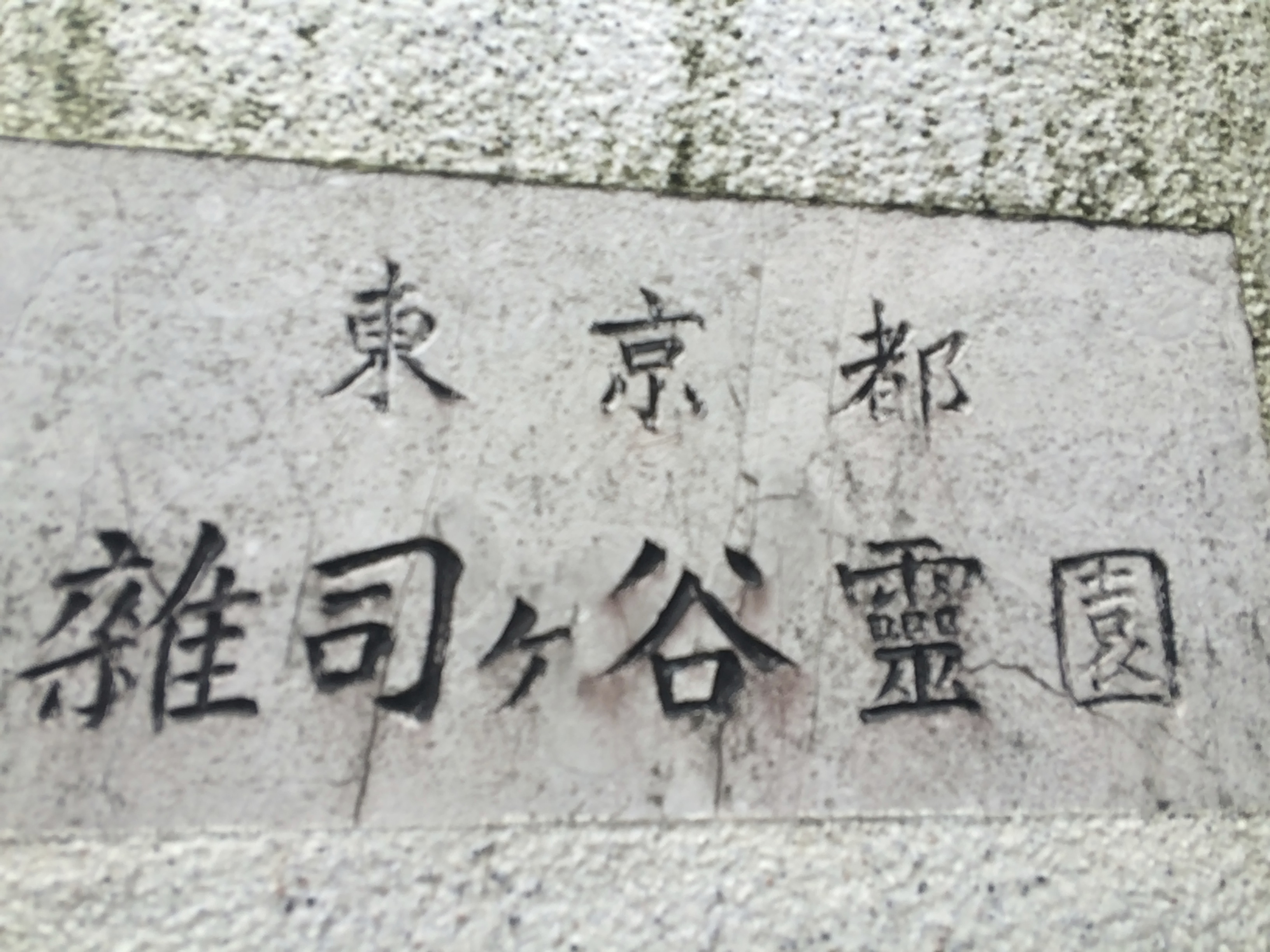
Zōshigaya Cemetery
Before Natsume Soseki was buried in Zoshigaya Cemetery, he buried a fictional character there. In his 1914 novel Kokoro, the tormented narrator Sensei visits Zoshigaya every month to stand at the grave of a friend whose death he caused -- a betrayal that haunts the book and its readers. Two years after writing those pages, Soseki himself was laid to rest in the same cemetery, in plot 1-14-1-3. Fiction and biography collapsed into one address. This kind of layered meaning defines Zoshigaya: a ten-hectare public graveyard in Toshima, Tokyo, where the dead tell stories that still ripple through Japanese culture.
Born from a Prohibition
Zoshigaya Cemetery exists because the Meiji government decided that the dead could no longer stay downtown. In 1873, cremation was briefly prohibited, and the following year the government designated nine sites as new public graveyards to handle the overflow of burials previously scattered across central Tokyo. The Tokyo prefectural government established six cemeteries including Zoshigaya, entrusting its construction to the Tokyo Chamber of Commerce and Industry. Administration passed to the prefectural government in 1876 and eventually to the Tokyo Metropolitan Park Association in 1985. Originally called after the town of Zoshigaya-Asahidecho where it sits, the cemetery received its current name in 1935. Today it spreads across 10 hectares of wooded paths and weathered stone in the Minami-Ikebukuro neighborhood -- an island of silence surrounded by one of the busiest districts in the world.
The Castaway and the Pioneer
The roster of notable burials at Zoshigaya reads like a syllabus of modern Japanese history. Nakahama Manjiro, buried in plot 1-2-10-1, was a fourteen-year-old fisherman who was shipwrecked on a remote island in 1841 and rescued by an American whaling vessel. He became one of the first Japanese people to live in the United States, attending school in Fairhaven, Massachusetts, before returning to Japan in time to serve as an interpreter when Commodore Perry's Black Ships arrived in 1853. A few rows away rests Ogino Ginko (1851-1913), who became the first licensed woman physician of Western medicine in Japan in 1885, driven to the profession after suffering the humiliation of being treated by male doctors for a disease contracted from an arranged marriage. Their graves sit among hundreds of others in a nonsectarian cemetery that accepted anyone regardless of faith -- a policy as revolutionary in 1874 as the lives it commemorated.
Poets, Painters, and a Prime Minister
The literary density of Zoshigaya is extraordinary. Lafcadio Hearn -- the Greek-Irish writer who took the name Koizumi Yakumo and became Japan's most famous foreign-born author -- rests in plot 1-1-8-35. Nearby lies Kyoka Izumi, whose novels and kabuki plays defined an era of Japanese romanticism, and Kafu Nagai, the essayist and diarist who chronicled Tokyo's pleasure quarters with unflinching honesty. Ogata Gekko, the ukiyo-e woodblock print artist, shares the grounds with Yumeji Takehisa, the painter and poet whose delicate images of women became icons of Taisho-era aesthetics. But Zoshigaya also holds darker legacies. Hideki Tojo, the Imperial Japanese Army general who served as the 40th Prime Minister of Japan and led the country through much of World War II, has a family grave here -- though after his execution for war crimes in 1948, American authorities scattered his cremated remains over the Pacific Ocean to prevent the site from becoming a nationalist shrine.
Where Fiction Meets the Ground
Natsume Soseki's decision to set a pivotal scene of Kokoro in Zoshigaya was not casual. The novel's Sensei carries a secret guilt -- he stole the affections of a woman from his closest friend, who then took his own life. Every month, Sensei walks to Zoshigaya to stand at that friend's grave, a ritual of remorse that forms the emotional spine of the book. When Soseki died in 1916, he was interred in the same cemetery he had transformed into a literary landscape. The grave is modest by any standard, marked with a simple stone. Visitors still come, some clutching paperback copies of Kokoro, to pay respects to the writer who understood that cemeteries are not just for the dead. They are for the living who cannot let go. Zoshigaya, with its tree-lined paths and its centuries of accumulated stories, embodies that truth more fully than almost any place in Tokyo.
From the Air
Located at 35.723N, 139.720E in the Toshima ward of northwest-central Tokyo, roughly 3 km northwest of the Imperial Palace. The cemetery's 10-hectare footprint appears as a dense patch of green canopy amid the urban grid, distinguishable from altitude by the contrast of mature trees against surrounding buildings. The Ikebukuro commercial district is immediately to the north. Nearest major airport is Tokyo Haneda (RJTT), approximately 18 km south-southwest. Narita International (RJAA) is about 65 km to the east. Tokyo Skytree (634 m) stands roughly 5 km to the east-southeast and serves as a reliable visual reference.