Zaans Museum
Step inside the Verkade Experience and the air carries something the rest of the museum world rarely offers: the actual smell of warm chocolate and baking biscuits. Three working production lines hum behind the glass, turning out chocolate, biscuits, and tea light candles in front of visitors. The Zaans Museum opened in 1998 at the edge of the Zaanse Schans open-air village; the Verkade Experience wing was added in 2009. Together their whole purpose is to add factual depth to the postcard image of Holland that draws tourists across the polders north of Amsterdam.
Larder of the Netherlands
The Zaan region earned a nickname that stuck: 'the larder of the Netherlands.' In the seventeenth and eighteenth centuries, hundreds of windmills along the River Zaan ground grain, pressed oil, sawed wood, and processed cocoa for nearby Amsterdam's hungry markets. The North Sea Canal opened in 1876, the railways arrived soon after, and what had been a mill economy reinvented itself as the country's industrial food belt. The permanent exhibition 'De Zaanstreek maakt het' traces that arc. Verkade, Bruynzeel, Honig, Albert Heijn, Lassie - the museum tells their stories not as marketing but as the connected history of a region that fed the country.
Monet's Zaandam Summer
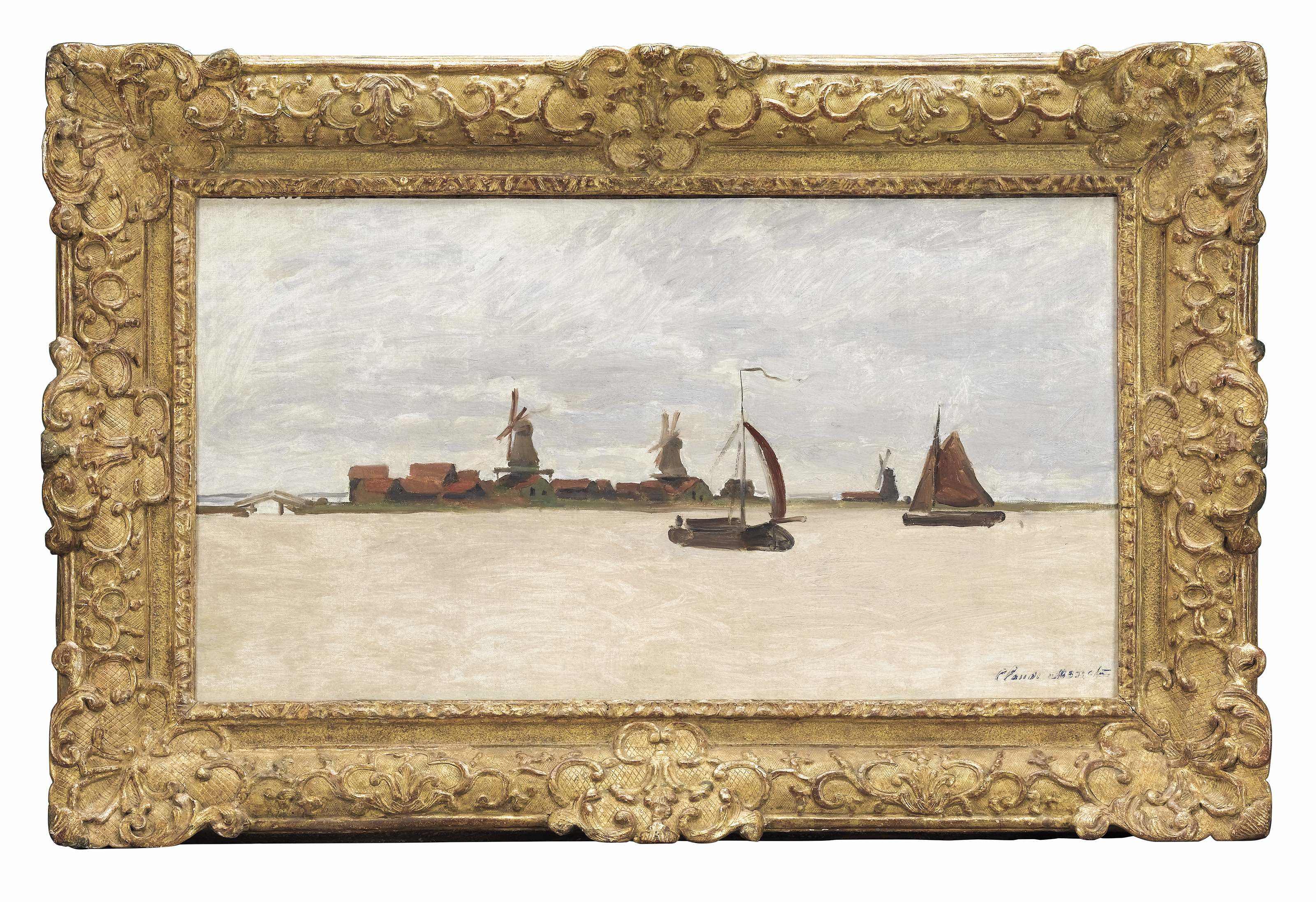
In 1871, Claude Monet spent four months in Zaandam, between June and October. He produced 25 paintings and nine sketches, including 'The Voorzaan and the Westerhem,' which the museum acquired in 2015. The canvas shows sawmills - de Bakker, de Roode Leeuw, De Notenboom - turning above ships in the river. Monet painted three versions of this scene, an early experiment in the series approach that later became a hallmark of his Giverny haystacks and Rouen cathedrals. He wrote to Camille Pissarro: 'Zaandam is quite remarkable and there is enough to paint for a lifetime. Houses in all colours, hundreds of mills, and delightful boats.' His enthusiasm sounds genuine, and the painting now anchors a gallery that places it among portraits of the Zaan families who built the very industries he saw turning.
Living Rooms of the Past
The museum manages three external locations scattered through the Zaanse Schans, each a small room where one craft or one life is restored to scale. The Cooperage came intact from Jaap Tiemstra, a barrel maker in north Amsterdam, who left his entire workshop to the museum when he died. The Weaver's House preserves the labor of sailcloth weaving as it was practiced in the nineteenth century, the looms still set up as if the family had stepped out for the day. The Jisper House is a fisherman's cottage - a replica of an 1860 original now held at the Zuiderzeemuseum - where visitors can dress in traditional Zaan costume and feel, briefly, how cramped and bright a pre-industrial home actually was.
The Tsar Who Wanted to Build Ships
In 1697, Peter the Great of Russia arrived in Zaandam to learn shipbuilding from the men who built the world's best merchant fleet. He lodged in a tiny wooden labourer's cottage built in 1632 from old ship timber. That cottage still stands in central Zaandam, now sheltered inside a stone protective shell built in 1895, and serves as an annex of the Zaans Museum. Visitors have been signing the walls and windows for centuries - Russian tsars, Dutch monarchs, Napoleon himself. The scratches are still legible. The Czar Peter House is one of the oldest wooden houses in the Netherlands, and Peter, who would later build St. Petersburg from marsh, slept in it because he wanted to know exactly how the Zaan shipwrights worked.
The Memory of the War
Twenty-eight war memorials stand across the Zaan region, marking the events of the Second World War in a part of the country that suffered under occupation alongside the rest of the Netherlands. The exhibition 'Monumenten spreken' - Monuments Speak - pairs each memorial with a short documentary, eyewitness accounts gathered by the Stichting Monumenten Spreken foundation. The museum does not stage the war as spectacle. It lets the people who lived through it describe what the stones remember, while the windmills outside keep turning as they did before the war and after it.
From the Air
Coordinates 52.4737 N, 4.8222 E. Museum sits at the southern edge of the Zaanse Schans on the Kalverpolder, a Staatsbosbeheer nature reserve. From altitude, look for the cluster of dark wooden windmills along the River Zaan north of Amsterdam. Nearby airports: Amsterdam Schiphol (EHAM) lies about 18 km southwest; Lelystad (EHLE) is about 35 km east. Recommended viewing altitude 1,500-2,500 ft for windmill visibility; the green of the polders contrasts sharply with the silver thread of the Zaan in clear weather.