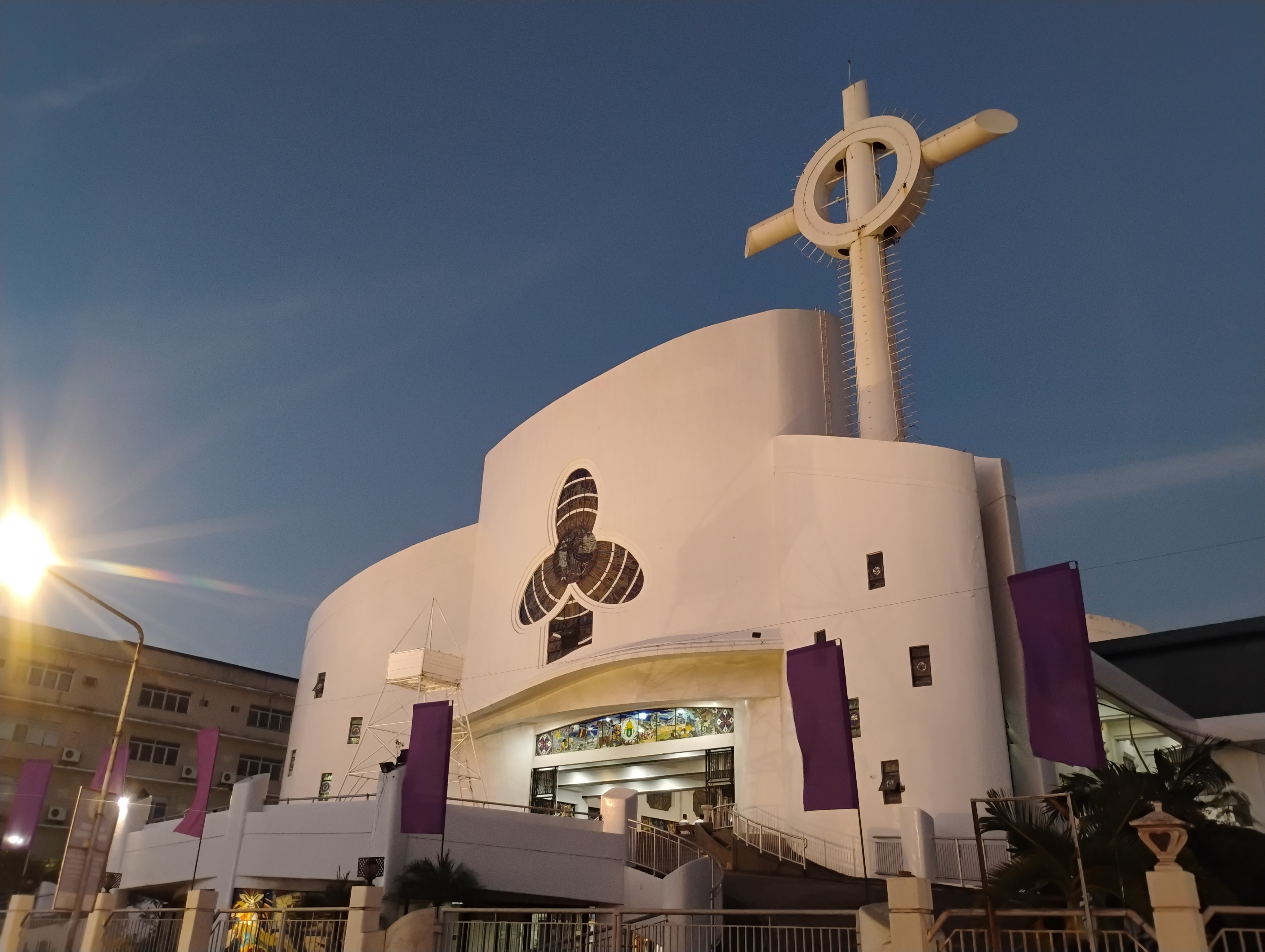
Zamboanga Cathedral
Termites brought down what Japanese bombs could not finish. The Metropolitan Cathedral of the Immaculate Conception in Zamboanga City -- seat of the oldest Catholic diocese in Mindanao -- has been built three times on two different sites, each iteration responding to a different kind of destruction. The original, constructed of wood and concrete at Plaza Pershing in 1870, was obliterated by American aerial bombing during the liberation of the city in March 1945. Its replacement, built in 1956, was quietly consumed from above by insects that hollowed out the ceiling. The current cathedral, completed in 2002, stands in cruciform on the same ground, designed to look like a candle -- an appropriate symbol for a church that keeps relighting itself.
The First Altar
The original cathedral stood at the front of Plaza Pershing, where the Universidad de Zamboanga now occupies the land. Built in 1870, it was a structure of wood and concrete with the image of the Immaculate Conception at the main altar, flanked by two Jesuit saints: Ignatius of Loyola on one side, Francis Xavier on the other. When the Diocese of Zamboanga was created in 1910, this church was elevated to cathedral status, making it the seat of the first Catholic diocese in all of Mindanao. For 75 years it anchored the spiritual life of a city where Catholicism and Islam lived in close proximity.
Destroyed to Be Liberated
On March 8 and 9, 1945, American forces conducted aerial bombings and artillery shelling to liberate Zamboanga from Japanese occupation. The bombardment destroyed two-thirds of the city's buildings, and the cathedral was among them. Yet the statue of the Immaculate Conception -- the same image that had watched over the altar since 1870 -- survived the bombs. It was carried through the rubble to a road that would afterward be named La Purisima Street, where it waited for a new home. The war left the city flattened, its cathedral gone, but the patroness intact.
The Cathedral That Termites Ate
In 1956, a new cathedral was designed and built beside Ateneo de Zamboanga University, on the site of the former Jardin de Chino chapel. Its facade featured a life-size sculpture of the Immaculate Conception and a bell tower. Inside, the Stations of the Cross were rendered in stained glass, and a bronze relief of the Last Supper decorated the day chapel. For four decades, this building served Zamboanga's Catholic faithful. Then Monsignor Crisanto de la Cruz discovered that termites had been devouring the ceiling. The structural damage was severe enough that reconstruction was the only option. The old cathedral was demolished on Easter Monday 1998 -- a deliberate choice of date that turned destruction into a promise of resurrection.
The Candle on La Purisima
The current cathedral was designed by Abarro and Associates in a cruciform layout, with a distinctive candle-like profile that evokes the Immaculate Conception. Inside, a marble statue of the patroness by National Artist for Sculpture Napoleon Abueva occupies the central space. Stained glass windows along the aisles depict every diocese in Mindanao from 1910 to 1984, transforming the interior into a visual history of Catholic expansion across the island. The baptistery holds a relic of Our Lady of the Pillar, linking the cathedral to Fort Pilar's shrine just blocks away. Behind the day chapel, a columbarium features a replica of Michelangelo's Pieta surrounded by stained glass images of the twelve apostles.
A Century Marked in Bronze
The cathedral was solemnly dedicated on December 6, 1999, with Cardinal Ricardo Vidal, Archbishop of Cebu, and President Joseph Estrada as guests of honor. Construction of the remaining wings continued until 2002. In 2010, on the feast of the Immaculate Conception, ground was broken for the Century Bell Tower on the Ateneo side of the cathedral, marking one hundred years since the Diocese of Zamboanga was established. The original statue of the Immaculate Conception -- the one that survived the 1945 bombing -- now rests in the parish office, still watching over the faithful, just from a quieter room.
From the Air
Zamboanga Cathedral is at 6.909N, 122.076E in the heart of Zamboanga City, adjacent to Ateneo de Zamboanga University along La Purisima Street. From altitude, the cruciform structure and its Century Bell Tower are identifiable within the dense urban core, a few blocks northwest of Fort Pilar. Zamboanga International Airport (RPMZ) is approximately 3 km to the northeast. Plaza Pershing, the site of the original 1870 cathedral, is nearby to the east.