Zealandia
The fence is 8.6 kilometres long, and it keeps out everything from deer to mice. Inside it, a valley in suburban Wellington is becoming something that hasn't existed in New Zealand for centuries: a forest without mammalian predators. Zealandia Te Māra a Tāne -- formerly the Karori Wildlife Sanctuary -- is the world's first fully fenced urban ecosanctuary, a 225-hectare experiment in ecological rewinding. Since the pest-exclusion fence was completed in 1999, species that had vanished from mainland New Zealand have been reintroduced here, bred here, and spilled out over the fence into the surrounding city. The kākā now screech through Wellington's suburbs because of what happened in this valley.
From Reservoir to Refuge
Before it was a sanctuary, the valley served Wellington's thirst. After large fires in 1850 and 1860 cleared the original broadleaf forest for farming, the discovery of alluvial gold in the Kaiwharawhara stream in 1869 triggered a brief gold rush. That gave way to quartz mining, which gave way to waterworks. The upper reservoir, held by a concrete gravity arch dam, was completed in 1908. For most of the twentieth century, the valley was a protected water catchment, closed to the public, and the native bush slowly regenerated on its own. When the upper dam was decommissioned around 1991 and the lower one in 1997, conservationists saw an opportunity. A valley already half-rewilded, already fenced by geography, already off-limits -- it needed only the right barrier to become an island on the mainland.
A Fence Against Eight Hundred Years
The predator-proof fence that encircles Zealandia was a world first. Designed to exclude fourteen species of introduced mammals, it was engineered through painstaking trials with each target species. The mesh is fine enough to stop a mouse. A curved top-cap prevents climbing. An underground skirt blocks burrowing. Construction finished in late 1999, and over the following nine months, every rat, stoat, weasel, cat, possum, and hedgehog inside the perimeter was hunted down and removed. The transformation that followed was not instant -- ecological recovery operates on the timescale of forests, not news cycles -- but it was real. Hardy pioneer species like mahoe still dominate, and the ancient podocarps that once towered here, rimu and kahikatea and tōtara, are being replanted by hand. The forest is in its early succession, a teenager by ecological standards, but it is growing in the right direction.
The Returning Chorus
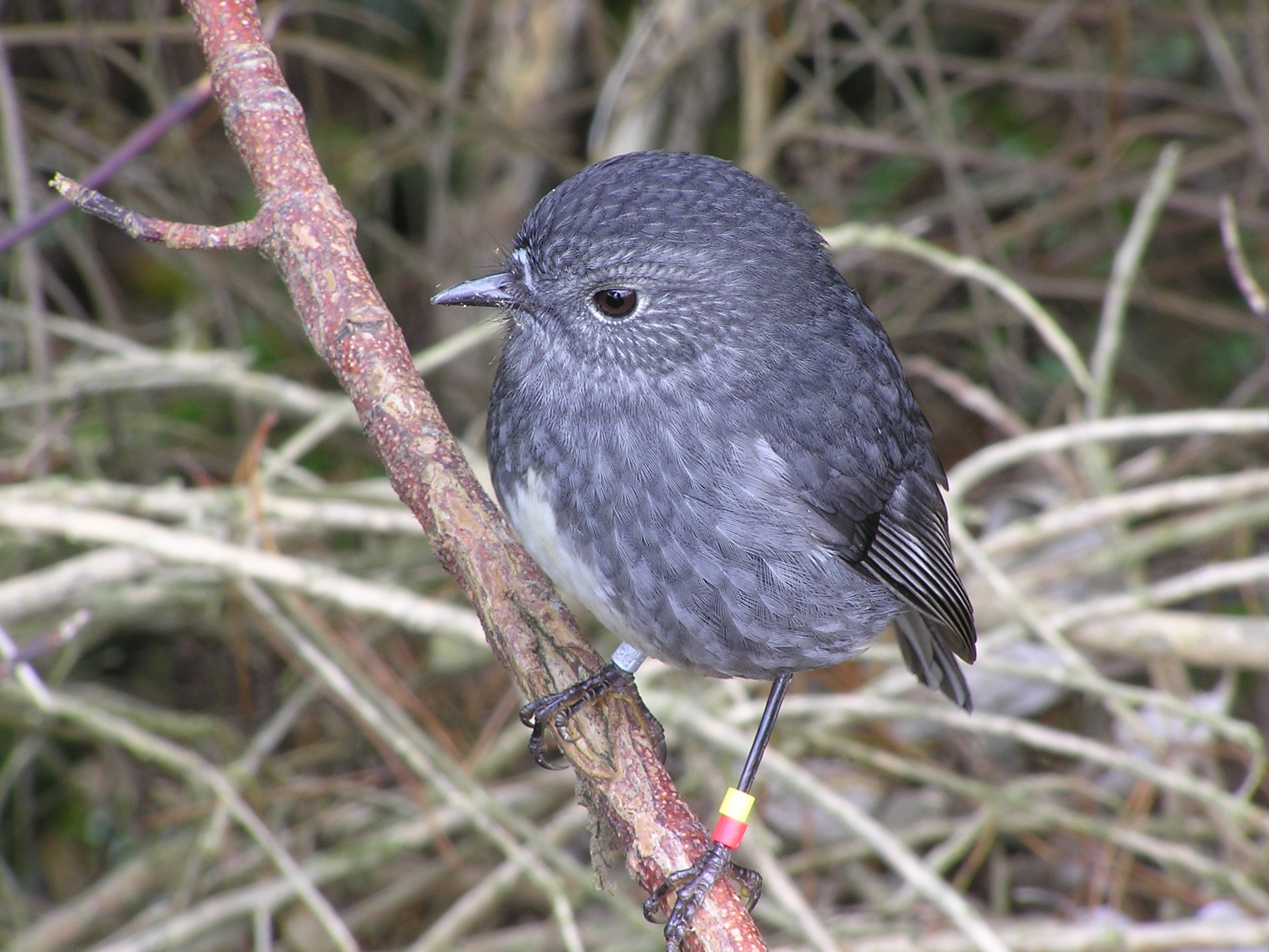
The species list reads like a roll call of New Zealand's evolutionary heritage. Twenty little spotted kiwi were released in July 2000, the first kiwi on the mainland in a generation. Three North Island kākā followed in 2002, then saddlebacks, robins, stitchbirds, whiteheads, and the impossibly rare takahē. Seventy tuatara -- reptiles whose lineage predates the dinosaurs -- arrived from Stephens Island in 2005. A hundred giant wētā came in 2007, and twenty-one Hamilton's frogs in 2006, one of the rarest amphibians on Earth. In 2021, Zealandia drained its lower reservoir by six metres to eradicate 22,000 European perch that had been devouring native fish and fouling the water with algal blooms. The sanctuary does not merely preserve -- it actively intervenes, removing what does not belong and reintroducing what does.
Spilling Over the Fence
Zealandia's most remarkable achievement may be what happens outside its boundaries. The tūī and kākā that bred safely within the fence did not read the map. They flew over it and into Wellington's gardens, parks, and backyards. The city now has bird populations it hasn't heard in living memory, not because someone released birds into the suburbs, but because a safe breeding population inside the fence produced enough young that they naturally dispersed outward. Bellbirds sing in Kelburn. Kererū, the heavy-bodied native pigeon, crash through suburban trees with their distinctive wingbeats. The sanctuary's model -- a predator-free mainland island as a breeding engine for surrounding habitat -- has inspired dozens of similar projects across New Zealand, from the 98-hectare Bushy Park to the 3,500-hectare Maungatautari Restoration Project enclosing an entire mountain.
A Living Proof of Concept
In 2023, Zealandia won the Supreme Tourism Award at the New Zealand Tourism Awards. The praise from Tourism Industry Aotearoa captured something essential: "Zealandia is everything we love about tourism: protecting our wildlife, telling our unique story, thrilling visitors and beloved by its community." But the sanctuary's significance reaches beyond tourism. New Zealand's government has set a goal of making the country predator-free by 2050, and Zealandia is the proof that such ambitions are not fantasy. A valley that was farmed, mined, dammed, and overrun with introduced predators is now home to species that once existed only on remote offshore islands. The forest is young, the restoration incomplete, and the fence requires constant vigilance. But the kiwi call at night in a Wellington suburb, and that fact alone rewrites what most people thought was possible.
From the Air
Zealandia sits at 41.29°S, 174.75°E, tucked into a valley between Wrights Hill and the Brooklyn wind turbine in Wellington's western suburbs. From 2,000-3,000 feet, look for a densely forested valley surrounded by suburban housing -- the contrast is stark. The Brooklyn wind turbine on Polhill is a useful visual reference. Wellington Airport (NZWN) is approximately 7 km to the southeast. The sanctuary is not visible as a distinct feature from high altitude, but the forested valley stands out against surrounding residential development.