Zeniarai Benzaiten: The Shrine Where You Wash Your Money
On the day of the snake, in the month of the snake, in the year of the snake -- April 1185, by the old calendar -- Minamoto no Yoritomo, the man who would become Japan's first shogun, had a dream. A spirit called Ugafukujin appeared in the form of a human-headed serpent and spoke: 'In a valley to the northwest, there is a miraculous spring that gushes out of the rocks. Go there and worship kami and hotoke, and peace will come to the country.' Yoritomo found the spring, built a shrine around it, and dedicated the site to the snake-bodied deity. The spring still flows. Eight centuries later, tourists line up inside the damp cave to dip their banknotes and coins into its waters, gently shaking wire baskets as the cold current rushes over their money. They are practicing zeniarai -- literally, 'coin washing' -- and they believe the rinsed currency will return to them multiplied. It is Kamakura's second most popular attraction after Tsurugaoka Hachimangu, and among the most charmingly irrational acts of faith in all of Japan.
A Dream in the Year of the Snake
The founding legend is specific enough to feel credible. Yoritomo was consolidating his military government in Kamakura when the vision came, and the timing -- the triple serpent alignment of snake day, snake month, snake year -- gave the story a mathematical neatness that elevated it beyond ordinary dream narratives. The spirit Ugafukujin was a traditional Shinto kami of waters and harvest, but the shrine that Yoritomo established was never purely Shinto. From its inception, Zeniarai Benzaiten blended native kami worship with the Buddhist goddess Benzaiten -- the Japanese incarnation of the Hindu deity Sarasvati, goddess of everything that flows: water, music, eloquence, wealth. The shrine's shintai, the sacred object housing the kami, is a stone sculpture of a snake with a human head -- Ugafukujin rendered in physical form. This fusion of Shinto and Buddhism survived even the Meiji government's 1868 decree forcing the two religions apart. The shrine was absorbed into a larger shrine system for a time but became independent again in 1970 under its present name.
The Regent Who Started the Ritual
Yoritomo built the shrine, but the money-washing tradition did not begin until 1257, when Hojo Tokiyori -- the regent who effectively ruled Japan from Kamakura -- came to worship at the spring. Tokiyori washed his own coins in the cave waters and told the faithful to do the same, promising that Ugafukujin would multiply their money and grant prosperity to their descendants. The recommendation caught on. Over the following centuries, the practice evolved from a regent's endorsement into a deep-rooted folk belief that persists with genuine conviction today. Visitors purchase small wicker baskets at the shrine, place their money inside, and ladle the cold spring water over their currency. Some wash bills; some wash coins. The truly committed wash credit cards. The convention holds that the washed money should be spent, not hoarded -- circulating it is what activates the blessing. Whether or not anyone's fortune has literally doubled, the shrine has never lacked for visitors willing to test the theory.
Through the Tunnel, Into the Valley
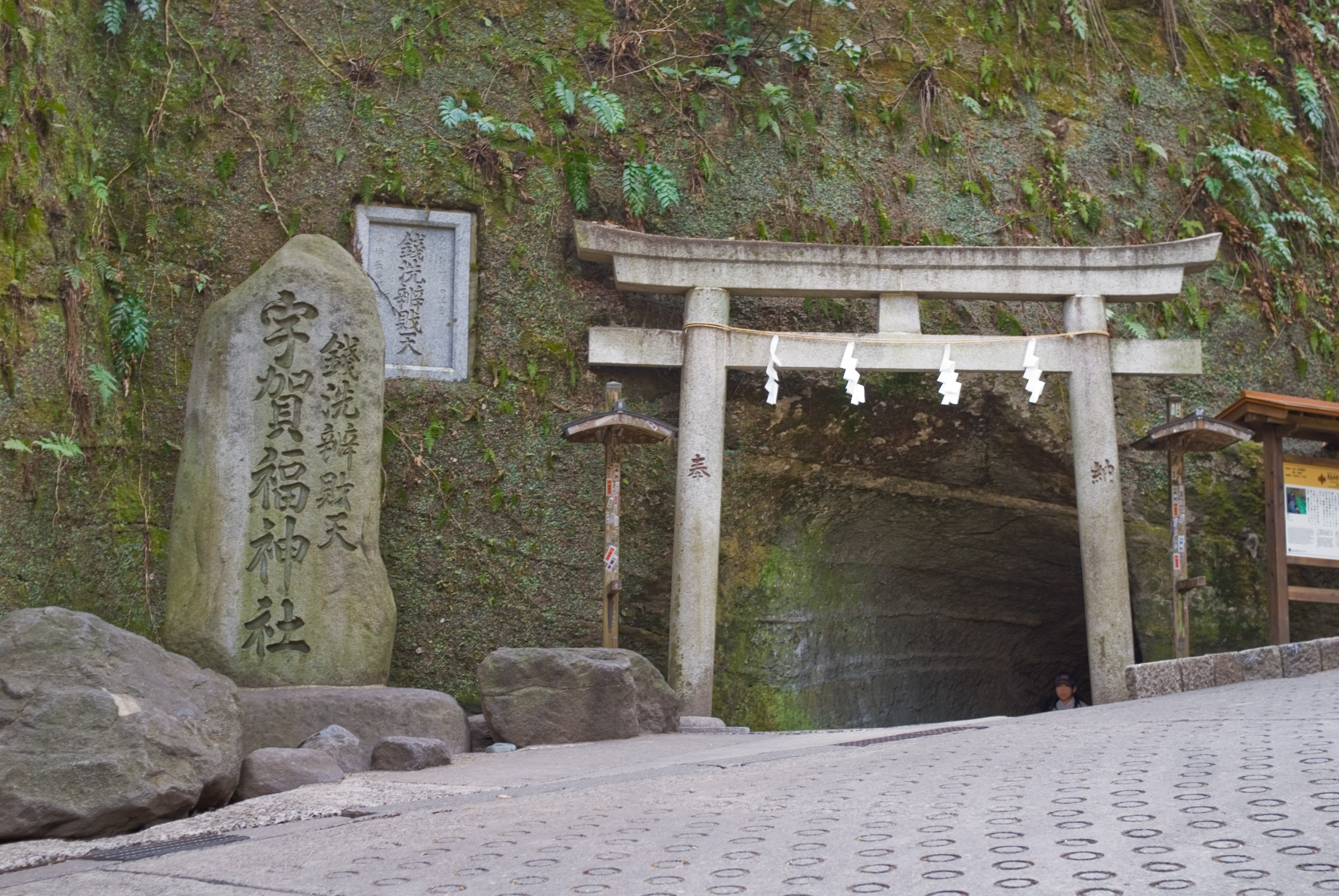
Reaching Zeniarai Benzaiten requires a short walk through Kamakura's wooded western hills, climbing past residential streets that thin out into forest. The shrine is tucked into a narrow valley called Kakurezato -- 'hidden village' -- and the name is apt. The main entrance today is a tunnel bored through the rock face in 1958, its mouth framed by torii gates and its interior lit by bare bulbs. The tunnel deposits visitors directly into the shrine precinct, a compact space hemmed in by cliff walls on all sides, with the money-washing cave at its heart. The shrine's original entrance lies on the opposite side, near a cluster of tea houses, approached through a narrow path lined with more torii donated by the faithful. In the past, that winding path was the only way in, which explains why the area earned the name Kakurezato. The effect of either approach is the same: a sudden transition from ordinary neighborhood to enclosed sacred space, as if stepping behind a curtain in the hillside.
Where Gods Overlap
Zeniarai Benzaiten stands as one of Japan's clearest surviving examples of shinbutsu shugo -- the fusion of Shinto and Buddhism that characterized Japanese religion for over a thousand years before the Meiji separation. The shrine's dual identity is encoded in its very name: Ugafuku is the Shinto kami; Benzaiten is the Buddhist goddess. Both are associated with water, with serpents, with prosperity. The overlap was not accidental but theological -- under the honji suijaku framework, kami and buddhas were understood as different faces of the same spiritual reality. Archaeological excavations above the shrine's tunnel entrance uncovered several Buddhist steles, now housed in the Kamakura Museum of National Treasures, physical evidence of the centuries when praying at this spring meant addressing both traditions simultaneously. Most Japanese shrines were scrubbed of their Buddhist elements after 1868. Zeniarai Benzaiten kept its dual name and its dual character. The snake-headed stone still sits inside. The spring still flows through the cave. And tourists still wash their ten-thousand-yen notes, hedging their bets across every available deity.
From the Air
Located at 35.326°N, 139.542°E in the wooded hills west of central Kamakura. The shrine is nestled in a narrow valley and not visible from altitude, but the surrounding hill terrain and forested ravines that characterize western Kamakura are distinctive. The area sits roughly 1.5 km northwest of Tsurugaoka Hachimangu. Kamakura occupies a valley open to Sagami Bay on the south side, with wooded hills enclosing it on three sides. Best viewed at 2,000-3,000 feet AGL approaching from the south. Tokyo Haneda Airport (RJTT) lies approximately 25 nautical miles northeast. Naval Air Facility Atsugi (RJTA) is roughly 15 nautical miles north-northwest. Enoshima island to the southwest and the Shonan coastline provide visual references.