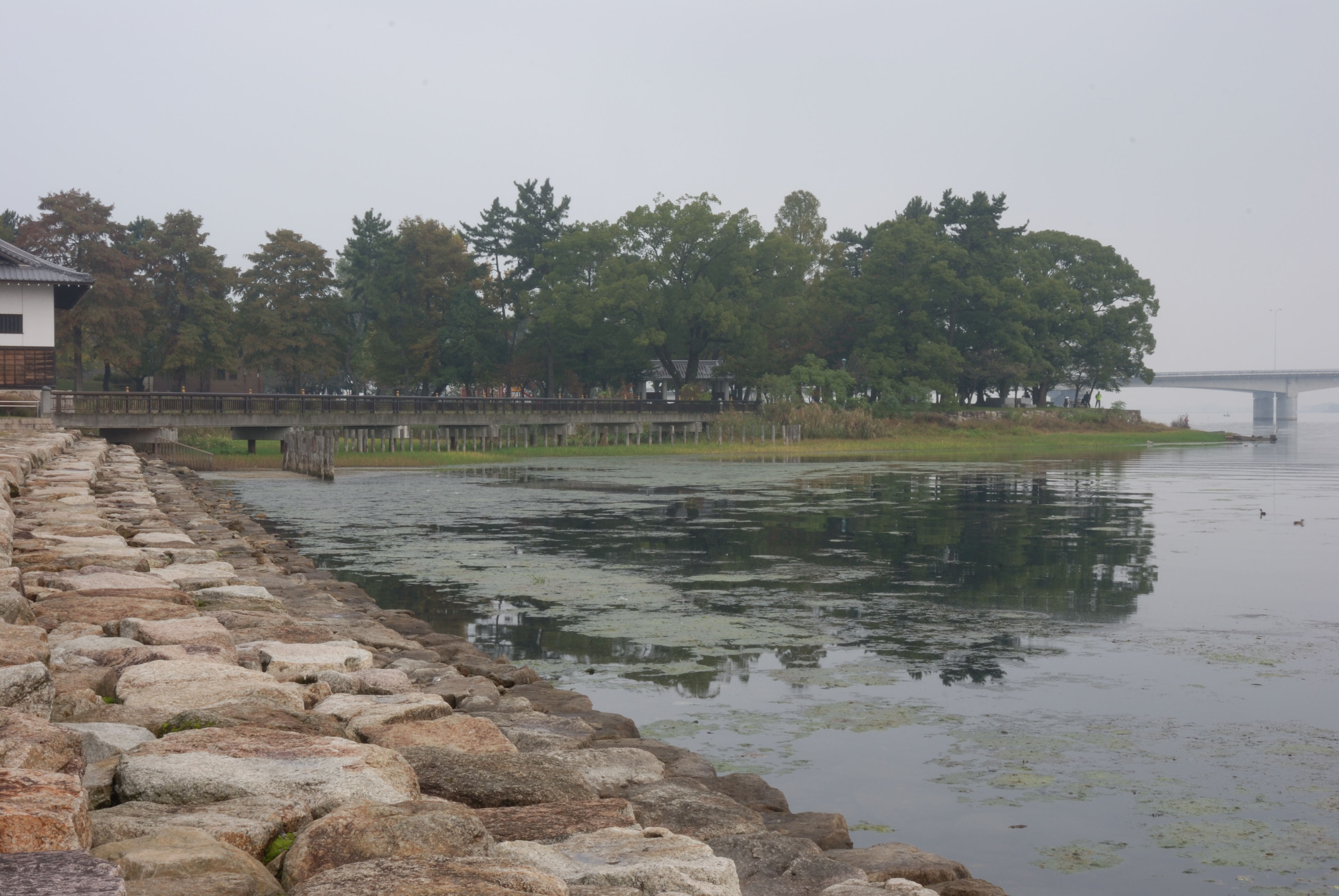
Zeze Castle
The dust had barely settled at Sekigahara. In October 1600, Tokugawa Ieyasu won the battle that would make him ruler of Japan, and almost immediately he turned his attention to a peninsula jutting into Lake Biwa near the city of Otsu. Here, at the narrowest point where the Tokaido highway -- the most important road in Japan, connecting Kyoto to Edo -- crossed the ancient Seta-no-Karahashi bridge, Ieyasu ordered the construction of a new castle. The existing Otsu Castle was to be demolished, its timbers and stones recycled into something built not for an old order but for the new one. Zeze Castle would guard the gateway to the imperial capital. Ieyasu entrusted the design to Todo Takatora, already regarded as the finest castle architect in the land, and conscripted the major western daimyo to provide the labor. Speed mattered more than elegance. The castle rose fast.
Architecture on the Water
Zeze Castle was a hirashiro -- a flatland castle -- but its setting gave it the character of a fortress afloat. The peninsula extended directly into Lake Biwa, and Takatora's design used the lake water itself to form natural moats separating the castle's three concentric baileys. The outermost San-no-maru sat on the shore. The Ni-no-maru and the innermost Honmaru were essentially islands, divided by stone walls and water-filled channels. The tenshu, or main tower, stood in the western corner of the Honmaru and was unusual for its four-story design at a time when three or five stories were more conventional. The castle is counted among Japan's top three lakeside castles, alongside Takashima Castle in Nagano and Matsue Castle in Shimane. But its waterside position was also its chronic weakness: the lakeshore eroded constantly, demanding expensive maintenance that would burden every lord who held the domain.
A Parade of Lords
The first daimyo appointed to Zeze was Toda Kazuaki, who received the newly created Zeze Domain with an assessed productivity of 30,000 koku -- a modest holding, but strategically priceless. His son Toda Ujizane was transferred to Amagasaki Domain in Settsu Province in 1617, and the castle passed through a succession of fudai daimyo clans, loyal vassals of the Tokugawa. The Honda clan took control in 1651 and held it for 13 generations, an unbroken tenure spanning more than two centuries until the Meiji Restoration dismantled the feudal order in 1868. During that time, the castle endured a severe earthquake in 1662 that badly damaged its structures. The lakeside erosion never stopped. Holding Zeze meant holding a beautiful but demanding piece of ground that the water was always trying to reclaim.
Dismantled but Not Lost
After the Meiji Restoration of 1868, the new government had no use for feudal castles. In 1870, Zeze Castle's structures were demolished or sold off piecemeal. The tenshu was torn down. The Ni-no-maru bailey eventually became a municipal water treatment plant -- a pragmatic transformation that would have appalled the samurai who once defended it. But the castle's gates proved more durable than the castle itself. Three of the original Otemon gates were relocated to nearby shrines: the main Otemon gate from the Honmaru went to Zeze Shrine, the North Otemon gate to Shinozu Shrine, and the South Otemon gate to Muchisaki Hachiman-gu. All three have been designated National Important Cultural Properties. A fourth gate, the Koraimon, was moved to the Hosomi Memorial Foundation in Izumiotsu, Osaka. One corner yagura tower survived relocation to Chausuyama Park in Otsu, though it has been so heavily modified for use as an assembly hall that it no longer resembles the original.
Stone Walls and Still Water
Today the site of the Honmaru is a public park called Zeze Castle Ruins Park, a twenty-minute walk from Zeze Station on the JR West Biwako Line. Fragments of the original stone walls remain, their massive cut blocks still fitted together with the precision that Takatora's masons brought to the work four centuries ago. The park is quiet, overlooking Lake Biwa -- the largest freshwater lake in Japan -- where the water that once filled the castle's moats still laps at the shore. It takes some imagination to see the fortress that once stood here, the four-story tower reflected in the lake, the Tokaido traffic streaming past under the watchful eye of the garrison. But the stones remember. And across the city, in shrines that had nothing to do with warfare, the gates of Zeze Castle still stand on their hinges, designated as treasures of a nation that no longer builds castles but has learned to preserve them.
From the Air
Located at 34.995N, 135.895E on the western shore of Lake Biwa in Otsu, Shiga Prefecture. Lake Biwa is the dominant visual landmark in the area, Japan's largest lake, easily identifiable from altitude. The castle ruins sit on a small peninsula extending into the lake on its southwestern shore, near where the modern city of Otsu meets the waterfront. Kyoto lies approximately 10km to the west over the Higashiyama mountains. Nearest airports: Osaka Itami (RJOO) approximately 30nm southwest, Kansai International (RJBB) approximately 50nm south. The lake creates its own microclimate, with morning fog common in autumn and winter.