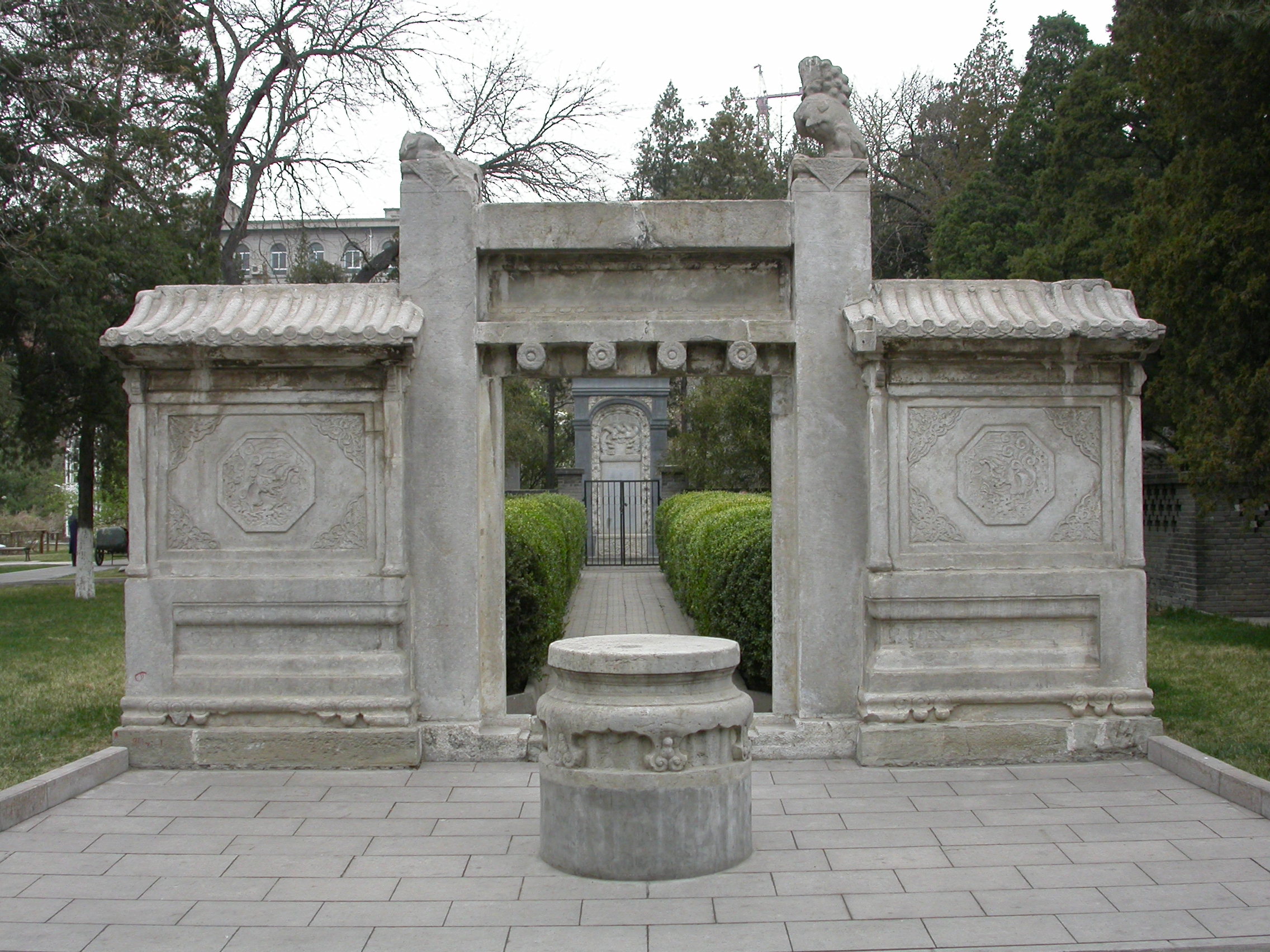
Zhalan Cemetery
Matteo Ricci wanted to be buried in Beijing. It was an audacious wish for a European in 1610, a foreigner requesting permanent rest in the capital of the Chinese empire. When the Wanli Emperor granted permission, he did more than honor a dead Jesuit. He established a burial ground that would become the oldest Christian cemetery in China, a place where eighty-eight Jesuits would eventually lie beneath tombstones that fuse Chinese dragons with Latin inscriptions, Eastern and Western traditions pressed together in carved stone.
An Emperor's Gift
Ricci died on May 11, 1610. His fellow Jesuit Diego de Pantoja petitioned the Wanli Emperor for burial land, and the emperor granted a plot confiscated from a disgraced eunuch, outside the Fuchengmen gate in the city's western fortifications. The funeral procession on April 22, 1611, departed from the Jesuit residence where the Cathedral of the Immaculate Conception now stands. Ricci's coffin remained in the cemetery chapel for several months before its final interment in November. In 1654, Johann Adam Schall von Bell, the German Jesuit who had become the Qing court's chief astronomer, obtained permission from the Shunzhi Emperor to expand the grounds. Schall von Bell was himself buried there in 1666, as was Ferdinand Verbiest in 1688.
Scattered Bones, Buried Stones
Zhalan endured three catastrophes. During the Boxer Rebellion of 1900, the cemetery was ransacked and the bones of the interred Jesuits scattered. The Boxer Protocol mandated restoration, which included framing some of the delicately carved tombstones in protective brick. A church dedicated to Mary, the Maweigou Church, was erected nearby. Then came the Cultural Revolution. Red Guards arrived with the intention of destroying the tombstones, symbols of foreign cultural intrusion. What happened next was the kind of moment on which history pivots for no grand reason: a staff member at the adjacent party school persuaded the Red Guards to bury the stones rather than smash them. They agreed. The Maweigou Church was demolished in 1974, but the tombstones survived underground.
Where Dragons Frame the Cross
Each tombstone at Zhalan is a small masterpiece of cultural fusion. A Chinese dragon crowns each stone, framing the christogram of the Society of Jesus. Bilingual epitaphs run side by side, Latin on the left, Chinese on the right. Ricci's inscription summarizes his life in both languages, a missionary who learned to speak Mandarin so fluently that Chinese scholars accepted him as an intellectual peer. The roster of those buried here reads like a who's who of early modern Sino-European exchange: Giuseppe Castiglione, the Italian painter who served three Qing emperors; Teodorico Pedrini, musician and diplomat; Ignaz Kogler, astronomer. These were not mere missionaries. They were scientists, artists, and advisors who shaped how China and Europe understood each other.
Resurrection in Stone
In the late 1970s, Deng Xiaoping approved the restoration of Matteo Ricci's grave. The tombstones of Ricci, Schall von Bell, and Verbiest were re-erected on their presumed original locations. Sixty additional original tombstones were set upright again in 1984, arranged in a fenced section: forty-six European missionaries and fourteen Chinese converts. Most of the carved stones have survived, though the tombstones of Longobardo, Buglio, Pereira, and Pedrini have been lost. Today, heads of state from Italy, the Czech Republic, and other countries visit Zhalan, paying respects at a cemetery that has been burned, scattered, buried, and rebuilt, but never entirely erased.
From the Air
Located at 39.93°N, 116.34°E in western Beijing, within the grounds of the Beijing Administrative College (formerly a Communist Party school). Nearest airport: Beijing Capital International (ZBAA), approximately 27 km northeast. The cemetery is small and not visible from altitude, but the neighborhood is identifiable by its institutional buildings west of the Second Ring Road.