Zhang Garden
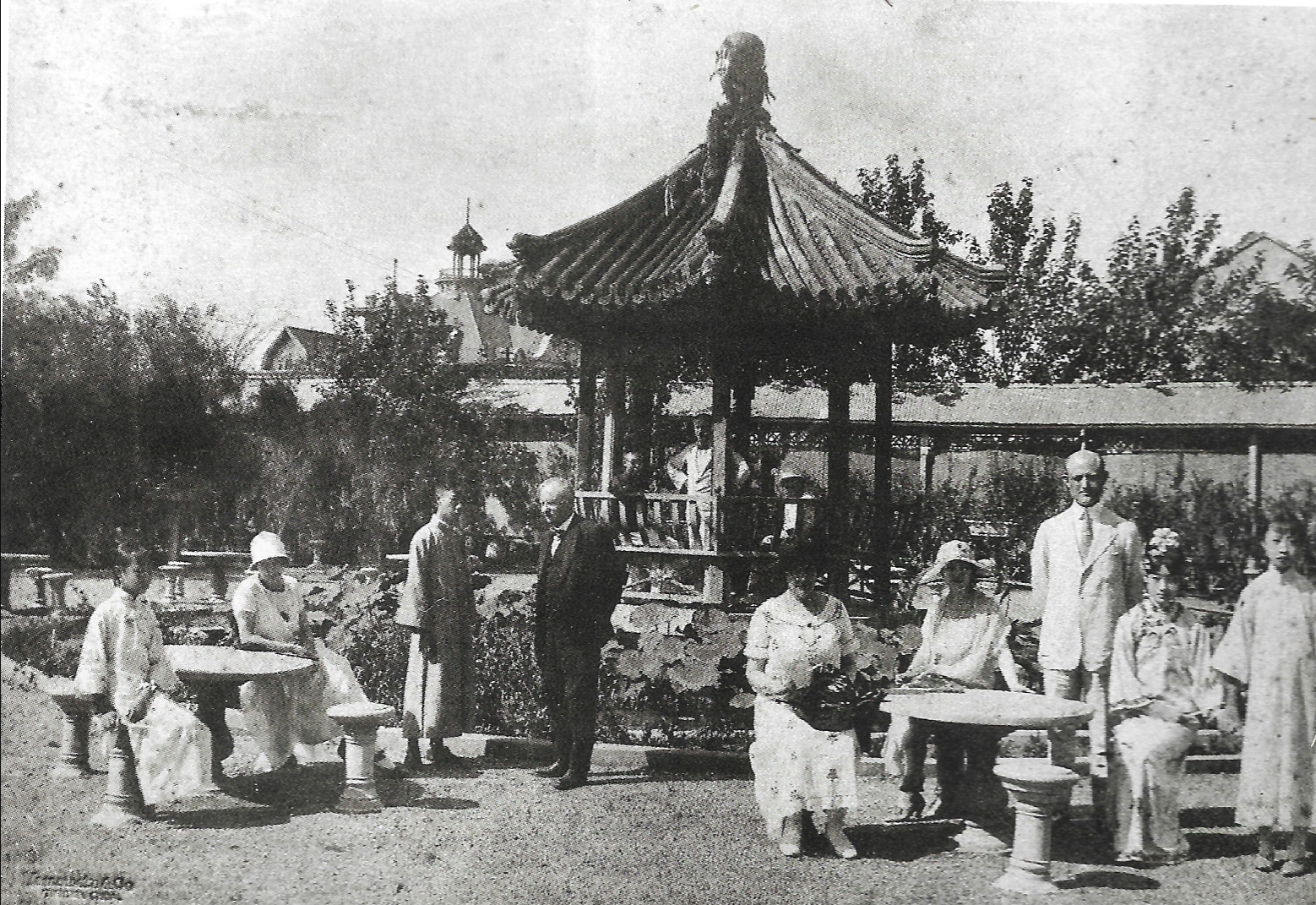
Two men lived in this house who could not have been more different. Sun Yat-sen, the revolutionary who overthrew millennia of imperial rule to become the first president of the Republic of China, stayed briefly in 1924. The following year, Puyi moved in. He was the last Emperor of the Qing Dynasty, a man who had been placed on the Dragon Throne as a toddler and deposed before he turned seven. For four years, from 1925 to 1929, the former emperor lived in this European-style mansion in Tianjin's Japanese Concession, a deposed sovereign in genteel exile, posing for photographs in the garden with his Empress Consort Wanrong and their English tutor Reginald Johnston.
A General's Garden
The mansion was built in 1916 by Zhang Biao, a former high-ranking official of the Qing Court, in the Japanese Concession of Tianjin. Zhang chose a European architectural style for his residence, fitting for a neighborhood where Western and Asian influences mingled freely. The house became known simply as Zhang Garden, or Zhangyuan, and it was substantial enough to attract notable guests even before its most famous residents arrived. The concession system that carved Tianjin into foreign-administered zones after the Boxer Uprising of 1900 had created a city of competing architectures and overlapping jurisdictions, and Zhang Garden belonged to that hybrid world.
An Emperor in Exile
When Puyi arrived in 1925, he was twenty years old and had been living in the Forbidden City under the terms of the Articles of Favourable Treatment. After a 1924 coup expelled him from the palace, he made his way to Tianjin, where the foreign concessions offered a measure of protection from the political chaos of Republican China. Photographs from the period show Puyi and Wanrong in the garden during winter, on the balcony in warmer months, and receiving visitors including Reginald Johnston and Freeman Freeman-Thomas, the Marquess of Willingdon. Wanrong is often pictured with her dog. The images capture a strange domesticity: an emperor without an empire, tending a rock garden in a foreign concession, waiting for history to decide what to do with him.
Demolished and Rebuilt
In 1929, Puyi left Tianjin, eventually making his way to Manchuria, where the Japanese would install him as the puppet emperor of Manchukuo. After his departure, Zhang Biao's son sold the property to the Japanese military in the 1930s. The original mansion was demolished and replaced with a European-style garrison building that served as a police station for the Japanese Concession. After World War II, the building changed hands again, serving as a garrison for the Chinese Kuomintang Army during the Civil War in 1946. Since then it has found quieter purposes as a theater and a library.
Layers of Power
What survives today is not the house where Sun Yat-sen slept or where Puyi posed for photographs with Wanrong. That mansion is gone. The building that stands at this address is the Japanese garrison that replaced it, a structure built over the foundations of one story to serve the purposes of another. Zhang Garden is a palimpsest of Chinese history in miniature: Qing dynasty official, Republican revolutionary, deposed emperor, Japanese occupier, Nationalist soldier, Communist theater. Each layer demolished or repurposed the one before it, and the site now sits quietly in the urban fabric of Tianjin, its weight of history far exceeding its modest physical presence.
From the Air
Located at 39.12N, 117.19E in Tianjin, within the former Japanese Concession area near the city center. Tianjin Binhai International Airport (ZBTJ) is approximately 16 km to the east. The site is in a dense urban area north of the Five Great Avenues district. Best viewed at 3,000-5,000 feet altitude.