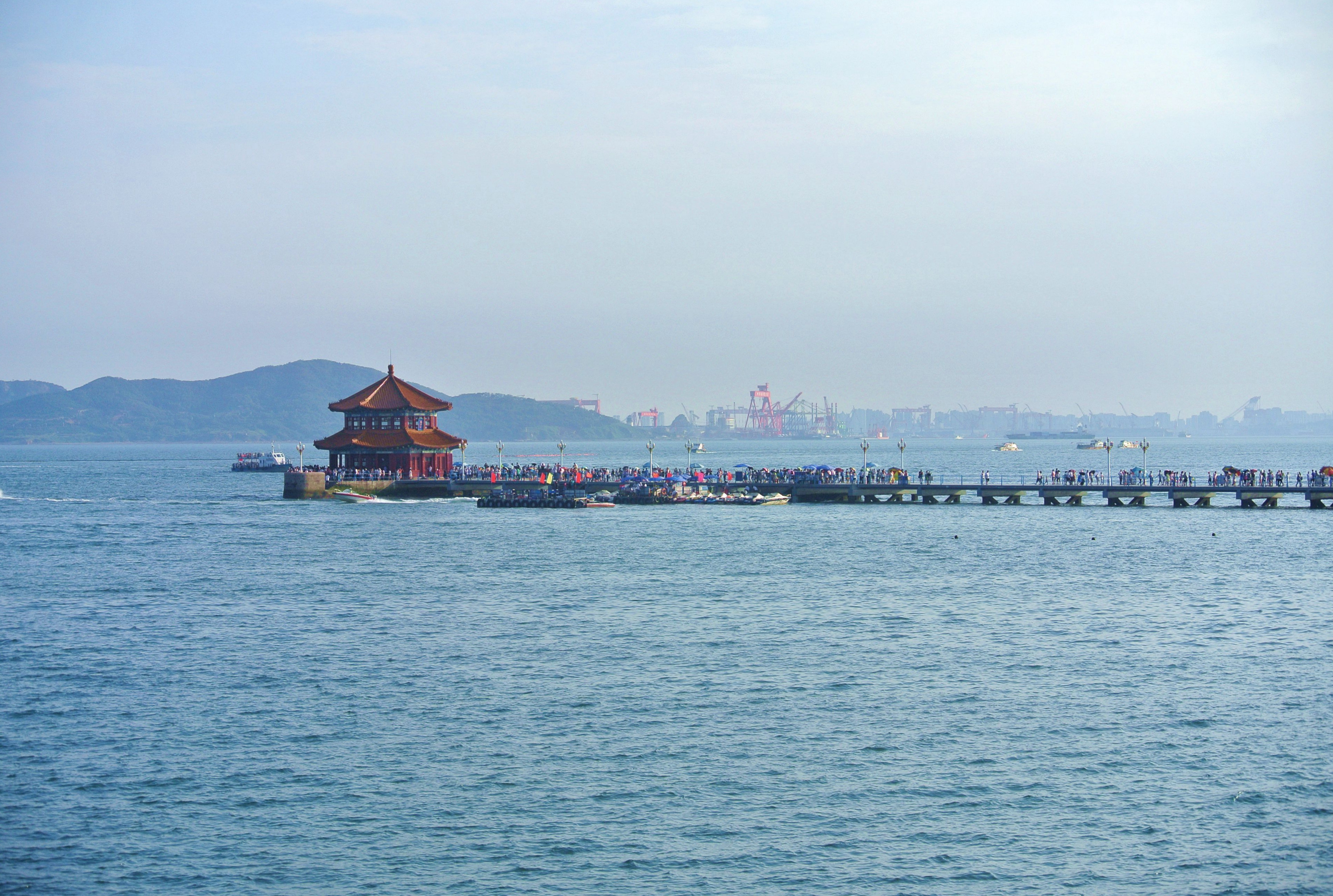
Zhanqiao Pier
If you have ever drunk a Tsingtao beer, you have seen Zhanqiao Pier. The octagonal Huilan Pavilion at the end of the 440-meter structure appears on every bottle -- a silhouette so closely associated with the city that it functions as Qingdao's unofficial emblem. The pier itself predates the German colonial period: it was built in 1891 by the Qing government, making it Qingdao's first wharf and the starting point for the transformation of a fishing village into a treaty port, a colonial capital, a Japanese-occupied city, and eventually one of China's most recognizable coastal metropolises.
Before the Germans
Zhanqiao Pier was a Qing dynasty project. In 1891, the government in Beijing decided to make the harbor at Jiaozhou Bay defensible against naval attack, and improving port facilities was part of that effort. The pier extended from the southern shore into the bay, providing a landing point for naval vessels and cargo. It was functional rather than ornamental -- a military wharf in a fishing settlement that barely registered on most maps. Six years later, in November 1897, the German Navy would seize the bay, and within a year the treaty port of Tsingtao would begin taking shape around this very pier. Zhongshan Road, which runs north from the waterfront behind Zhanqiao, was laid out in 1897 during the first months of the German colonial period.
The Pavilion and the Brewery
The Huilan Pavilion -- whose name translates loosely as "Billowing Back and Forth Tower" -- was added to the end of the pier in 1930, long after the Germans had lost control of Qingdao. Its octagonal shape and upswept eaves gave the pier a distinctly Chinese character that contrasted with the European architecture climbing the hillside behind it. When Tsingtao Brewery, founded by German and British settlers in 1903, adopted the pavilion as its logo, the image of Zhanqiao became inseparable from the city's most famous export. The brewery, incidentally, uses spring water from nearby Mount Lao in its beer -- another thread connecting the landmarks of Qingdao into a single identity.
Waterfront After Dark
The area around Zhanqiao Pier concentrates much of what makes Qingdao distinctive. To the southeast sits Xiao Qingdao, the tiny island with its white lighthouse. Along the shore, the China Navy Museum displays decommissioned warships. Behind the pier, neighborhoods of German colonial architecture climb the hill toward St. Michael's Cathedral. At night, the coastline transforms: spotlights illuminate the nearby buildings, neon signs glow along the waterfront, and the Huilan Pavilion at the pier's end is lit against the dark water of Jiaozhou Bay. Walk to the end of the pier and you stand where Qingdao's history began -- a Qing dynasty wharf that predates the German colony, the Japanese occupation, and the Communist revolution, still extending into the same waters it was built to serve.
From the Air
Zhanqiao Pier extends from the southern shore of Qingdao at approximately 36.060N, 120.315E, visible as a long narrow structure reaching into Jiaozhou Bay with a distinctive pavilion at its end. Nearest airport: ZSQD (Qingdao Jiaodong International Airport). The pier is at the foot of Zhongshan Road in the Shinan District, surrounded by the old German colonial quarter.