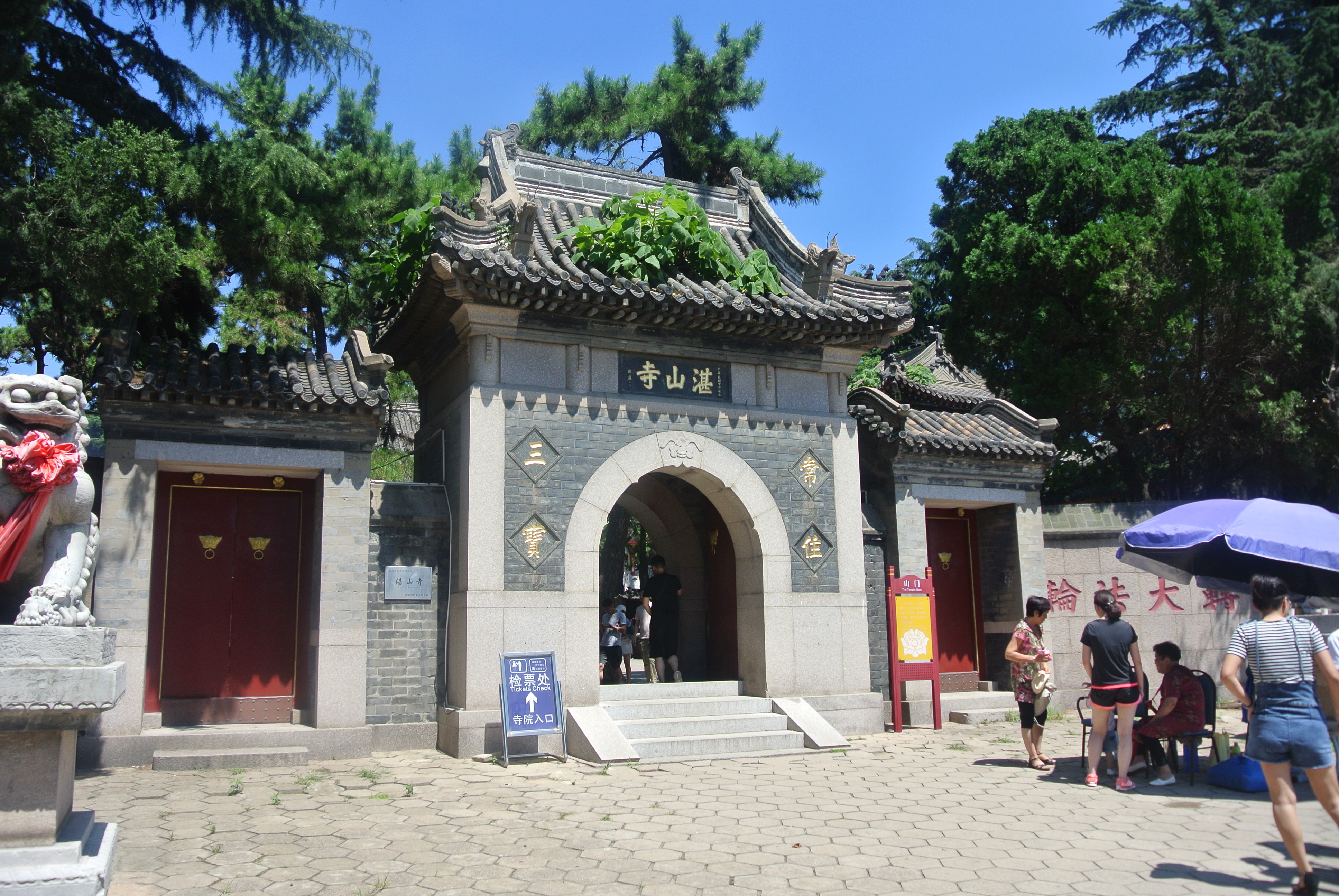
Zhanshan Temple
The monastery faces the sea. Zhanshan Temple sits on the southern slope of its namesake mountain -- Zhanshan, meaning "clear mountain" or "deep mountain" -- in Qingdao's Shinan District, its rectangular compound of halls and towers oriented toward the Yellow Sea. Completed in 1945, it is an active Buddhist sanctuary in a city better known for German colonial architecture and Tsingtao beer. On the eighth day of the fourth lunar month, the traditional birthday of the Buddha, thousands of worshippers fill the grounds for religious observances that have continued through political upheaval and cultural revolution.
Through the Gates
The compound unfolds along a central axis in the traditional Chinese Buddhist pattern. Past the entry portal, scripture shops sell incense sticks and devotional supplies. A Bell Tower houses the first of many Buddha statues; across from it stands a Drum Tower with another. The Four Heavenly Kings Hall comes next, its large central Buddha flanked by four imposing guardian statues, one depicted playing a pipa. Behind it rises the larger Mahavira Hall, the spiritual heart of the complex, dedicated to Sakyamuni -- Siddhartha Gautama, the historical Buddha. Here a central gilded figure is attended by two smaller statues, each flanked by eight priests, and the hall is furnished for active worship: cushions for kneeling, candles for lighting incense, the quiet murmur of prayer.
The Reclining Buddha and the College
Behind the Mahavira Hall, the compound continues to the Hall of Three Saints, where three gilded statues stand about twelve feet tall. But the most striking image in the temple lies deeper in the complex: the Hall of the Recumbent Buddha, where a gilded, bejeweled figure of the Buddha stretches out almost twenty feet behind a long altar. The statue depicts the Buddha's final earthly moment, the parinirvana, and its scale dominates the room. Across from this hall stands the Shandong Zhanshan Buddhist College, where monks study Buddhist scripture and philosophy. The Qingdao Buddhist Association also maintains its headquarters on the grounds, making the temple not merely a place of worship but an institutional center for Buddhism in the region.
Bells and Borrowed Names
Near the exit stands the Olympic Mascot Bell Tower, added for the 2008 Olympics when Qingdao hosted sailing events. The panoramic view from its top encompasses the temple grounds and the sea beyond, though access requires a small fee. Zhanshan Temple's influence extends well beyond Qingdao: the Cham Shan Monastery in Hong Kong is both named after it and designed in its image, carrying the architectural and spiritual tradition of this seaside sanctuary across the South China Sea. The connection speaks to Zhanshan's significance within Chinese Buddhism -- a working monastery where the sound of the morning bell still reaches the water, and where the devotion of centuries outlasts the politics of any single era.
From the Air
Zhanshan Temple is located at approximately 36.065N, 120.359E on the southern slope of Zhanshan hill in Qingdao's Shinan District, facing the Yellow Sea. The temple compound with its traditional Chinese rooflines is visible from low altitude. Nearest airport: ZSQD (Qingdao Jiaodong International Airport). The temple is east of the main Qingdao waterfront area, inland from the coastline.