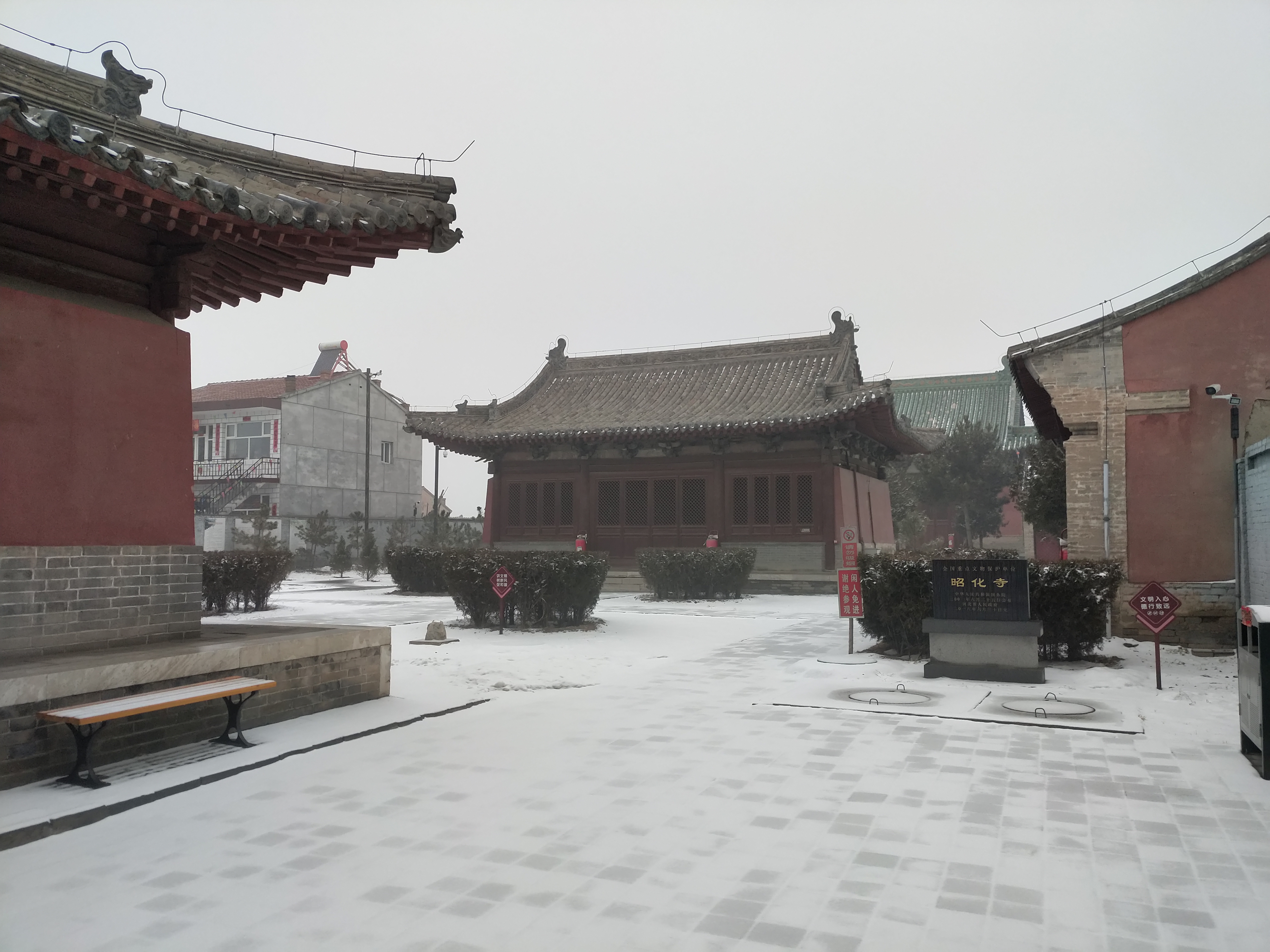
Zhaohua Temple
In 1930, a Norwegian painter stumbled upon a temple in rural Hebei Province and found something worth copying stroke by stroke: over 150 square meters of frescoes depicting more than 500 characters drawn from nearly every corner of Chinese religious tradition. The murals of Zhaohua Temple, painted by the folk artist Ren Chao, compress the entire spiritual world of Buddhism, Taoism, and Confucianism onto the walls of a single complex. The Norwegian made meticulous copies of every painting, preserving a record of artwork that few outside the region had ever seen.
Built at the Dawn of the Ming Frontier
Construction of Zhaohua Temple began in 1397 during the early Ming dynasty, in the town of Huai'an within the Zhangjiakou region of Hebei Province. The temple expanded significantly during the reign of Ming Zheng Tong around 1436, transforming from a modest shrine into a complex spanning over 3,820 square meters. The expansion earned the site its formal name, Zhaohua Temple, in recognition of its architectural and spiritual significance. The structure combined stone, brick, and magnificent wooden elements, with halls decorated in glass tiles, ridged cornices, and gold accents. Its location near the northern frontier placed it at the intersection of Chinese civilization and the steppe cultures beyond the Great Wall.
Generals and Gods on the Walls
The temple's fame rests on its murals, and they deliver on that reputation. Within the 248.5 square meters of the main hall, vast paintings depict armored generals such as Qin Shubao of the Tang dynasty and Yuchi Gong, legendary warriors who became door gods in Chinese folk tradition. The rear wall, covering over 36 square meters, presents a comic-style narrative sequence portraying characters from Buddhism, Taoism, and Confucianism alongside the human Empress Baiguan. The murals make no effort to separate these traditions -- Buddhist deities share wall space with Taoist immortals and Confucian sages, reflecting the syncretic religious culture that flourished in Ming-era northern China.
Ren Chao's Crowded Canvas
The folk artist Ren Chao is credited with the frescoes, and his work reveals a sensibility more narrative than devotional. Over 500 individual characters populate the walls, making the temple interior feel less like a place of quiet worship and more like a visual encyclopedia of the Chinese spiritual world. The frescoes reference nearly all central deities in both Buddhism and Taoism, creating a panoramic survey of divine personalities that would have been familiar to the rural communities surrounding Huai'an. That the paintings survived centuries in a region prone to both military conflict and harsh winters testifies to the care of generations of temple custodians.
A State-Protected Treasure in the Hebei Hills
Today, Zhaohua Temple holds state-protected cultural relic status, recognizing both its architectural importance and the irreplaceable quality of its murals. The Mahavira Hall anchors the complex, with bell and drum towers, gate buildings, and sacred halls where devotees still worship traditional Chinese gods. The temple's location in Zhangjiakou places it in a region better known for its proximity to Beijing and its role as a co-host city for the 2022 Winter Olympics than for its Ming dynasty heritage. From the air, the temple compound appears as a cluster of traditional rooflines set against the hills of northern Hebei, a small island of decorated stone and painted plaster in a landscape shaped by agriculture and industry.
From the Air
Located at 40.46°N, 114.46°E in Huai'an, Zhangjiakou, Hebei Province. The temple is in a hilly rural area of northern Hebei. Nearest major city is Zhangjiakou. The nearest airport is Zhangjiakou Ningyuan Airport (ZBZJ). The temple compound is modest in size but visible as a traditional architectural cluster in the surrounding rural landscape.