Zhengding County
Four pagodas, each from a different dynasty, each in a different architectural style, all standing within a few square kilometers. Zhengding County in Hebei Province was once the administrative and spiritual heart of northern China, a city so important that it served as regional capital for over 1,500 years. Then a railway decision in 1896 redirected history. To avoid the cost of bridging the Hutuo River, engineers moved the terminus south to a village of a few dozen families called Shijiazhuang. That village became the provincial capital; Zhengding became a footnote. But the pagodas remained, and so did the temples that had made this small county the birthplace of one of the world's most influential schools of Buddhism.
Cradle of Rinzai Zen
In the village of Linji, south of Zhengding's old town, the monk Linji Yixuan founded the Linji School during the Tang dynasty -- one of the five great schools of Chinese Chan Buddhism. The school took its name from the village itself. During the Song dynasty, two Japanese monks, Eisai and Shuniyo, carried Linji's teachings across the sea, where the school became known as Rinzai and reshaped Japanese spiritual life for centuries. The grey-brick Chengling Pagoda still marks the site where Linji Yixuan's mantle and alms bowl were enshrined in 867. Rebuilt during the Jin dynasty between 1161 and 1189, the 33-meter octagonal tower rises from a richly decorated Sumeru Pedestal. Japanese pilgrims still come here, drawn to what they regard as one of the birthplaces of Zen.
A Skyline of Dynasties
Zhengding's four surviving pagodas read like a textbook of Chinese architectural evolution. The Xumi Pagoda, built in 636 during the Tang dynasty, is the tallest at 48 meters -- an austere, hollow column of stone and brick with a square floor plan and thirteen tiers of eaves. The Lingxiao Pagoda, first erected in 860, rises 41 meters on an octagonal base; its lower four stories are brick, but the upper five are entirely wood, built around a central pillar in a Song dynasty design from 1045. The Hua Pagoda defies convention entirely -- its lower three stories are octagonal, but the fourth is circular, tapering to a cone studded with carvings of Buddhas, elephants, and aquatic creatures. Four miniature pagodas, each capped with an egg-shaped finial, cluster around its base. At the Lingxiao Pagoda's foot, a Dutch bishop named Frans Schraven was martyred in 1937 by Japanese soldiers after he refused to surrender the Chinese women and girls sheltering in his compound.
The Great Buddha Temple
Longxing Monastery, also called the Great Buddha Temple, has survived where most of Zhengding's religious complexes have not. Originally built during the Sui dynasty, its ensemble of historical buildings remains almost intact -- a rarity in northern China. The Great Compassion Pavilion houses a statue of the Thousand-Armed, Thousand-Eyed Avalokiteshvara depicted with forty-two arms, one of the most striking Buddhist sculptures in the country. The Hall of Mani and the Rotating Sutra Library Hall preserve Song-era architectural techniques. Throughout the temple, Buddhist statues cast during the Tang and Song dynasties are considered priceless artifacts. Nearby, Kaiyuan Temple retains the only surviving example of a Tang dynasty bell tower, a 14-meter structure initially built in 540 and rebuilt in 898, whose grand bracket-work exemplifies the architectural ambition of the era.
The Railway That Reversed Fortune
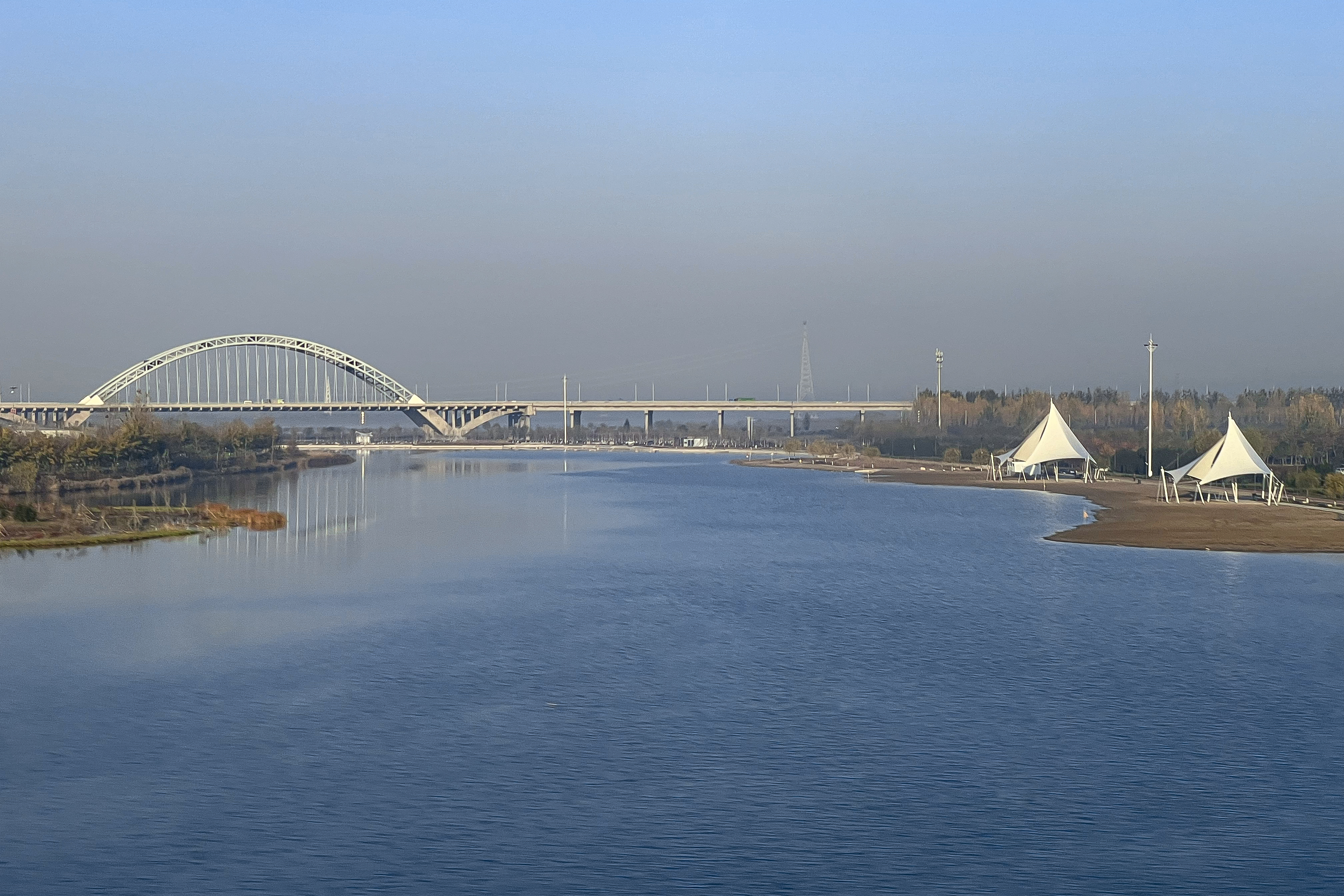
For centuries, Zhengding sat at the center of power in its region. From the 4th century through the 1911 Revolution, it served continuously as the administrative seat for surrounding counties, prefectures, and circuits. Ancient states had fought over this ground -- the Xianyu Kingdom placed its capital here during the Spring and Autumn period, and the Warring States-era kingdom of Zhongshan established the city of Dongyuan on this site. The reversal came with a bridge that was never built. When the Qing government approved a railway branch from Taiyuan to Zhengding in 1896, cost calculations dictated moving the eastern terminus south to avoid bridging the Hutuo River. The new junction at Shijiazhuang -- literally 'the Shi Family Village' -- exploded from a settlement of perhaps several dozen people into a metropolis that became Hebei's provincial capital in 1968. Zhengding was left behind, a county seat administered by the city it once outranked.
Stone Turtles and Living History
In June 2000, workers on Fuqian Street unearthed a bixi -- a gigantic stone turtle that once supported a monumental stone tablet. At 8.4 meters long, 3.2 meters wide, and 107 tons, the roughly 1,200-year-old sculpture now sits at Kaiyuan Temple, a reminder of the scale at which Zhengding's rulers once built. The county's Confucian Temple claims the earliest surviving Dacheng Hall of its kind in China, likely dating to the late Tang or early Five Dynasties period, though county records give the formal date as 1374. Recent restoration efforts have reclaimed the Prefectural Confucian Temple as well, demolishing surrounding residential buildings to create a public plaza in front of its restored Halberd Gate. Zhengding today operates as something between an open-air museum and a living county, its ancient monuments threaded through ordinary streets where the past is impossible to ignore.
From the Air
Zhengding County sits at 38.15°N, 114.57°E, approximately 15 km north of Shijiazhuang city center. The pagodas are visible as vertical elements rising above the flat North China Plain. Shijiazhuang Zhengding International Airport (ICAO: ZBSJ) is located in the county's northeast corner. Best viewed at 3,000-5,000 feet AGL for pagoda detail. The Hutuo River runs between Zhengding and Shijiazhuang to the south.