Zhengzhou Museum
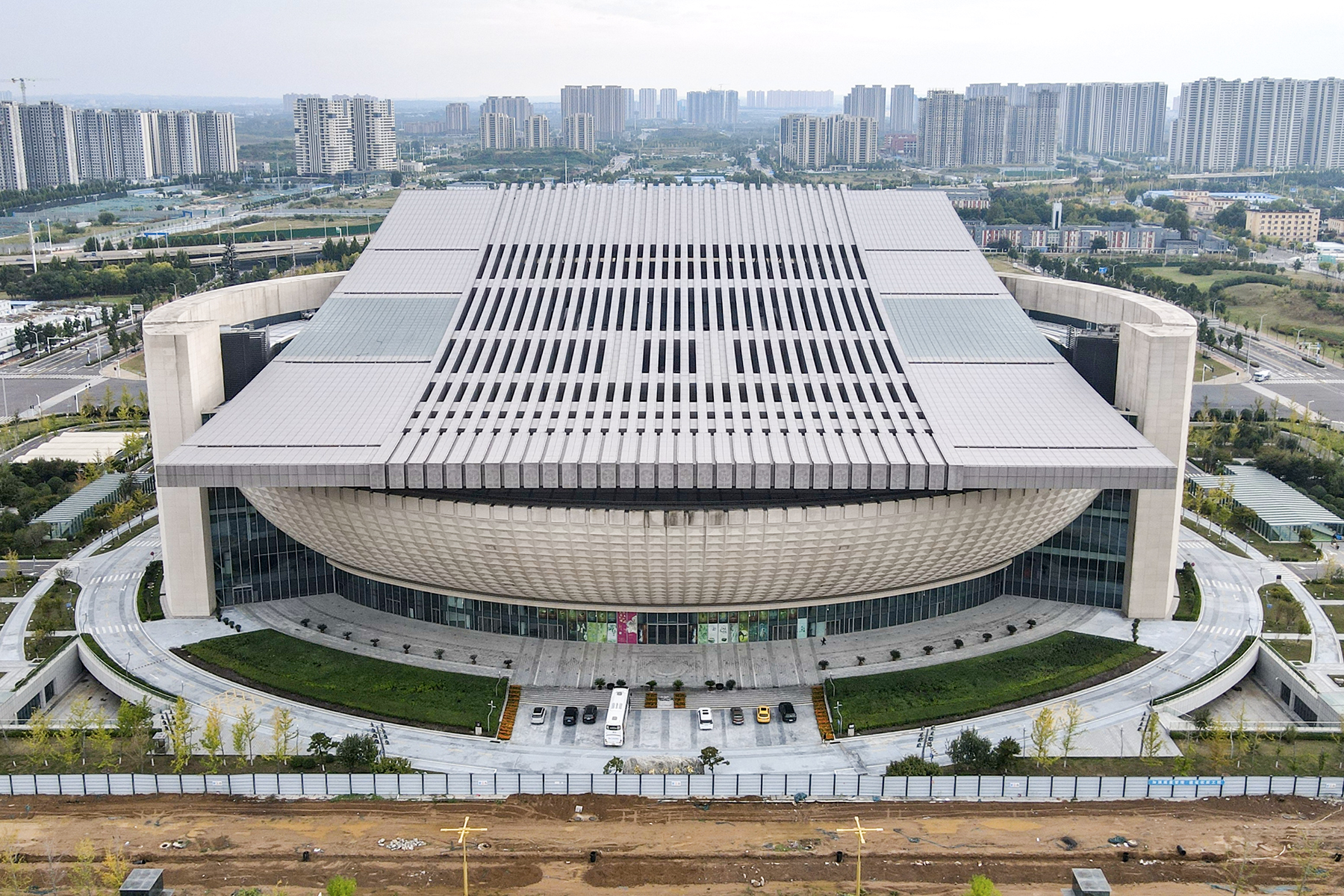
The Songshan Road building of the Zhengzhou Museum is shaped like a bronze ding -- the heavy ritual cauldron that symbolized political authority in ancient China. The symbolism is deliberate: a ding standing in the center of the country, exactly where Zhengzhou sits on the map. Across the city, the museum's newer Wen Han Street building, completed in 2021, takes the form of a crown and spans 147,000 square meters, making it one of the largest single museum structures in China. Together, the two buildings house nearly 60,000 artifacts tracing the history of the Central Plains from the Paleolithic age to the modern era.
From a Cemetery to Two Campuses
The museum began modestly. On July 1, 1957, it opened as the Zhengzhou Cultural Relics Exhibition Hall, housed in the Martyrs' Mausoleum inside Bishagang Park -- a cemetery originally built by General Feng Yuxiang to honor fallen soldiers of the Northern Expeditionary Army. The location was austere and small, covering just 4,330 square meters divided into two courtyards. In 1962, the name was changed to Zhengzhou Museum, and for decades it served as a local repository in the shadow of the larger and more famous Henan Museum. The transformation came in two stages: a move to South Songshan Road in 1999, where the ding-shaped main building gave the institution an architectural identity, and then the opening of the Wen Han Street building in April 2021, which catapulted the museum into an entirely different category of scale.
Engineering for Earthquakes and Art
The Wen Han Street building is notable not just for its size but for its engineering. It is the first museum in China to use link beam dampers in its main structure -- a seismic resilience technology that allows the building to absorb earthquake energy without transferring it to the collections inside. With 21 exhibition halls spread across 36,000 square meters of display space, the building was designed to present the full sweep of Central Plains civilization in a single visit. The crown-like exterior, visible from across the city, intentionally evokes the ceremonial headpieces of ancient Chinese royalty -- another architectural metaphor linking the museum's modern form to the artifacts it contains.
Sixty Thousand Pieces of the Central Plains
As the first prefecture-level museum established in Henan after the founding of the People's Republic of China in 1949, the Zhengzhou Museum has had decades to accumulate a collection that punches well above its municipal weight. Notable holdings include Neolithic pottery from the Yangshao and Longshan cultures, Shang and Zhou dynasty bronzes unearthed from sites within modern Zhengzhou's boundaries, Tang and Song dynasty stone carvings, and ceramics spanning virtually every major period of Chinese production. The Shang bronzes are of particular significance given that Zhengzhou itself sits atop the ruins of the ancient Erligang city, one of the earliest Bronze Age urban centers in East Asia. Many of the museum's most important pieces were literally excavated from the ground beneath the city's streets -- artifacts of a civilization that the modern city inadvertently preserves by sitting on top of it.
From the Air
Located at 34.75°N, 113.62°E in Zhengzhou. The newer Wen Han Street building's distinctive crown-shaped architecture may be visible from lower altitudes. The museum sits in the urban core of the city, west of the Songshan Road commercial corridor. Zhengzhou Xinzheng International Airport (ICAO: ZHCC) is approximately 40 km to the southeast.