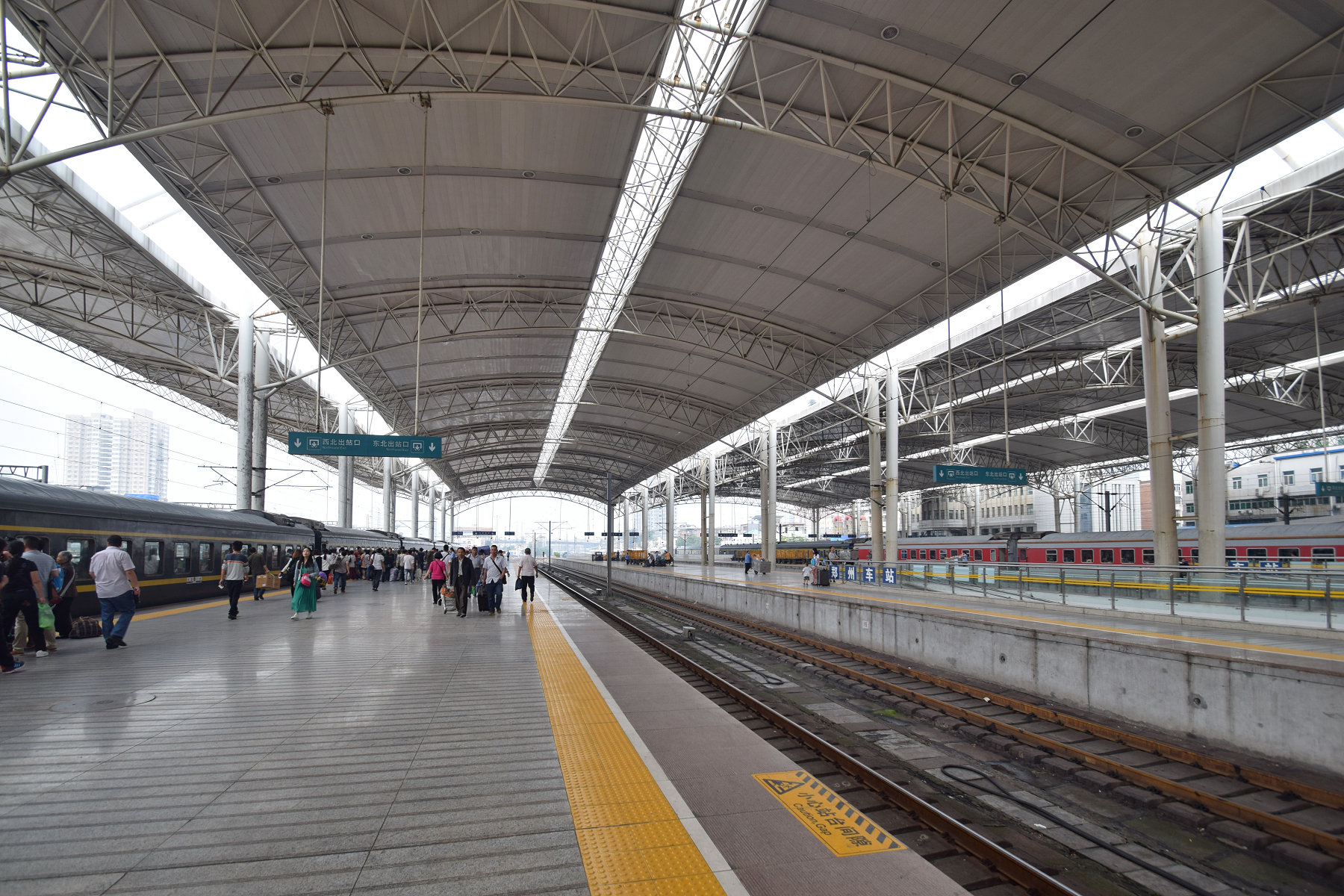
Zhengzhou Railway Station
There is a reason the Chinese call Zhengzhou railway station "the heart of Chinese railway network." Look at a map of China's rail system and two lines cross here like an enormous plus sign: the Beijing-Guangzhou Railway running north-south, the Longhai Railway running east-west. Every other major rail route bends around or connects to these two arteries. Since 1904, when a small station with one platform and four tracks opened on the Beijing-Hankou line, this crossroads has shaped the movement of people and goods across a nation of a billion.
One Platform, Four Tracks
The station opened in 1904 as a stop on the Beijing-Hankou Railway, one of the great engineering projects of late imperial China. Four years later, in 1908, the Kaifeng-Luoyang Railway reached Zhengzhou, and the station became a junction -- the point where east-west and north-south rail traffic converged. The name changed in 1913 to Zheng County railway station, reflecting the modest status of the settlement at the time. Ticket offices arrived in 1928. A freight yard was added in 1932. Growth was steady but unremarkable, the station expanding in step with a provincial town that gave little indication of the megacity it would become.
War, Flood, and Reconstruction
The Second Sino-Japanese War nearly destroyed what peacetime had built. In February 1938, Japanese air strikes severely damaged the station. Three months later, the tracks between Zhengzhou and Zhongmu were destroyed -- not by bombs but by the deliberate breach of Yellow River dikes ordered by the Chinese Nationalist government to slow the Japanese advance. The resulting 1938 Yellow River flood killed hundreds of thousands of civilians and disrupted transportation across the entire region. The station fell silent. Reconstruction came in stages after the war, each expansion reflecting the growing importance of Zhengzhou as a transportation node in the new People's Republic. The freight yard moved east to Erligang in 1953. The marshalling yard separated from the main station in 1962 to form Zhengzhou North railway station. The station kept growing because China kept moving, and every route seemed to pass through Zhengzhou.
Thirteen Platforms, Twenty Tracks
Today's station is a sprawling complex with two station buildings covering 144,000 square meters, 13 platforms, and 20 tracks. The east building -- the main entrance -- stands 63.3 meters high with 68 ticket counters and elevated waiting rooms connected by escalators. The west building houses additional counters, restaurants, and shops. Ten waiting rooms line a connecting channel at the second level, and two underground tunnels handle arriving passengers. In 2013, the opening of Zhengzhou Metro Line 1 added underground rail access, and in 2015, the Zhengzhou-Jiaozuo Intercity Railway brought high-speed service to the station for the first time. The metro station's concourse features a wall decorated to resemble an old-fashioned Chinese train carriage, painted in the traditional olive-green livery -- a nod to the era when this station was not yet a modern transit hub but a place where the nation's rail journeys began and ended.
Still the Crossroads
Zhengzhou has since built a dedicated high-speed station -- Zhengzhou East -- to handle the growing bullet train network. Additional stations serve specific high-speed routes to Wanzhou, Fuyang, and Lanzhou. But the original station, anchored in the city center barely a kilometer from the Erqi Memorial Tower, remains one of the busiest in the country. Its location at the intersection of the Beijing-Guangzhou and Longhai railways has not changed in over a century. What has changed is everything around it: the small county town that barely justified a station in 1904 is now a city of more than 10 million people. The station that once had one platform and four tracks now handles conventional, high-speed, and intercity services in a single integrated hub. Geography is destiny for transportation networks, and Zhengzhou's geography -- dead center in a country that moves along its rail lines -- has made this station essential since the day it opened.
From the Air
Located at 34.75°N, 113.65°E in central Zhengzhou. The station's rail infrastructure -- converging tracks from north, south, east, and west -- is clearly visible from altitude. The station is approximately 1 km southwest of the Erqi Memorial Tower. Zhengzhou Xinzheng International Airport (ICAO: ZHCC) is 37 km to the southeast. Zhengzhou East railway station, the main high-speed hub, is visible to the east.