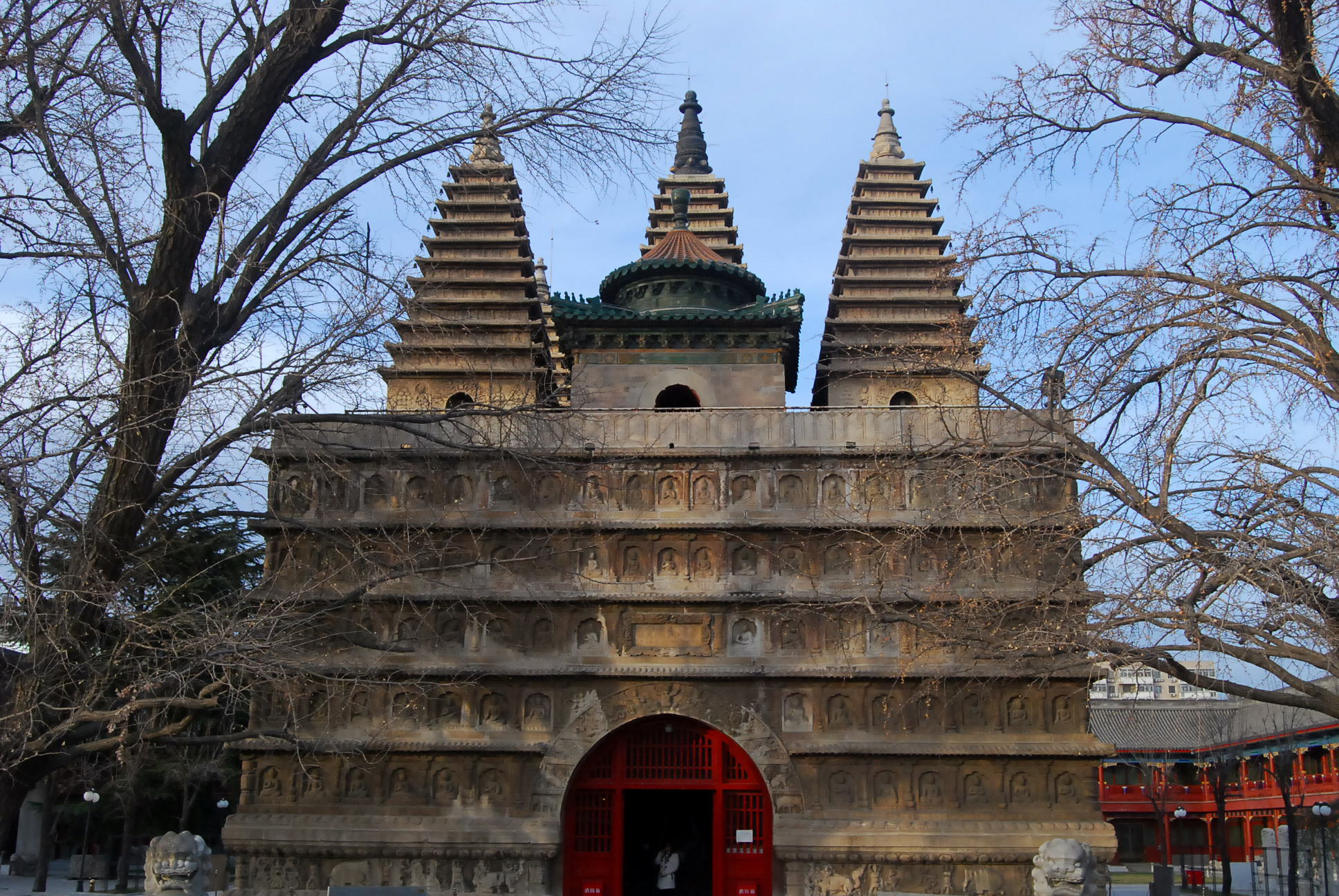
Zhenjue Temple
Five stone pagodas rise from a single massive platform in Beijing's Haidian District, an architectural form so unusual that most visitors stop and stare before they can quite articulate why. The Zhenjue Temple, formally the Temple of the Great Righteous Awakening, is the oldest surviving diamond throne pagoda in China. Its design traces a line from the Mahabodhi Temple in Bodh Gaya, India, across a thousand years of artistic transmission, through mural paintings in the Dunhuang Grottoes, and into the marble reality that the Chenghua Emperor ordered built in 1473.
Five Golden Buddhas, One Stone Platform
The temple's origin story involves an Indian monk named Sariputra who visited the court of the Yongle Emperor in the early fifteenth century. According to tradition, Sariputra brought designs for the diamond throne pagoda and five golden Buddha statues, one for each tower. Legend holds that those statues remain buried beneath the pagodas. The design itself, a vajra throne supporting five towers, is inspired by the Mahabodhi Temple at Bodh Gaya, where the historical Buddha is said to have achieved enlightenment. But the Chinese interpretation diverges significantly from its Indian model: the Zhenjue Temple's central pagoda is only slightly taller than the four corner towers, creating a more balanced silhouette, and the decorations are distinctly Chinese, including glazed-tile roofs and sutra texts carved into the stonework.
Surviving Fire, Rebellion, and Alliance
The diamond throne pagoda is built of marble, and that material choice saved it. The temple complex originally included at least six wooden halls, renovated during the Qing dynasty in 1761 when their roofs were tiled in imperial yellow. But wood burns. In 1860, during the Second Opium War, fire destroyed the wooden structures. In 1900, the Eight-Nation Alliance that suppressed the Boxer Rebellion inflicted further damage. The wooden halls perished completely. Only the stone pagoda building survived, its seven-meter-tall platform and five towers standing amid ruins. The pedestal that once supported the Big Treasure Hall remains as a ghostly outline on the temple grounds, marking where a grand wooden structure once dominated the complex.
A Museum Among the Stones
Today the Zhenjue Temple houses the Beijing Art Museum of Stone Carvings, its grounds displaying carved tombstones, architectural fragments, and stone artwork from across Beijing's history. Among the exhibits are Jesuit tombstones relocated from the separate French Jesuit cemetery that once existed in Haidian District, including those of Jean-Francois Gerbillon, Joachim Bouvet, and Michel Benoist. The temple has been listed as a national monument since 1961. Among the decorative carvings, a pair of footprints symbolizes the spread of Buddhism across the world, a motif found in Buddhist art from India to Japan. The Zhenjue Temple is the oldest of six diamond throne pagodas in China, the others located at the Temple of the Azure Clouds and the Yellow Temple in Beijing, and at temples in Hohhot, Kunming, and Zhengding.
From the Air
Located at 39.94°N, 116.32°E in Beijing's Haidian District, near the National Library of China. The five-pagoda structure is small and not individually visible from altitude, but the temple grounds are identifiable as a green enclave in the dense urban fabric. Nearest airport: Beijing Capital International (ZBAA), approximately 27 km northeast.