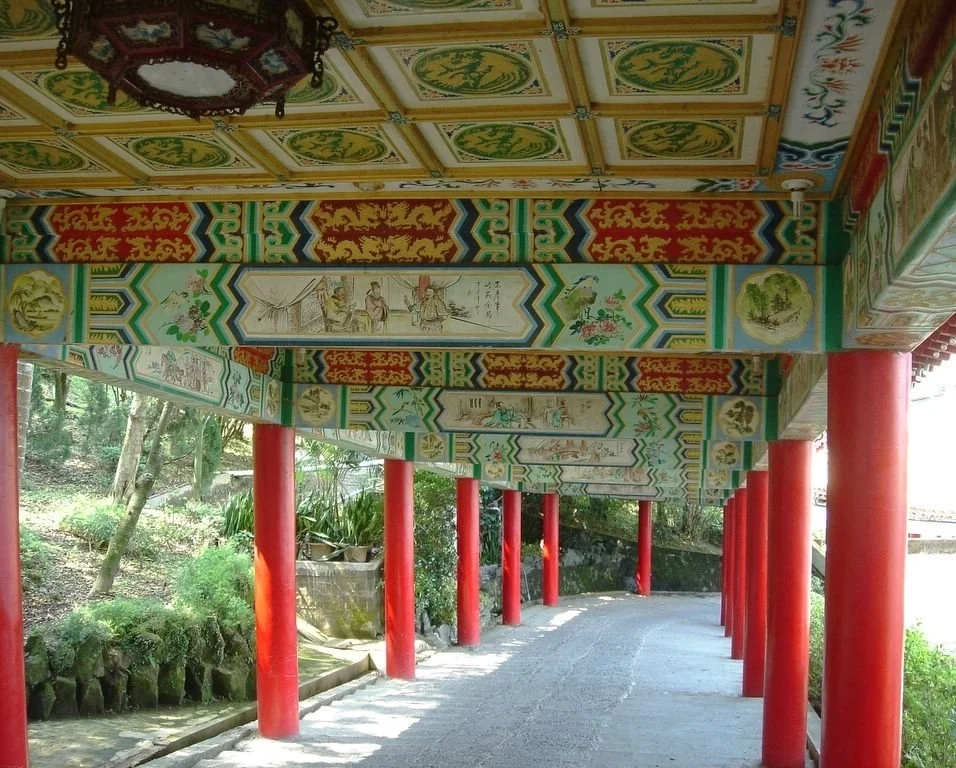

Zhinan Temple
Folklore in Taiwan says that unmarried couples who climb to Zhinan Temple together will not stay together for long. The explanation offered most often involves the temple's main deity, Lü Dongbin — one of the Eight Immortals of Taoism, famous for both his spiritual attainments and, in popular legend, a certain susceptibility to romantic feeling. Because his own love for the Immortal Woman He went unrequited, the story goes, Lü Dongbin takes a jealous interest in the happiness of couples who visit his temple. Whether or not visitors believe the legend, many choose to come alone rather than test it. The warning has probably sent more than a few solo pilgrims up the thousand-step stairway, which at least ensures they arrive with a clearer head.
A Temple Named for a Direction
Zhinan Temple was founded in 1882 on the slopes of Houshan — known colloquially as Monkey Mountain — in what is now Taipei's Wenshan District. The name Zhinan (指南) means "pointing south," a reference to the temple's relationship with its principal deity. Lü Dongbin is said to dwell in the southern courtyard of the heavenly realm, and the temple, perched on its mountainside, orients itself toward him symbolically. The name also evokes the lodestone compass — zhǐnán, in another usage, means compass — giving the temple a navigational quality that suits its hillside position above the city. You climb to reach it, and once there, the city spreads below in the Taipei Basin while the mountains continue upward behind.
Climbing to the Chunyang Chapel
The oldest surviving structure on the site is the Chunyang Chapel, built in 1890. Its funding came from a particular source: gold miners working in Jinshan, on the north coast. Mining communities have long had their own relationship with protective deities, and the miners' investment in a Taoist shrine in the mountains reflects the networks of devotion that crisscrossed early Taiwan. The chapel houses a statue of Lü Dongbin in his role as founder of the Chunyang — Pure Yang — sect of Quanzhen Taoism. The present statue was a 2002 gift from Yongle Temple in Shanxi province, China, described as Zhinan's home temple, acknowledging the mainland origins of the Quanzhen tradition the temple carries. Reaching the chapel gate requires ascending roughly 1,300 steps in total — 1,000 to the Yuanzhen Pond and the Tudigong shrine, then another 300 to the chapel itself.
A Complex of Four Traditions
Zhinan Temple is not a single structure but a compound that has accumulated chapels over more than a century. Facing the Chunyang Chapel, the Lingxiao Chapel — built between 1963 and 1966 — houses the Jade Emperor on its upper floor and the Three Pure Ones below, while its ground level contains the classrooms and offices of the China Taoism Institute, a Quanzhen seminary offering two-year degrees in Taoism. To the right of the Chunyang Chapel stands the Buddhist-themed Daxiong Chapel, built in 1973. The chapel's black statue of Sakyamuni Buddha has a specific provenance: it was donated by a Thai military officer who, while in exile in Taiwan, made a vow to present such a statue if he returned to power. Behind the Lingxiao Chapel, the smaller Dacheng Chapel is dedicated to Confucius. The compound thus honors Taoism, Buddhism, and Confucianism within the same hillside precinct — the three teachings that have shaped Chinese spiritual life for two millennia.
Getting Up the Mountain
Visitors arrive several ways. The Maokong Gondola — a cable car that runs from the lowlands near Taipei Zoo up through the tea-growing hills of Maokong — passes Zhinan Temple Station, making the ascent by aerial tramway possible. The gondola was operational between 2007 and 2008 before being suspended due to erosion-related structural concerns; after repairs, service was restored. Bus routes also serve the temple, including the No. 530 from Zhinan Bus Company. And then there are the steps — the stairway of roughly a thousand steps that remains, for many pilgrims, the appropriate approach. The climb takes time and effort, and that is part of the point. Arriving breathless at the Chunyang Chapel gate has a different quality than arriving by cable car, though both visitors meet the same immortal at the top.
Above the City, Facing South
Zhinan Temple occupies a position that feels removed from the urban density below. Wenshan District, which includes the Maokong area, sits in the southeastern part of Taipei where the city meets the mountains — the transition from built-up metropolis to forested hillside happens within a few hundred meters. From the temple precincts on a clear day, the Taipei Basin stretches to the north and west, the city's towers visible at a distance that lends them an unfamiliar smallness. The mountains continue upward behind the temple, wild and forested, home to the macaques who give Monkey Mountain its name. Lü Dongbin's temple sits between two worlds: the city that sends pilgrims up the steps, and the mountain that holds the temple in its slope, indifferent to legend, indifferent to the straits of love.
From the Air
Zhinan Temple sits at approximately 24.979°N, 121.587°E on the slopes above the Maokong area in Taipei's Wenshan District. The hillside location, southeast of the central city, is visible from the air as the forested ridgeline where urban Taipei gives way to mountainous terrain. From 4,000 feet, the temple compound appears as a cluster of traditional rooflines on the upper slope, with the gondola line descending toward Taipei Zoo visible nearby. Taipei Songshan Airport (RCSS) lies approximately 9 nautical miles to the north-northeast. The mountainous terrain around Wenshan rises steeply; pilots should be aware of terrain elevation in this area, with ridges exceeding 1,000 feet MSL in the Maokong hills.
Nearby Stories
- Dapu Incident 9.3 km away
- Shuanglianpi Wetland 18 km away
- Toufen 41 km away
- North Jiangsu Main Irrigation Canal 980 km away
- General Cliff Rock Paintings 1050 km away
- Sinking of MV Sewol 1061 km away
- Yellow Sea 1111 km away
- Twin Forts of Romblon 1358 km away