Zhongnanhai
Mao Zedong did not want to live in Zhongnanhai. When the Communist Party took Beijing in 1949, the chairman resisted moving into the imperial lakeside compound, uncomfortable with its associations to the dynasties his revolution had overthrown. He preferred the party's temporary headquarters in the suburban hills of Xiangshan Park. It was Ye Jianying, the interim administrator of Beijing, who finally persuaded the leadership that Zhongnanhai's walls and security infrastructure made it the only practical choice. Mao relented. He moved into the Library of Chrysanthemum Fragrance, filled the courtyard-style building with bookshelves, and spent the next seventeen years reading, governing, and swimming in the compound pool. He would eventually die there too, in Building 202, a specially reinforced earthquake shelter, on September 9, 1976.
The Central and Southern Seas
The name Zhongnanhai translates to "Central and Southern Seas," referring to two artificial lakes that have shaped Beijing's geography for nearly a thousand years. During the Jin dynasty, Emperor Zhangzong created the northern lake in 1189. The Yuan dynasty expanded it, and when the Ming dynasty's Yongle Emperor moved his capital to Beijing in 1403, workers dug the Southern Sea and piled the excavated earth to form Jingshan, the hill north of the Forbidden City. Together with Beihai to the north, the three connected lakes form Taiye Lake, once the heart of an imperial garden called the Western Park. The Zhengde and Jiajing emperors of the Ming dynasty preferred the gardens here to the formal spaces of the Forbidden City, building palaces and Taoist temples along the shores. By the late Qing, Empress Dowager Cixi had made Zhongnanhai her de facto center of government, traveling to the Forbidden City only for ceremonies.
Where Mao Swam and Zhou Refused to Spend
When the party leaders first moved in, many buildings were dilapidated, gardens were overgrown, and there was no modern office complex or purpose-built auditorium. Premier Zhou Enlai resisted renovation, citing fiscal austerity. The party's early leaders were assigned residences on an ad hoc basis, often moving into houses originally built for Qing dynasty servants. Mao's personal geography within the compound reveals his character: he lived at the Library of Chrysanthemum Fragrance until 1966, then relocated to the Poolside House next to the indoor swimming pool built in 1955. He would spend much of each day either swimming or reading reports poolside, and among Zhongnanhai staff, the phrase "you are wanted at the swimming pool" meant you had been summoned to see the chairman. In 1958, Mao met Soviet leader Nikita Khrushchev at the pool -- a setting that was either deliberately informal or deliberately humiliating, depending on which account you read.
The Architecture of Parallel Power
Zhongnanhai's internal geography reflects the structure of Chinese governance. The northern section, clustered around the Central Sea, houses the State Council and its offices -- the premier's workplace, the vice premiers' suites, and six numbered conference rooms where the State Council convenes. The southern section, centered on the Southern Sea, belongs to the Communist Party's Central Committee, including the Secretariat and the office of the general secretary. Qinzheng Hall, originally built by the Kangxi Emperor as his primary workspace, now houses the general secretary's office and the Politburo Standing Committee's meeting room. An encrypted hotline runs from Qinzheng Hall to the White House. This division of space between party and state is not merely administrative -- it is the physical expression of the parallel authority structures that define Chinese politics.
Behind the Slogan Wall
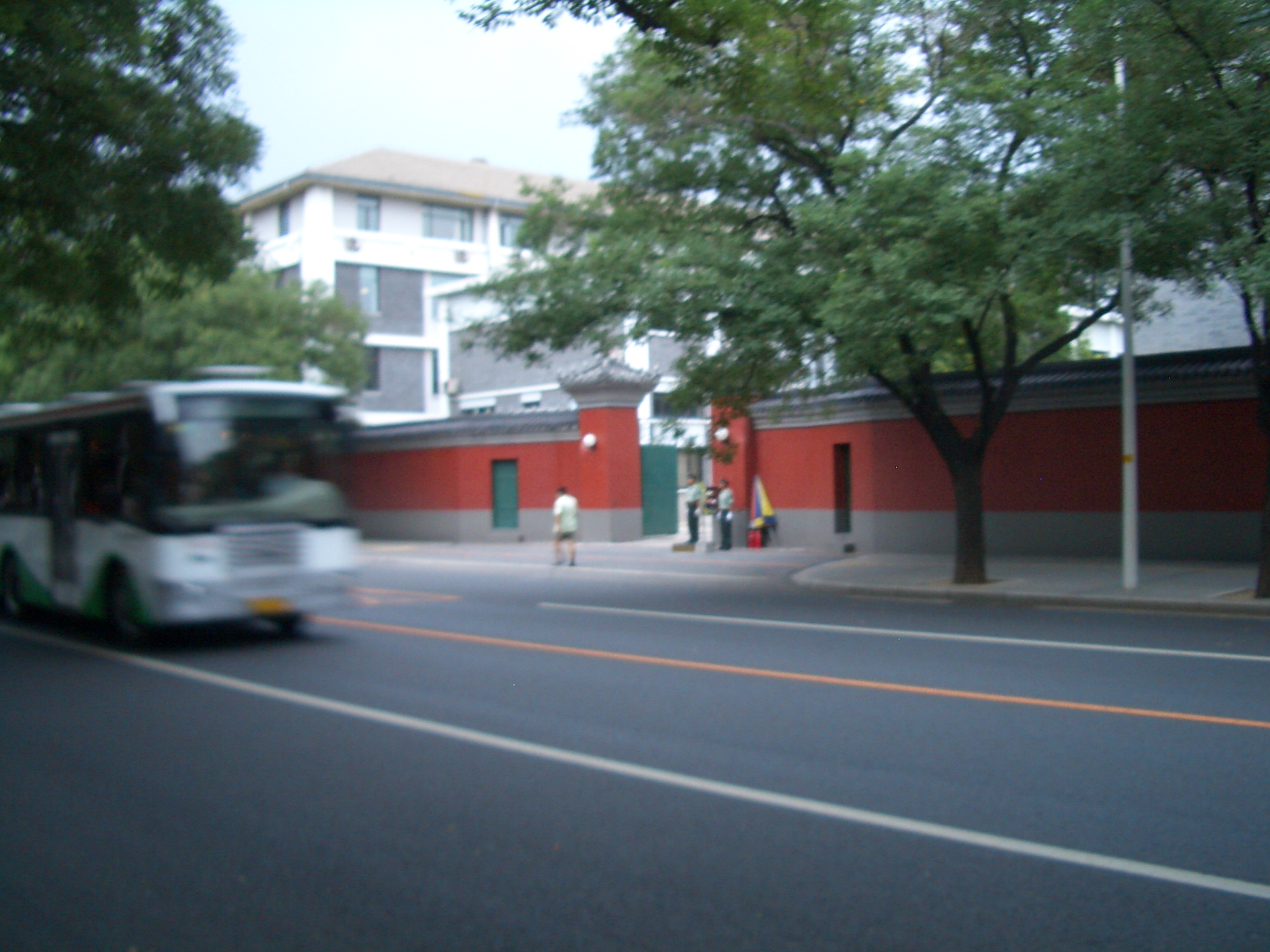
Visitors to Chang'an Avenue see Xinhua Gate, the compound's southern entrance, flanked by political slogans and backed by Mao's calligraphy reading "Serve the People." What they cannot see is the compound's internal transformation since 1949. The original buildings have been renovated, demolished, and rebuilt in successive waves. In the late 1970s, Wang Dongxing, then head of the Central Committee General Office, demolished the original Qinzheng Hall and spent 6.9 million yuan intended for reconstruction on his own private residence before being removed from power. The rebuilt hall was inaugurated as the Secretariat's headquarters in March 1980. Today, Zhongnanhai remains closed to the general public, its perimeter patrolled by plainclothes military personnel. The brief period of public access in the years after the Cultural Revolution ended permanently after the 1989 Tiananmen Square protests. The lakes that gave the compound its name still reflect the sky, as they have since the Jin dynasty -- but now they do so behind walls that few outsiders ever pass through.
From the Air
Located at 39.91N, 116.38E, immediately west of the Forbidden City along Chang'an Avenue. From altitude, Zhongnanhai appears as a large walled compound with two prominent lakes (Central and Southern Seas) surrounded by dense urban Beijing. The white dagoba of adjacent Beihai Park is a useful visual reference. Nearest airport is Beijing Capital International (ZBAA/PEK), approximately 26 km northeast.