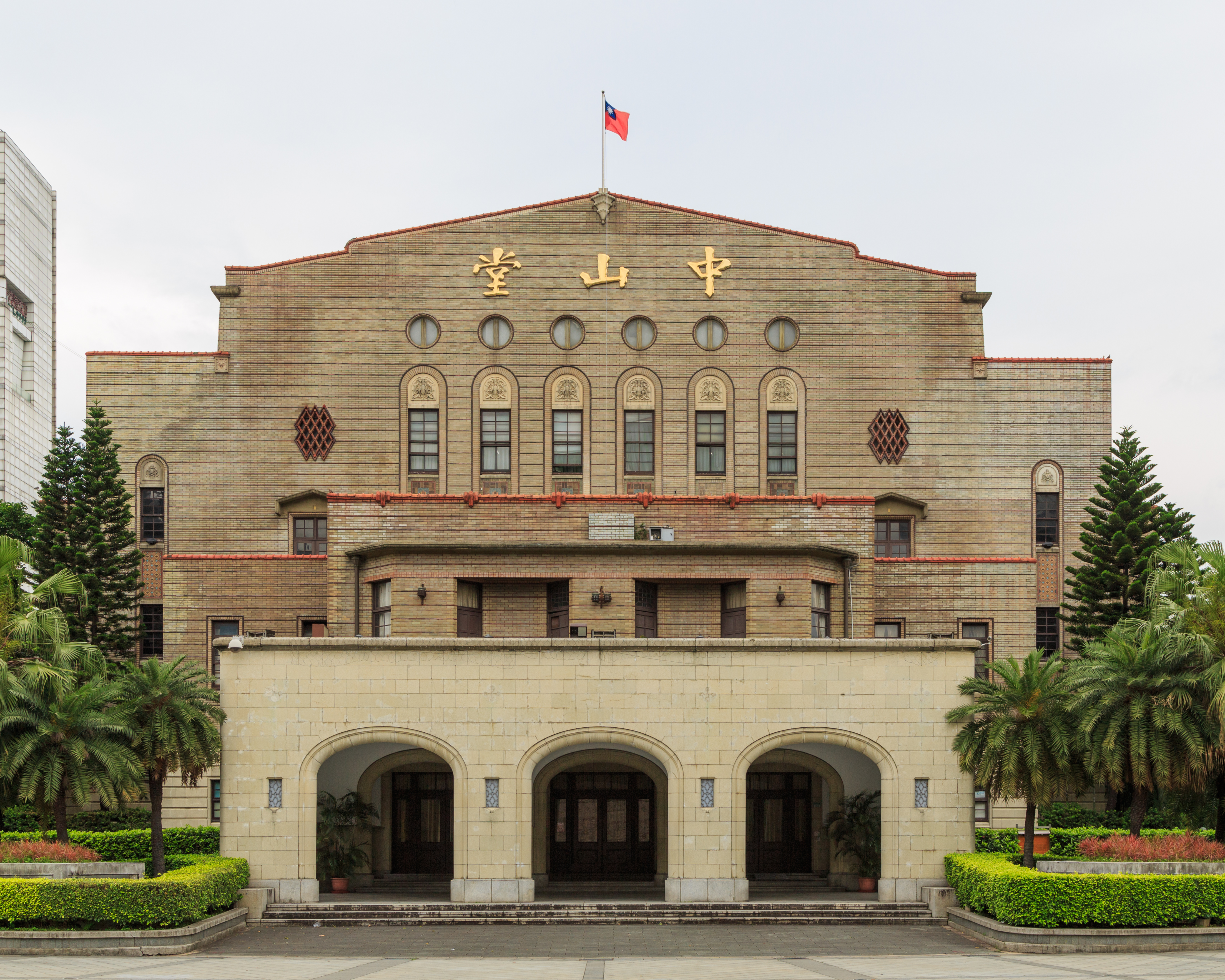
Zhongshan Hall
The tiles were light green on purpose. When the Taihoku City Public Auditorium was completed in 1936, its architects had already anticipated air raids, and the building's facade was designed to blend with the surrounding vegetation from above. Four stories of earthquake-resistant steel, 113,750 square feet of floor space, windows adorned in Spanish Islamic motifs -- and all of it camouflaged in a color chosen for survival. Nine years later, inside this same building, Japan would formally surrender Taiwan.
An Emperor's Tribute, A Colony's Hall
The hall began as a gesture of imperial loyalty. In 1928, to mark the ascension of Emperor Showa, the Japanese colonial government in Taiwan demolished the Qing dynasty government office in Taipei and commissioned a grand public auditorium in its place. Construction started on 23 November 1932 under chief engineer Ide Kaoru, who spent 980,000 yen and employed 94,500 workers over four years. The result was the fourth largest city public auditorium in Japan, surpassed only by those in Tokyo, Osaka, and Nagoya. Its four-story steel structure was built to withstand typhoons and severe earthquakes -- practical engineering for a subtropical island sitting on the Pacific Ring of Fire.
The Room Where It Happened
On 25 October 1945, in the hall's Guangfu Auditorium, Chen Yi accepted the formal surrender of Ando Rikichi, the last Japanese Governor-General of Taiwan. The building was promptly renamed Zhongshan Hall in honor of Sun Yat-sen, and it joined more than 125 other public halls across Taiwan that were either demolished or given the same name under KMT rule. The Guangfu Auditorium, a two-story hall with Islamic-inspired design that seats 500, became the physical threshold between Japanese colonial rule and the Republic of China's administration. The Japanese Instrument of Surrender was signed in that room, and the space has been preserved as a monument to that transition ever since.
A Stage for Statecraft
For decades after the war, Zhongshan Hall served as one of Taiwan's premier diplomatic venues. U.S. President Richard Nixon was received here, along with South Korean President Syngman Rhee, South Vietnam's Ngo Dinh Diem, Philippine President Carlos P. Garcia, and Iran's Shah Mohammad Reza Pahlavi. The Sino-American Mutual Defense Treaty was signed within its walls. Chiang Kai-shek held three presidential inauguration ceremonies on the building's east balcony, addressing crowds gathered in the plaza below. The Zhongzheng Auditorium, seating over 2,000, was Taipei's only concert hall after the war and hosted sessions of the National Assembly until 1993.
Art in the Stairwell
Between the second and third floors, visitors encounter an unexpected masterpiece. The Water Buffalo, a plaster relief by sculptor Huang Tu-shui measuring 5.55 by 2.50 meters, depicts a pastoral scene of tropical plants, Taiwanese water buffaloes, and children in straw hats. Completed in 1930, it was Huang's final work before his death at age 35. Nearby, in the plaza, stands a bronze statue of Sun Yat-sen sculpted by Pu Tiansheng, modeled after a photograph of Sun giving a speech in Nagasaki in 1924. Unveiled on 10 October 1949, the statue stands as a reminder of the hall's layered purpose: part government building, part cultural archive, part memorial to the ideologies that have shaped Taiwan.
Encore Performances
Today, the hall hosts chamber and orchestral music, traditional Chinese music, opera, dance, and the Golden Horse Film Festival -- Taiwan's equivalent of the Oscars, which held eight of its early ceremonies here. The building sits at 98 Yanping South Road in the Ximending neighborhood, accessible from Exit 5 of the Taipei Metro's Ximen Station. Designated a historic site in 1992, it remains one of Taipei's most architecturally distinctive buildings, its green tiles now preserved rather than concealing. A feet-washing basin near the entrance, once used by visitors to clean their feet before entering during the Japanese era, survives as a small reminder that this building has been asking people to pause at its threshold for nearly a century.
From the Air
Located at 25.04N, 121.51E in Taipei's Zhongzheng District, adjacent to the Ximending shopping area. The hall is part of the dense urban fabric west of Taipei Main Station. The Tamsui River lies to the west with Guanyin Mountain beyond. Nearest airport is Taipei Songshan (RCSS), about 5 km east. Taiwan Taoyuan International (RCTP) is approximately 30 km southwest. Best observed at 2,000-4,000 feet.