Zhongshan Park (Beijing)
The five colors of soil on the Altar of Earth and Harvests tell a story older than the park that contains them. Green for east, red for south, white for west, black for north, yellow for center -- each color represents a cardinal direction and the earth's fertility in that region. When the Yongle Emperor built this altar in 1421, he placed it symmetrically opposite the Imperial Ancestral Temple, creating a balance between the worship of ancestors on one side of the Forbidden City and the worship of the earth on the other. For five centuries, this arrangement expressed the emperor's dual obligation: to honor those who came before and to ensure the harvests that sustained those who lived now.
The Most Central Park
Of all the gardens and parks surrounding the Forbidden City -- Beihai with its white dagoba, Jingshan with its hilltop pavilion -- Zhongshan Park occupies the most politically central position. It sits just southwest of the Forbidden City walls, within the old Imperial City, wedged between the seat of dynastic power and the avenue that replaced it as China's ceremonial thoroughfare. The altar where Ming and Qing emperors made offerings to the gods of earth and agriculture remains the park's spiritual center, though the offerings have long since stopped. The park takes its name from Sun Yat-sen, whose honorific name "Zhongshan" was adopted by parks across China during the Republican era. A statue of Sun Yat-sen stands within the grounds, a 20th-century revolutionary honored in an imperial space.
An Archway with a Complicated History
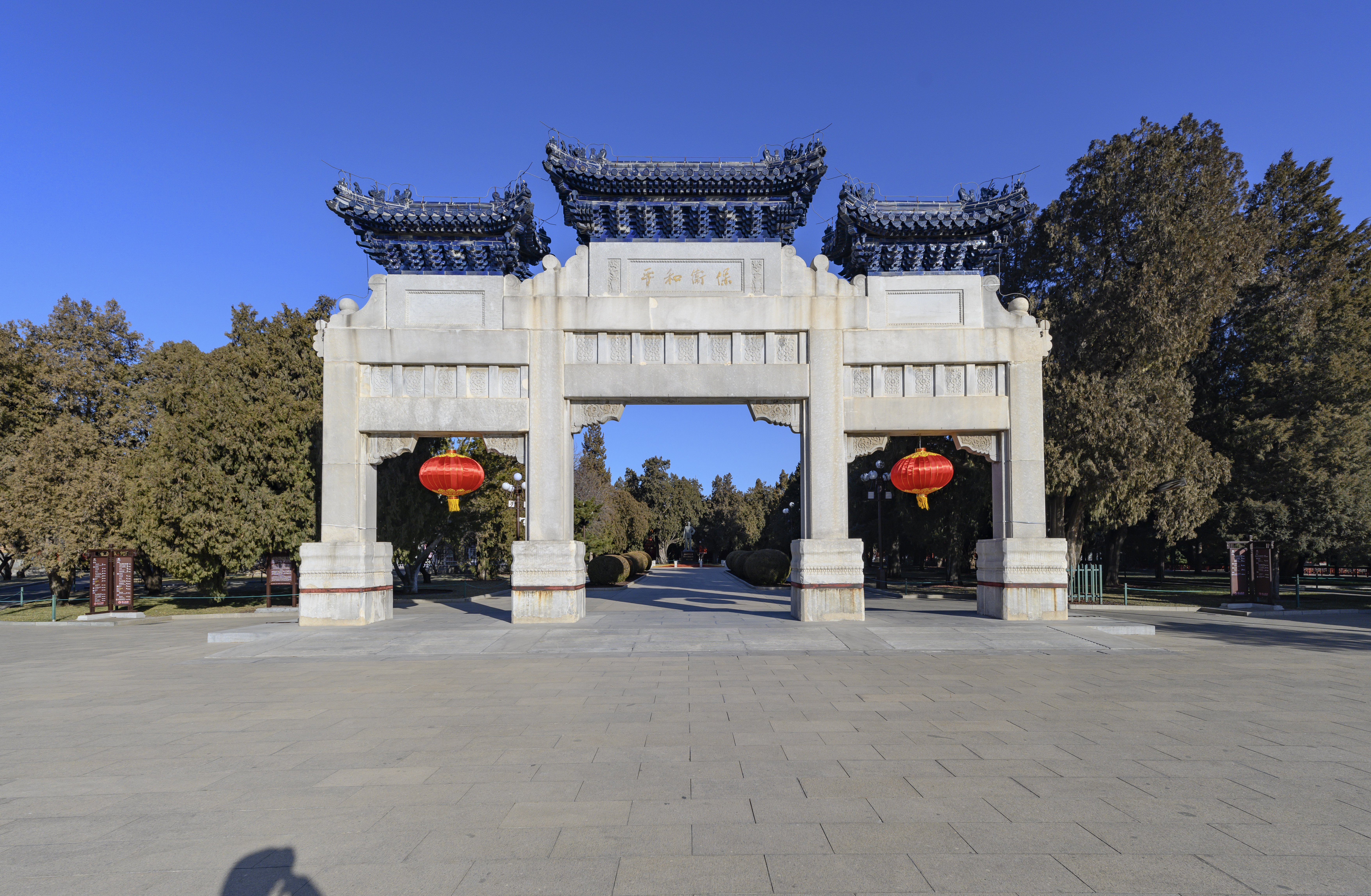
Among the park's stone archways, one carries a particularly layered past. The Qing government originally erected it to commemorate Baron Clemens von Ketteler, a German diplomat killed during the Boxer Rebellion in 1900. The Eight-Nation Alliance demanded the memorial as part of the peace settlement, and the archway was built at the site of the killing near Dongdan. After World War I, when Germany was no longer a force to appease, the archway was moved to Zhongshan Park and rededicated to peace. Its name was changed to the "Archway for Defending Peace," transforming a monument to imperial humiliation into one of aspiration. The stone structure itself remained unchanged -- only its meaning shifted, as meanings in Beijing so often do.
Imperial Pavilions and Dutch Tulips
Beyond its ceremonial architecture, Zhongshan Park preserves a collection of halls and pavilions originally built for members of the imperial family. The Lanting Eight-column Pavilion and various garden structures recall the leisure activities of a court that controlled an empire from behind these walls. But the park's most unexpected feature arrived in 1977, when the Princess of Holland presented 39 varieties of tulips to Zhongshan Park. The flowers are housed in a greenhouse that keeps them on display year-round, an improbable touch of the Netherlands nestled among imperial Chinese architecture. The greenhouse anchors a tradition of horticultural display that has made the park a destination for Beijing residents who come not for history but for flowers, shade, and a quiet bench near the center of a city that rarely stops moving.
Between the Palace and the Avenue
Zhongshan Park exists in the narrow space between Beijing's imperial past and its political present. Chang'an Avenue runs along its southern edge, carrying traffic past the Great Hall of the People and Tiananmen Square. The Forbidden City's red walls define its northern boundary. Within these constraints, the park offers something increasingly rare in central Beijing: unstructured public space. Families stroll past the Altar of Earth and Harvests without knowing its ceremonial purpose. Retirees practice tai chi beneath trees that predate the revolution. The symmetry that the Yongle Emperor designed six centuries ago -- ancestral temple on one side, earth altar on the other -- still shapes the geography of power. But the altar itself belongs to everyone now, and the five-colored soil still points in all directions.
From the Air
Located at 39.91N, 116.39E, immediately southwest of the Forbidden City. From altitude, Zhongshan Park appears as a green rectangle between the Forbidden City moat and Chang'an Avenue. The circular Altar of Earth and Harvests is visible within the park grounds. Nearest airport is Beijing Capital International (ZBAA/PEK), approximately 26 km northeast.