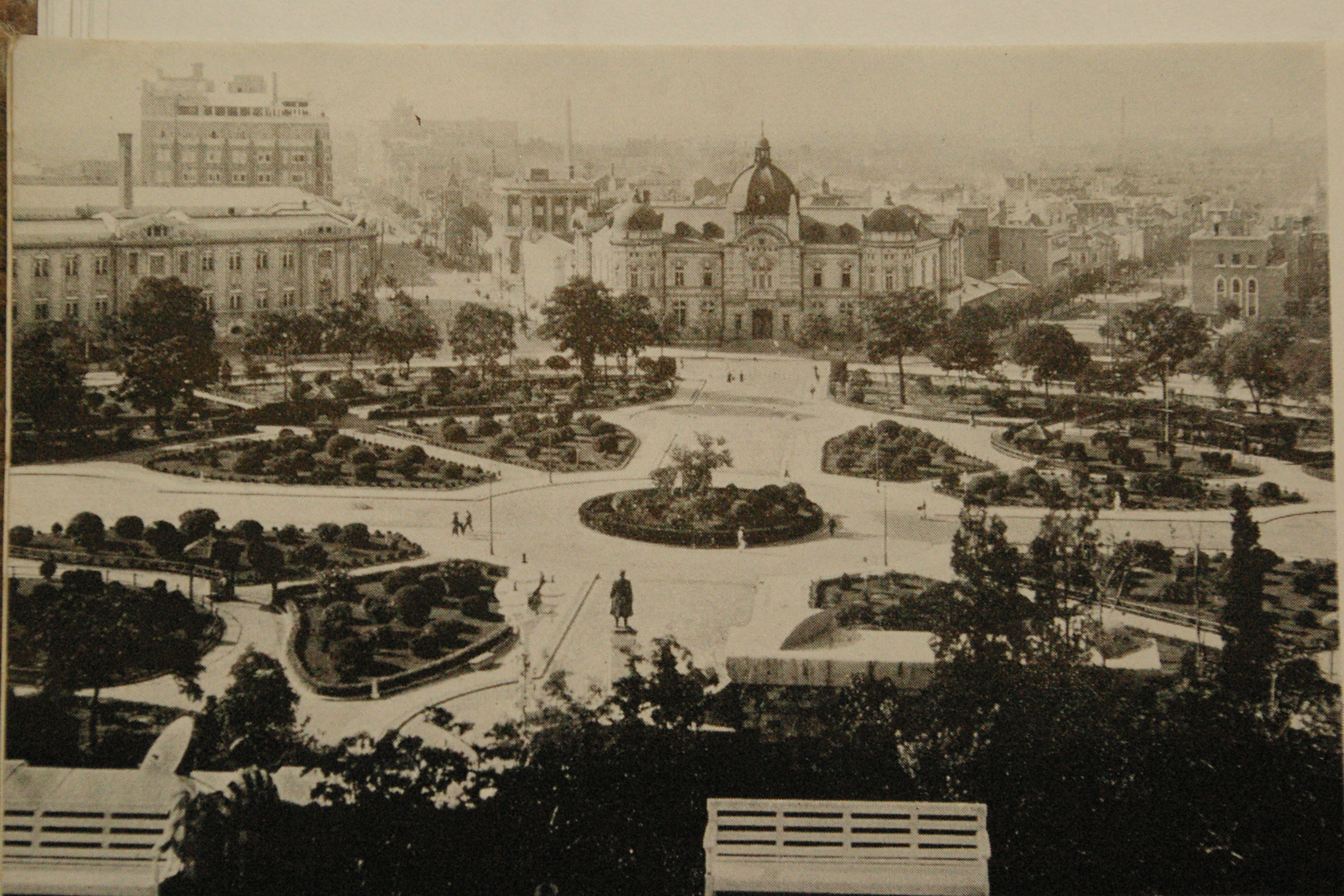
Zhongshan Square
Ten roads radiate from a circle 213 meters across in the center of downtown Dalian, and on warm summer evenings, the paved area inside the five-lane roundabout fills with people dancing. They gather in the green zone surrounded by Renaissance columns and Art Deco facades, practicing ballroom steps and line dances beneath buildings designed by Japanese architects for a colonial administration that ended eighty years ago. Foreign language enthusiasts stake out corners for conversation practice. The square that Tsar Nicholas II's engineers laid out in 1898 has become, improbably, one of the most vibrant public gathering spaces in northeast China.
Three Names, Three Empires
Russia built the square in 1898 as Nikolayevskaya Square, naming it after Tsar Nicholas II during the brief period when the Russian Empire controlled what it called Port Arthur. When Japan defeated Russia and took the Liaodong Peninsula, the square became Ohiroba, "the large plaza," to distinguish it from the smaller Nishihiroba, or "west square," now known as Friendship Square. After Japan's withdrawal in 1945, the square received its current name: Zhongshan Square, honoring Sun Zhongshan, known in the West as Sun Yat-sen, the first president of the Republic of China. Three names in less than fifty years, each one erasing the previous regime's claim to the center of the city.
Ten Roads from a Circle
The square's circular design creates a distinctive star pattern visible from the air. Ten roads spoke outward in a precise arrangement: Shanghai Road to the north, Renmin Road to the east, Yan'an Road to the south, and Zhongshan Road to the west, with six smaller streets filling the gaps between them. Renmin Road and Zhongshan Road together form the main east-west artery of downtown Dalian. East of the square, Renmin Road passes through the hotel district toward Gangwan Square and the Port of Dalian. West, Zhongshan Road runs through Friendship Square, the commercial hub of Qingniwaqiao, past City Hall, and on toward the old port district of Lushun. Pedestrian underpasses connect the inner green space to the surrounding streets.
China's First Musical Square
In 1995, the installation of 36 audio systems made Zhongshan Square the first "musical square" in China. The addition transformed the roundabout's interior from a traffic island with grass into an active public venue. The music provided a soundtrack for the evening dancing that has become the square's signature activity, drawing residents who use the space as an open-air dance floor, a social club, and a language exchange. The classical buildings ringing the square serve as an unlikely backdrop: former banks, a former police station, and a former hotel that once catered to the colonial elite now witness the informal, spontaneous public life of a Chinese city where the most European-looking architecture in Liaoning Province frames the most characteristically Chinese use of public space.
The Business of Empire's Leftovers
Zhongshan Square anchors Dalian's Zhongshan District and its central business district. The colonial-era buildings that line the roundabout house Chinese banks, government offices, and cultural institutions, their original Japanese and Russian functions replaced but their facades preserved. The square operates simultaneously as a working commercial center, a protected heritage site, and a neighborhood gathering place. It is the kind of space that reveals its full character only when experienced at different times of day: a financial hub during business hours, a tourist attraction in the afternoon, and a community dance floor after dark. The geometry that Russian engineers designed for imperial grandeur has proved remarkably adaptable to purposes they never imagined.
From the Air
Located at 38.92N, 121.64E in the Zhongshan District of central Dalian. The distinctive circular plaza with ten radiating roads is clearly visible from altitude as a hub in the city's road network. Nearest major airport is Dalian Zhoushuizi International (ZYTL/DLC), approximately 10 km northwest. Renmin Road leads east toward the Port of Dalian and Zhongshan Road leads west through the city center toward Lushun.