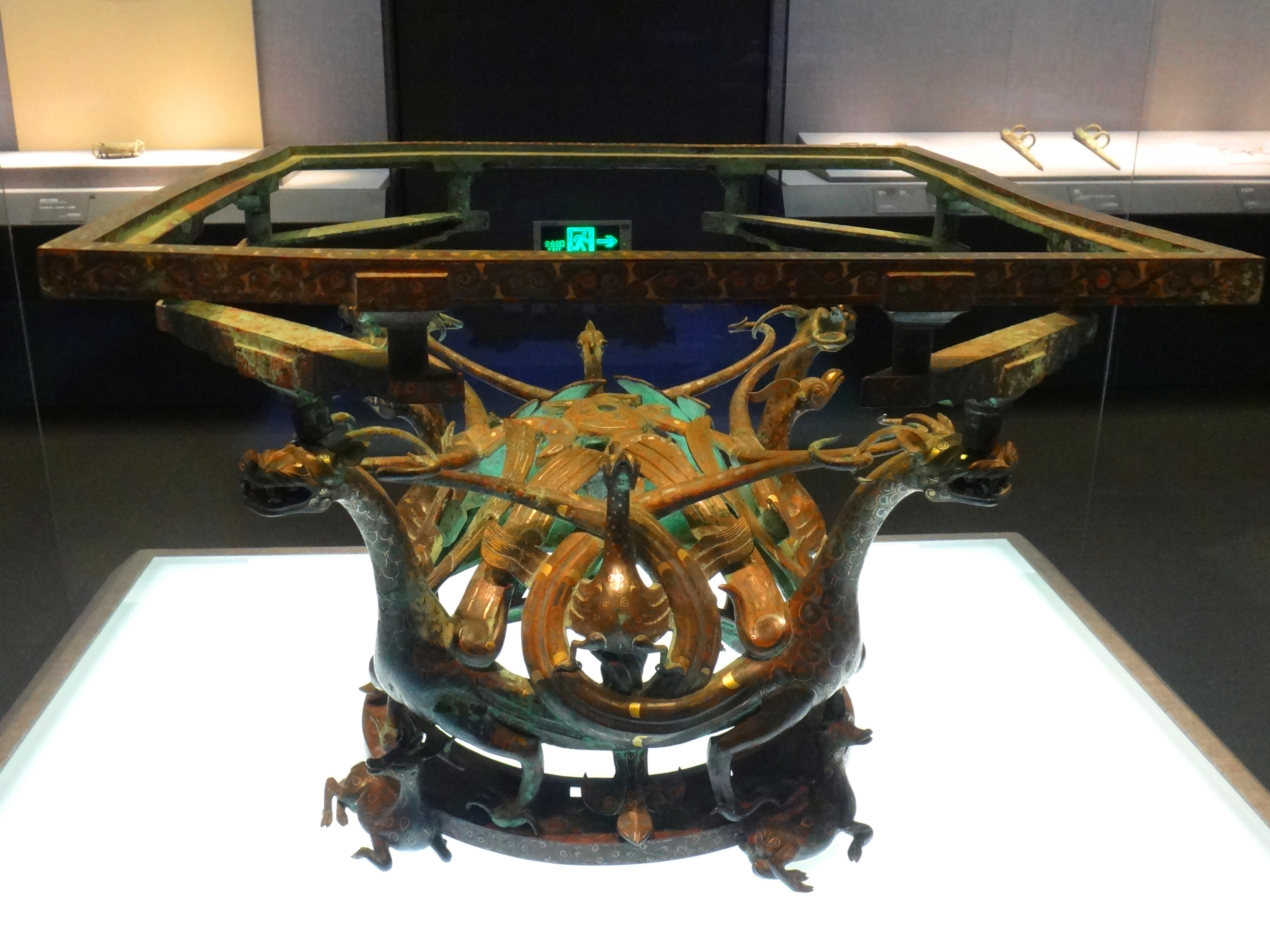
Zhongshan (state)
When the king of Qi learned that Zhongshan had claimed the title of wang -- king -- he was livid. 'I am a state of ten thousand chariots and Zhongshan is one of a thousand chariots,' he fumed. 'How dare she assume a title the equal of mine?' The insult revealed more than royal indignation. It confirmed that this small kingdom, wedged between the Taihang Mountains and the North China Plain in what is now Hebei Province, had earned the grudging attention of the great powers. Zhongshan survived for roughly 120 years during the Warring States period, a span during which far larger kingdoms rose and fell. It is the only minor state to have earned its own chapter in the Strategies of the Warring States, the era's great diplomatic record.
A Kingdom Between Mountains and Plains
Zhongshan -- meaning 'central mountain' -- took its name from a hill called Huangshan that sat inside the walls of its capital, Lingshou. The capital was strategically placed with the Taihang Mountains shielding its west, north, and south, while its east opened onto flat plains. Founded around 380 BC at the confluence of two rivers, the city measured roughly 4,000 by 4,500 meters. Its pounded-earth walls ranged between 18 and 34 meters wide. A satellite fort built 1.5 kilometers to the east defended the city's only vulnerable approach. Archaeological surveys in the 1970s revealed palace foundations, bronze and ceramic workshops, marketplaces, and 125 tombs clustered around the capital, with dozens more scattered throughout the countryside.
Stew, Hostages, and Survival
The kingdom's early history reads like a war saga. After establishing its capital at Gu around 414 BC, Zhongshan was conquered by the state of Wei in 407. The story surrounding that conquest is grim: General Yue Yang's son, living in Zhongshan when war broke out, was taken hostage and paraded before his father. When the psychological pressure failed, the captors killed the son, made him into stew, and sent a portion to Yue Yang -- who drank it before the Zhongshan messenger to demonstrate his resolve. By 381 BC, however, Zhongshan had won its independence back. In 315, it seized copper mines from Yan during a succession crisis, and in 323 it joined a five-state vertical alliance that allowed its ruler to claim the title of king. Shrewd diplomacy kept larger neighbors at bay until Zhao, which nearly surrounded Zhongshan on all sides, finally conquered it in 296 BC after a decade of annual invasions.
Treasures Beneath the Earth
In the late 1970s, archaeologists discovered the tombs of King Cheng and his son King Cuo in Pingshan County, Hebei. Though the main chambers had been looted, the storage rooms were intact and yielded what scholars consider the richest archaeological find from any Chinese state of the 4th century BC. The artifacts told a complicated cultural story. Ritual vessels came from surrounding Warring States kingdoms, some items bore the influence of northern nomadic peoples, but the luxury goods were distinctly Zhongshan in style. This blend has fueled ongoing scholarly debate about Zhongshan's identity -- whether they were a sinicized minority heavily influenced by Chinese culture, or a Chinese people shaped by contact with nomadic neighbors. The kingdom's bronze knife-shaped coins, called chengbo, weighed exactly fifteen grams, matching the knife coins of Yan, which suggests a deliberate currency alignment between trading partners.
One of China's Earliest Great Walls
Zhongshan built its own defensive border wall around 369 BC to guard against Zhao -- making it one of the earliest Great Walls of China, predating the more famous Qin dynasty construction by over a century. In 1988, archaeologist Li Wenlong surveyed the surviving sections in Tang County and found the Zhongshan Great Wall within Baoding stretching approximately 49 kilometers. Built from stone or a mix of earth and stone, the remnants stand between 0.4 and 3 meters high, with widths of 1 to 2.5 meters. At the sacrificial site of Guocun, four kilometers southwest of Lingshou, 142 pits were found containing animals -- sheep, goats, and cattle -- buried with jade pendants and bi disks. These pits closely mirror the sacrificial practices of the state of Jin, evidence of the deep cultural currents that flowed between China's warring kingdoms even as they fought to destroy one another.
From the Air
The ancient state of Zhongshan was centered near modern Pingshan County, Hebei, at approximately 38.33°N, 114.29°E. The terrain transitions from the Taihang Mountains to the west to the North China Plain to the east. The capital Lingshou's archaeological site and the royal tombs are near Pingshan. Nearest major airport is Shijiazhuang Zhengding International Airport (ICAO: ZBSJ), about 60 km to the southeast. Best viewed at 5,000-8,000 feet AGL to appreciate the mountain-plain transition that defined the kingdom's geography.