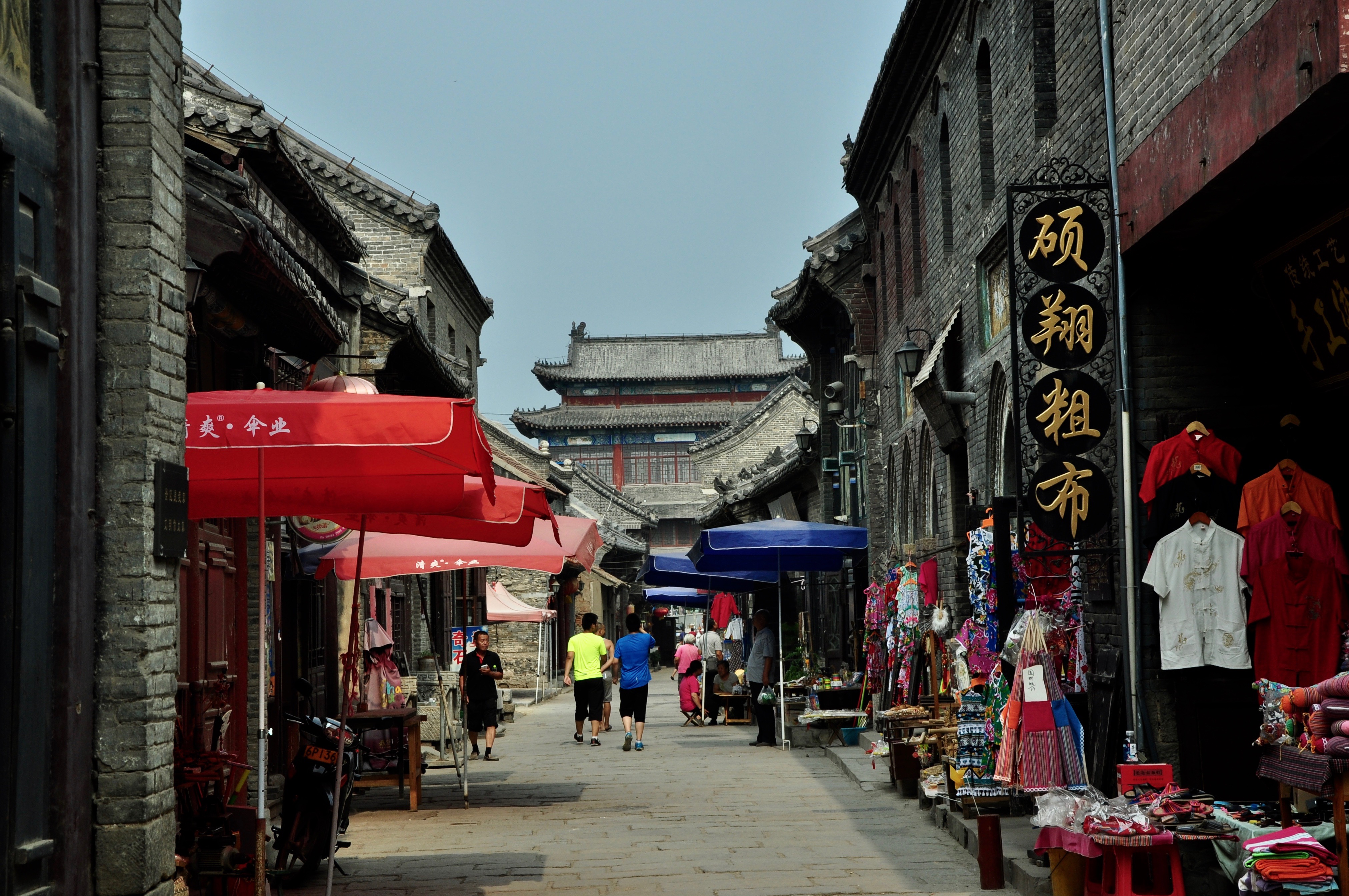
Zhoucun, Zibo
A stone monument stands at the center of Zhoucun's old commercial street, carved with four Chinese characters: "No Tax Today." The trick is in the word "today." In the 17th century, a clever official named Huahsi Lee exploited a single day's imperial tax exemption to create what amounted to a permanent loophole -- and the merchants of this Shandong textile district have been telling the story ever since. Zhoucun, a district of Zibo in Shandong Province covering 307 square kilometers, has been a hub of commerce for centuries, and that monument on Zhoucun Dajie is both its most famous artifact and its most revealing.
The Monument That Cheated an Emperor
The story goes like this: in the 17th century, Zhoucun's textile industry was thriving, but corrupt local officials had created a department solely for extorting money from merchants through excessive taxes. Trade was collapsing as merchants fled. Huahsi Lee, a native of Zhoucun who had risen to serve in the Qing Ministry of Justice, returned home and was appalled. He reported the situation to the Shunzhi Emperor, who found himself in a bind -- to refuse mercy would look bad, but to waive taxes entirely was out of the question. The emperor's compromise was characteristically stingy: Zhoucun could have one day free of tax. Huahsi turned this crumb into a feast. He erected a monument reading simply "No Tax Today" -- phrased so that, on any given day, it applied.
Seven Generations of Conscience
The monument's clever ambiguity did not sit entirely well with Huahsi Lee. According to local tradition, he eventually took personal responsibility for the lost tax revenue, paying it himself. He went further still, promising that anyone robbed within 200 li -- roughly 115 kilometers -- of Zhoucun would receive compensation from his family. This guarantee, extraordinary in its scope, was reportedly maintained by his descendants for seven generations, spanning approximately 200 years. Whether the details are perfectly accurate or embroidered by time, the story captures something real about Zhoucun's identity as a merchant town that valued trade above all else and protected it fiercely.
Silk, Film, and Commerce
Zhoucun's commercial DNA has never faded. The district's main industries remain textiles and furniture manufacturing, echoing the silk trade that made it prosperous centuries ago. The old commercial center has been refurbished, its traditional buildings restored to showcase the architecture of a historic trading town. Director Zhang Yimou recognized the district's period atmosphere when he chose to film scenes for his acclaimed 1994 film To Live here, using Zhoucun's streets as a backdrop for his story of a family's survival through China's 20th-century upheavals. With an estimated population of about 288,440, the district retains its character as a place where making and selling things is not just an occupation but a tradition.
Walking Zhoucun Dajie
The heart of Zhoucun is its Dajie, the old main street that has served as the commercial center for centuries. Walking it today, visitors move through restored traditional shopfronts and workshops where craftspeople demonstrate techniques that have been passed down through generations. The "No Tax Today" monument still stands at the center, though it has long since lost any legal force. Five subdistricts and four towns compose the broader district, stretching across the flat agricultural landscape of central Shandong. The street itself is the draw -- a living piece of commercial history in a region where trade routes once connected the coast at Qingdao to the interior at Jinan, and where a culture of commerce was strong enough to inspire one official to outwit an emperor with four carved characters.
From the Air
Located at 36.80°N, 117.87°E in Zibo, Shandong Province. Nearest major airport is Jinan Yaoqiang International Airport (ZSJN), approximately 110 km to the west. Zhoucun sits within the broader urban area of Zibo, visible from altitude as part of the continuous development along the Jiaoji Railway corridor. The flat terrain of central Shandong stretches in all directions. Best viewed at 3,000-5,000 feet.