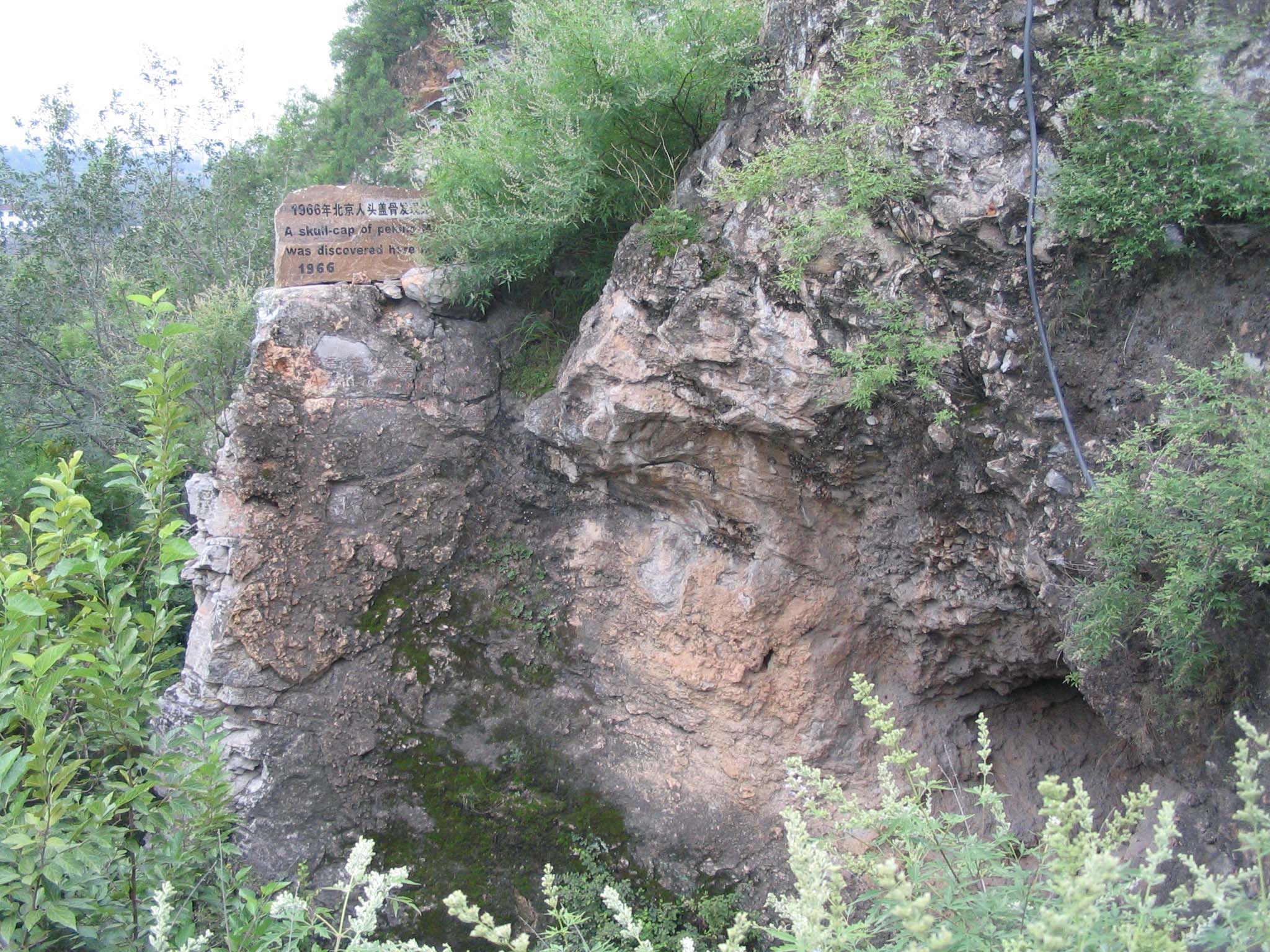
Zhoukoudian Peking Man Site
On a December evening in 1929, paleontologist Pei Wenzhong worked alone in a 40-metre crevasse at the base of Dragon Bone Hill. The weather was frigid. He held a hammer in one hand and a candle in the other. What he pried from the rock that night was the first nearly complete skullcap of Homo erectus pekinensis -- Peking Man -- a discovery that would reshape the understanding of human evolution and then, in one of science's cruelest losses, vanish without a trace.
Dragon Bone Hill
Local quarry workers had always known there were bones in the limestone hills of Zhoukoudian, about 50 kilometres southwest of Beijing in Fangshan District. They called the place Dragon Bone Hill. In 1921, Swedish geologist Johan Gunnar Andersson and American paleontologist Walter Granger were led to the site by these quarry men. Andersson noticed white quartz foreign to the area and immediately recognized the site's potential. His assistant, Austrian paleontologist Otto Zdansky, excavated in 1921 and 1923, sending material back to Uppsala University in Sweden. Among the crates were two human teeth -- the first evidence of an ancient human presence that would eventually yield remains from more than 40 individuals, over 10,000 stone tools, and animal fossils from 200 separate species.
The Race to Understand
Canadian paleoanthropologist Davidson Black, working at the Peking Union Medical College, recognized the find's significance and secured $80,000 from the Rockefeller Foundation for systematic excavation. The Cenozoic Research Laboratory was established in 1928, and an international team of scientists converged on the site despite primitive conditions -- researchers rode mules to the excavation and stayed at caravansaries along the way. French paleontologist Pierre Teilhard de Chardin visited regularly from 1926. French archaeologist Henri Breuil confirmed the presence of stone tools in 1931, the same year evidence of fire use was accepted. By 1932, nearly 100 workers were deployed at the site daily. Five nearly complete skullcaps were recovered, along with 200 human fossils in total.
The Loss
Black died at his desk one night in 1934, one of the Peking Man skullcaps sitting before him. German Jewish anthropologist Franz Weidenreich replaced him and continued excavations until the Japanese invasion of China halted work in 1937. Japanese atrocities at the site included the bayoneting of three workers and forcing a fourth to pull a rickshaw until he starved to death. In 1941, with war engulfing the Pacific, the bulk of the fossil collection was packed into wooden footlockers and left the Peking Union Medical College on 4 December 1941, intended for transport to safety at the coast -- and disappeared. The SS President Harrison, which was supposed to collect them at Qinhuangdao, ran aground trying to reach China days after Pearl Harbor; the fossils never made it to the ship and their fate remains unknown. Despite decades of searching, the original Peking Man fossils have never been recovered. Fortunately, Weidenreich had made meticulous casts and detailed measurements, preserving the physical characteristics if not the physical specimens.
Deep Time at the Surface
Excavations resumed in 1949 and have continued intermittently, yielding additional teeth, bone fragments, and a Homo sapiens premolar from excavations in the 1970s. Modern dating techniques confirm the site was occupied between 230,000 and 500,000 years ago, though some animal remains date back 690,000 years. The Upper Cave, discovered in 1930 on the upper part of Dragon Bone Hill, revealed a different chapter: evidence of archaic Homo sapiens from 36,000 to 39,000 years ago, including burial rites -- white powder sprinkled around remains on the lower level. More than 20 fossil-bearing localities have been excavated across the Zhoukoudian system. Today it is a UNESCO World Heritage Site, and 13 layers have been excavated at the main site to a depth of nearly 40 metres. The original fossils remain missing, a scientific treasure lost to the chaos of war.
From the Air
Located at 39.69N, 115.92E in Fangshan District, about 50 km southwest of central Beijing. The cave system is set in limestone hills visible as lighter-colored terrain amid the forested landscape. Nearest major airport is Beijing Daxing International Airport (ZBAD). The UNESCO World Heritage Site museum complex is visible from lower altitudes. Recommended viewing at 2,000-4,000 feet AGL.