Zhuolu County
The Yellow Emperor may or may not have founded a city here. The legendary Battle of Zhuolu, in which the Yellow Emperor defeated his rival Chi You and unified the ancient Chinese tribes, may or may not have taken place on this ground. Modern Zhuolu County, in the northwest corner of Hebei Province, promotes both claims enthusiastically -- and the historical uncertainty does nothing to diminish the appeal. What is beyond dispute is that this county of 294,000 people, sitting at the confluence of the Sanggan and Yang Rivers near the headwaters of the Yongding River, has found a different kind of identity in the 21st century: it grows grapes on what Chinese government sources call the largest vineyard in Asia.
Legends at the Confluence
Zhuolu's location has always been its defining feature. The county spans 2,802 square kilometers where the Sanggan River meets the Yang River before their combined waters flow east as the Yongding River toward Beijing. This confluence placed ancient Zhuolu at a natural crossroads, which is precisely what makes the legendary associations plausible even if they remain unproven. The Yellow Emperor, or Huang Di, is the mythological progenitor of Chinese civilization, and Chi You represents the rival tribal confederation he defeated to establish dominance. Tourist sites throughout the county celebrate these figures, blending archaeology, mythology, and commercial enterprise in proportions that shift depending on who is telling the story.
Vines on the Frontier
Zhuolu is part of the Huai-Zhuo Basin viticultural region, alongside Xuanhua and Huailai, where conditions conspire to produce surprisingly good wine grapes. The climate delivers a heat summation of 3,532 degree-days Celsius, cool dry summers, and only 413 millimeters of annual rainfall. The soil is a sandy lime loam with good drainage, and the sharp difference between daytime and nighttime temperatures concentrates sugars and acidity in the fruit. The Longyan grape is the local specialty, but over twenty varieties are cultivated. Cabernet Sauvignon thrives here. The county has invested in grape tourism, developing a "Zhuolu Grape Sightseeing Zone" that combines vineyard visits with wine tasting in a landscape more often associated with heavy industry.
Steel, Almonds, and the Modern Economy
Beyond the vineyards, Zhuolu's economy reflects the industrial character of the broader Zhangjiakou region. Iron and steel metallurgy dominate the manufacturing sector, a legacy of the mineral wealth that runs through northern Hebei's geology. Almond orchards round out the agricultural picture, their spring blossoms providing a brief visual counterpoint to the industrial facilities that employ much of the workforce. The county borders Beijing's Mentougou District to the east, placing it within the gravitational pull of the capital's economy while retaining a distinctly provincial character in its daily life.
Where Myth Meets the Modern Grid
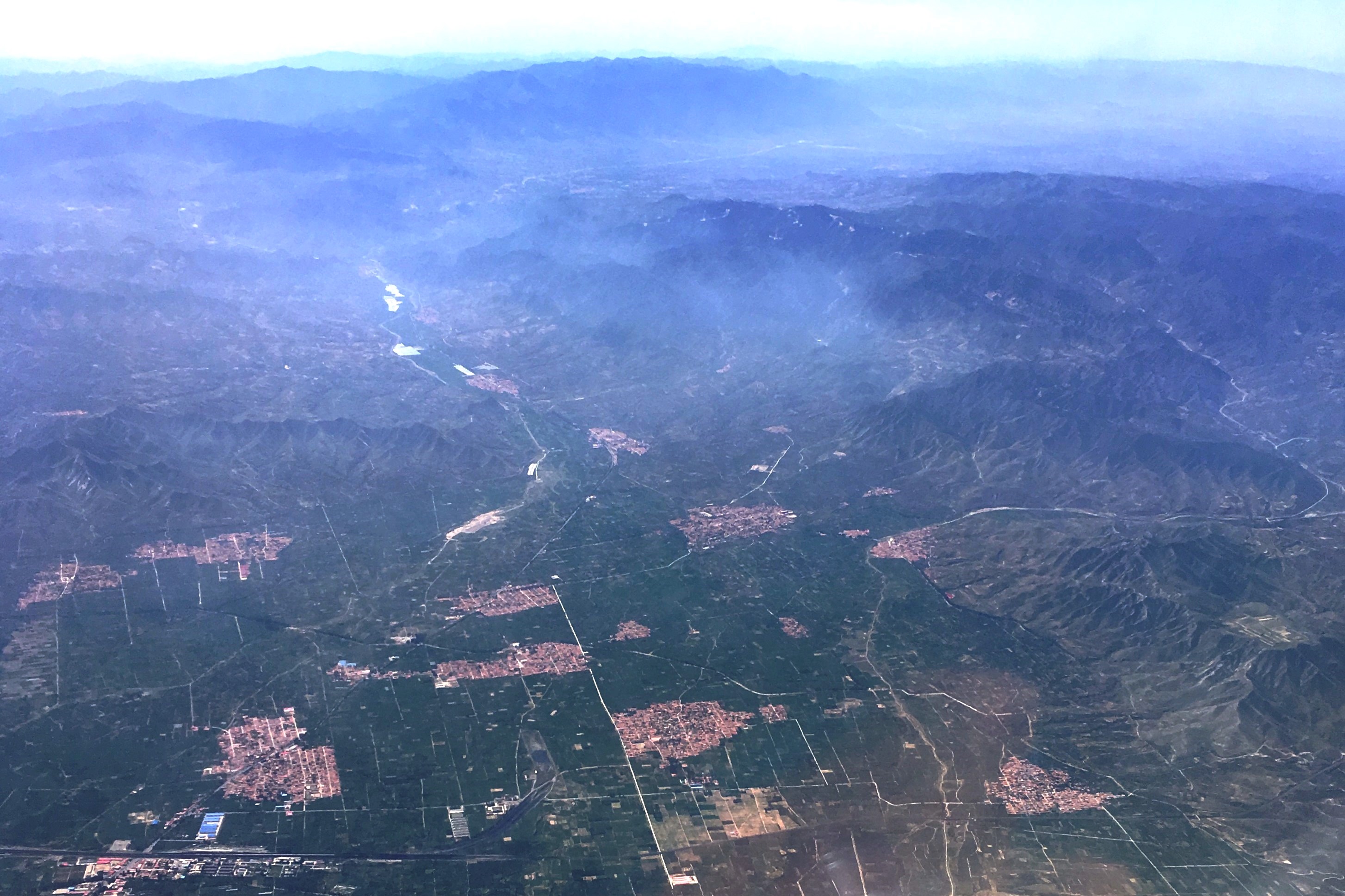
From the air, Zhuolu reads as a patchwork of agricultural plots, industrial zones, and small towns arranged along river valleys. The confluence of the Sanggan and Yang Rivers is the geographic anchor, their waters merging in broad, shallow channels that have attracted settlement for millennia. Whether or not the Yellow Emperor ever stood here, the landscape explains why someone would have wanted to -- it is fertile ground at a defensible junction, the kind of place where civilizations naturally take root. The grape vines stretch in neat rows across the valley floor, a thoroughly modern crop growing on soil that legend says witnessed the birth of China itself.
From the Air
Located at 40.38°N, 115.21°E in northwest Hebei Province, near the confluence of the Sanggan and Yang Rivers. The county borders Beijing's Mentougou District to the east. Nearest major city is Zhangjiakou. Nearest airport is Zhangjiakou Ningyuan Airport (ZBZJ). The landscape features river valleys, agricultural plots including extensive vineyards, and industrial areas.