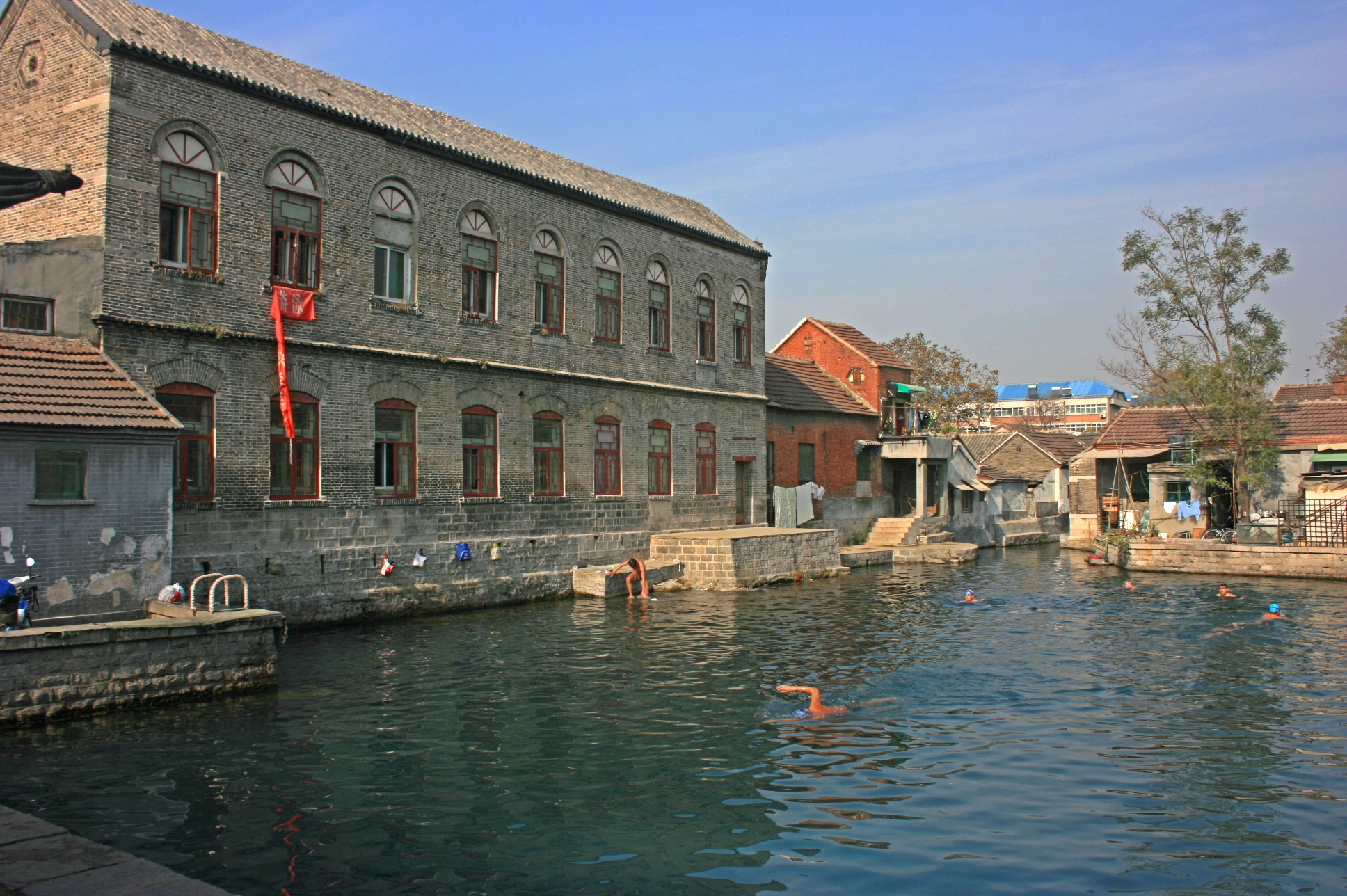
Zhuoying Spring
The name comes from Mencius. In his text "Li Lou Shang," the philosopher uses the phrase "wash out the tassel" -- and so the spring became Zhuoying, the Washing-Out-the-Tassel Spring. It is number 19 among the 72 famous springs of Jinan, an artesian karst spring that rises through the limestone bedrock in the historical center of the city. The spring feeds a large pool -- the Palace Pool -- that today serves as a public outdoor swimming pool. Residents of the surrounding neighborhood swim in water that has been bubbling up from the earth for as long as anyone has recorded the city's history.
A Pool Stained by War
The Palace Pool's history includes at least one episode of violence. When the army of the Jin dynasty invaded Jinan, pushing south into the territory of the Southern Song dynasty, the local garrison commander Guan Sheng refused to surrender. A battle followed, and after the fighting, soldiers washed the textile decorations of their lancets in the spring's pool. The water that had inspired a Confucian poet became, for that moment, a place to rinse the evidence of combat. It is the kind of detail that collapses the distance between a sacred natural feature and the human events that play out around it -- the spring does not choose its uses.
The Palace That Named the Pool
The spring pool acquired the name Palace Pool during the Ming dynasty, when the De Wang Palace was constructed at the site. The royal compound incorporated the spring into its grounds, turning a natural feature into a royal amenity. The palace is gone now, but the name persists. Today, the pool sits in a historical residential neighborhood where private homes crowd right up to the water's edge. It is an arrangement that would be nearly unthinkable in most modern cities -- houses built directly on the banks of an active spring, with access to the water as casual and immediate as stepping out of a front door. In Jinan, this is simply how people have always lived with their springs.
The Spring City Underground
Jinan's fame as the City of Springs rests on geology. The city sits where the Tai Mountain range meets the North China Plain, and rainwater that falls on the mountains percolates through porous limestone before hitting impermeable rock layers that force it upward through cracks and fissures. The result is one of the most prolific artesian spring systems in China -- water rising under its own pressure, no pump required. Zhuoying Spring is one expression of this system, and the Palace Pool it feeds is one of the most intimate. Unlike Baotu Spring, with its grand pavilion and tourist infrastructure, Zhuoying Spring remains embedded in a residential neighborhood. Its cultural significance is inseparable from its ordinariness. This is not a spring set apart for contemplation. It is a spring that people live with, swim in, and have fought beside.
From the Air
Located at 36.667°N, 117.018°E in the historic center of Jinan, near the southern end of Qushuiting Street. The Palace Pool is visible as a body of water within the dense old-city neighborhood. Nearest airport is Jinan Yaoqiang International Airport (ZSJN), approximately 30 km northeast. Look for Daming Lake to the north as a reference point. Elevation approximately 30 meters above sea level.