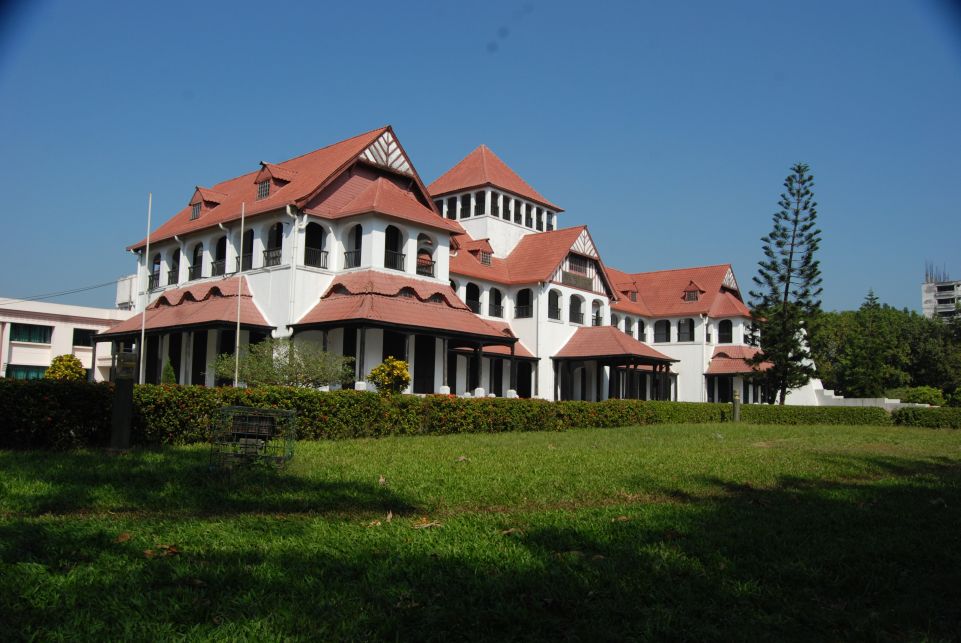
Zia Memorial Museum
The building at Chittagong's Old Circuit House has been many things since the British Raj erected it in 1913: a residence for government officials, a radio broadcasting studio, a military base, a torture chamber, and finally the room where a president was murdered. That this single structure could hold so many chapters of South Asian history -- colonial administration, partition, liberation war, national independence, political assassination -- says something about both the building's durability and Bangladesh's turbulent first century. Today it is called the Zia Memorial Museum, though even that name is contested, and the museum itself has been closed for years, its walls crumbling for lack of government funds.
A Building That Outlived Its Purpose
The British built circuit houses across the subcontinent as way stations for traveling officials -- functional, respectable buildings that announced colonial authority without overstating it. Chittagong's Circuit House served that role from 1913 through the end of the Raj. After partition in 1947, the building found a new purpose: on 5 June 1954, the newly established Radio Pakistan broadcasting center in Chittagong began transmitting from its rooms. The voices that carried across the airwaves from this building spoke in the language of a new country, Pakistan, that was itself an experiment in nationhood. Within two decades, that experiment would fracture violently, and the Circuit House would stand at the center of the breaking.
The Rooms That Became Cells
During the 1971 Liberation War, the Pakistan Army converted Chittagong Circuit House into a military base. Several rooms became torture cells where Bengali civilians and suspected freedom fighters were subjected to electric shocks and worse. Women were raped inside the building; those who became pregnant were killed, their bodies thrown into a well on the grounds. Skulls and skeletal remains of victims were later recovered from the site. On 17 December 1971, the day after Pakistan's formal surrender, Rafiqul Islam lowered the Pakistani flag from the Circuit House flagpole and raised the flag of Bangladesh. Crowds gathered to welcome the freedom fighters home. The building had witnessed the worst of the war and now stood as backdrop to its end.
The Night of 30 May
A decade later, the Circuit House became the site of another violent turning point. On 29 May 1981, President Ziaur Rahman -- founder of the Bangladesh Nationalist Party and the country's seventh president -- arrived at the building to mediate a dispute among local BNP leaders. That night, Colonel Matiur Rahman organized a group of soldiers to seize the president and bring him to Chittagong Cantonment. Their grievance was specific: they wanted the demotion of Army Chief Hussain Muhammad Ershad and officers who had sat out the 1971 war in Pakistan. When the soldiers advanced on the Circuit House in the early hours of 30 May, a firefight erupted with Zia's security detail. The attackers broke through, pulled the president from his room, and Colonel Matiur Rahman shot him dead. The wall where the bullet struck is still preserved inside the building.
A Museum in Limbo
Four days after the assassination, the government of Acting President Abdus Sattar approved converting the building into a museum. The Zia Memorial Museum was inaugurated on 6 September 1993, during Prime Minister Khaleda Zia's first term. Seventeen galleries displayed Ziaur Rahman's personal belongings, a replica of his mausoleum, and a remarkable artifact: the microphone that M. A. Hannan and Zia himself used to broadcast the Proclamation of Bangladeshi Independence from the Kalurghat Radio Center in 1971. At its peak, the museum welcomed at least 150 visitors daily. But the museum's fate has tracked the country's political divisions. Awami League politicians have pushed to rename it the Liberation War Memorial Museum, arguing the building's true significance lies in the 1971 atrocities. BNP politicians have resisted. As of 2025, the building sits in a vulnerable state -- no government funds have been released for maintenance or renovation in fifteen years, and the museum remains closed to the public.
From the Air
Located at 22.35N, 91.82E in central Chittagong, near the waterfront. The building is not individually distinguishable from altitude, but sits within the dense urban core of Chittagong, roughly 22 km north of Shah Amanat International Airport (VGEG). The Karnaphuli River to the south and the Port of Chittagong provide visual orientation. Best approached at low altitude from the south following the river.