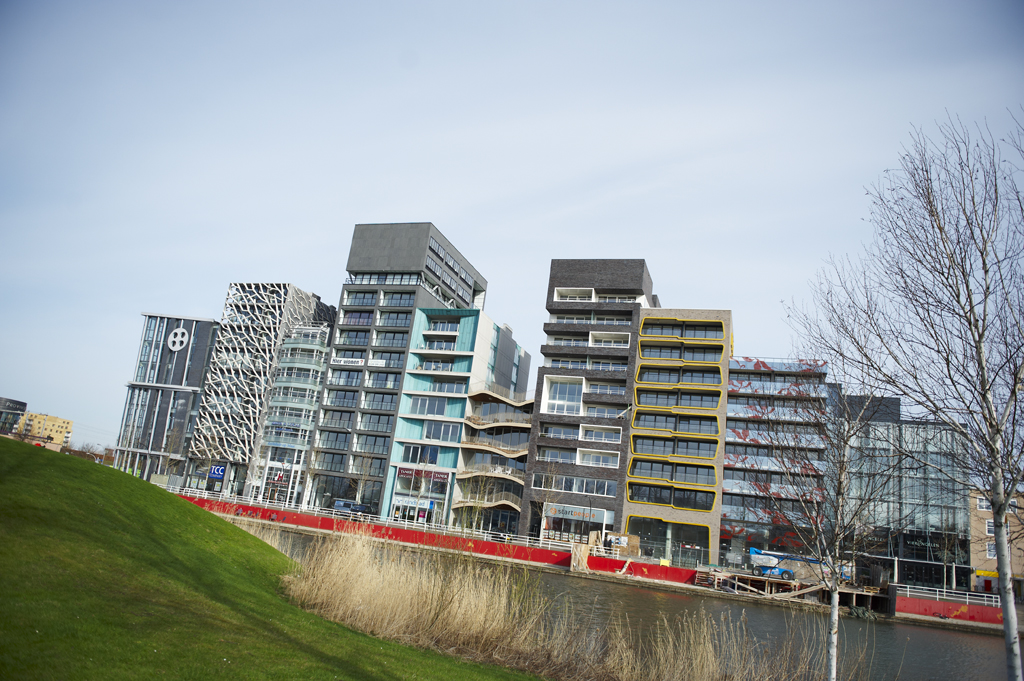
Zilverparkkade
Imagine the canal-house facades of Amsterdam - those tall, narrow, gabled brick fronts wedged shoulder-to-shoulder along the water, each one different because each one was built by a different merchant in a different decade, the whole row pulled together by a shared rhythm and a shared height of about four or five stories. Now imagine commissioning that, on purpose, on a parcel of drained seabed in a new city, all at once. That is what Zilverparkkade is. Between 2002 and 2010, the urban-design firm West 8 carved a single Lelystad block into ten narrow plots and gave each plot to a different architect, with the brief: do whatever you want, as long as it is tall, thin, and faces the water. The result is a small street where every building disagrees with its neighbours - amiably, in the Dutch way - and somehow they all add up to a wall.
Why Lelystad Needed a Skyline
Lelystad is one of the youngest cities in the Netherlands - on a polder drained from the Zuiderzee in 1957, named for the engineer Cornelis Lely who designed the closure that made the reclamation possible. The city was planned, then half-built, then abandoned by its own ambitions when the population growth that planners had projected for the 1980s did not arrive. For decades it had the bones of a city - the wide boulevards, the empty shopping centre, the train station to nowhere - without the body of one. By the late 1990s, the municipality decided to try again. It hired Adriaan Geuze of West 8 to redesign the centre, and Geuze, who is one of the most influential Dutch landscape architects of his generation, proposed something simple: give Lelystad what most planned cities never get, which is the visual density and variety that older cities accumulate by accident. The Zilverparkkade was the experiment.
Ten Architects, Ten Arguments
The Fensalir, by Jeroen van Schooten, is the tallest in the row - fourteen stories, with a 'head' on the top three floors that turns ninety degrees from the rest of the building, breaking the wall line. The Aeratus, by Pim van der Ven, is sheathed in oxidised copper that has turned the green of verdigris and given the building its Latin name. The Wave, by Bjarne Mastenbroek, is the shortest - five stories, with balcony floors that ripple along the facade in a deliberate echo of the wavy pedestrian bridge that crosses the pond across the street. The Koh-I-Noor is named for the diamond. The Jocator and Klusor - Latin for joker and bridge - were completed last, in 2010, to fill the gap that the others had left between them. The Identi has a glass-roofed penthouse on the eleventh floor where the facade should be. No two are alike. That is the point. The street works the way the Herengracht works in Amsterdam: each building insists on itself, the row insists on being a row.
The Quay That Is Not a Quay
Kade is the Dutch word for the stone embankment along a canal - the working edge of a city where boats tied up and goods came off. Zilverparkkade is not, in any historical sense, a kade. The water it faces is an artificial pond inside Zilverpark, dug for the project. There are no boats. There is no trade. The reference is purely architectural: a city built on dry seabed, looking at itself in a mirror of borrowed canal-house geometry. Dutch critics have argued for years about whether this is honest or theatrical, a fresh take on an old form or a stage set pretending to be a town. The answer, walking past it on a grey afternoon, is probably both. The reflections in the pond are real reflections. The buildings are functional offices and apartments where people actually live. The reference is consciously a reference. Lelystad knows what it is - and what it is, on this stretch of street, is a city that decided to remember in advance.
What It Feels Like to Live Here
Most of the buildings combine commercial space on the ground floors with apartments above. Walk along the kade in the late afternoon and you can see balconies in use: dinner being set out on the Wave, laundry on the Identi, someone reading on the Aeratus in green copper light. The penthouse on the Identi has its own atrium and glass roof; the residents up there look down on the rest of the row. From the public side, the street feels narrow and tall in a way Dutch streets are supposed to feel - the eye is held at a human scale, even though the heights vary from five to thirteen storeys. The bicycle bridge across the pond is itself wavy, a kind of architectural rhyme with the building that took its name. Lelystad has plenty of failures in its city centre. This is not one of them.
An Experiment That Held
Architecture critics in the early 2000s were sceptical that the Zilverparkkade approach could work outside Amsterdam - that a planned city on a polder could fake the layered authenticity of a historic canal district. Twenty years on, the experiment looks more durable than the doubts. The buildings have aged at different rates, the way a real canal row ages, with the verdigris on the Aeratus actually arriving as the copper oxidised on schedule. The Wave's curves are now part of how Lelystad sees itself. The kade has not become Amsterdam, but it was never supposed to. It became something a little stranger: a Dutch city centre built from scratch that managed to feel, on a quiet weekday morning, like a place rather than a plan.
From the Air
Zilverparkkade is in central Lelystad at 52.51 N, 5.48 E, in Flevoland province on land reclaimed from the IJsselmeer in 1957. The buildings sit just south of the railway station and face the small Zilverpark pond. Visible from the air as the tightest cluster of tall structures in an otherwise low city. Nearest airport: Lelystad (EHLE), 6 km east. Schiphol (EHAM) is 65 km southwest.