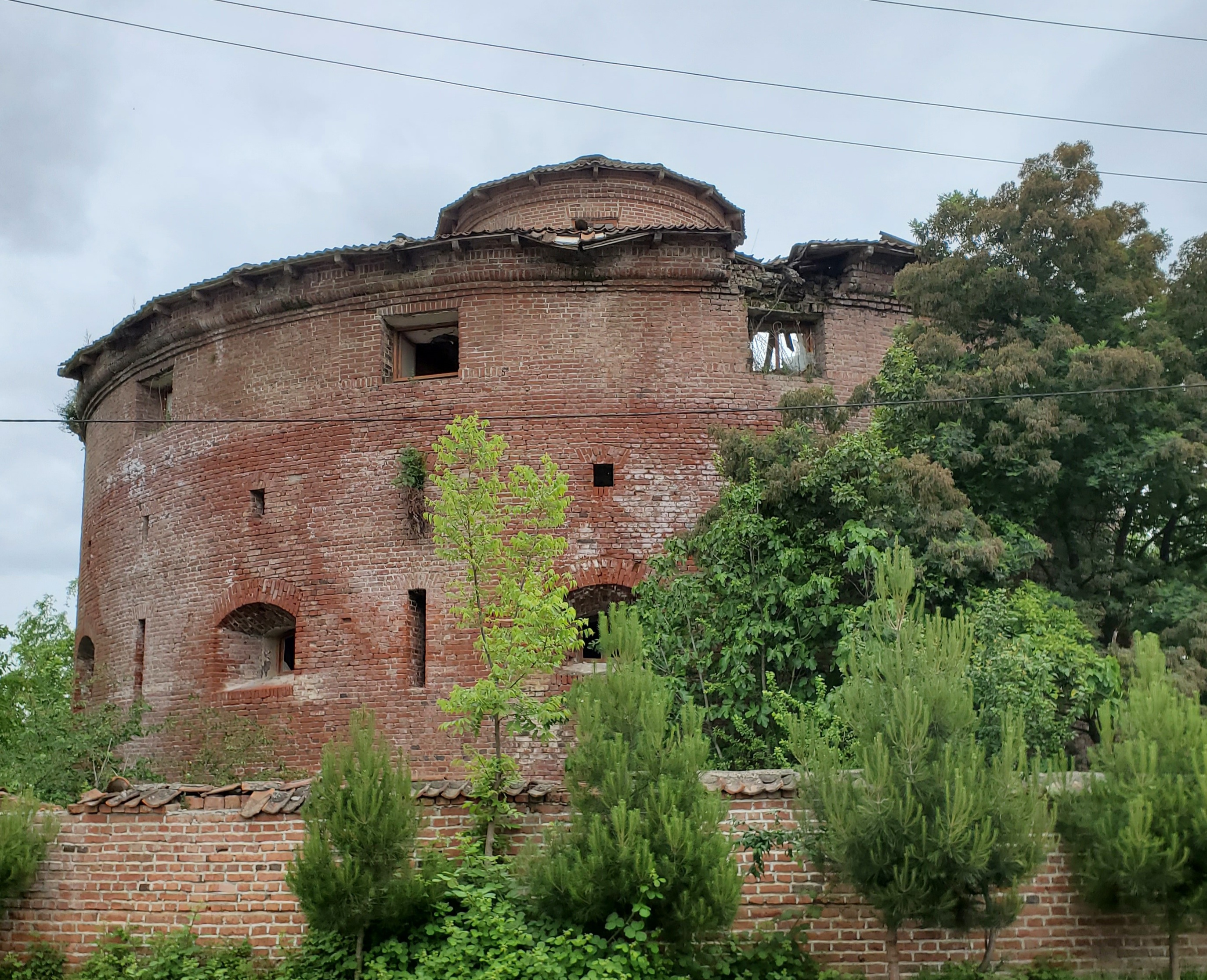
Zindan Fortress
The name tells you what it became. Zindan means dungeon in Persian, and for ninety years this round stone tower in the Azerbaijani city of Lankaran held prisoners behind walls originally built for war. But the fortress had a life before incarceration, and it has found another one after. Designed as a military stronghold in the 18th century, repurposed as a prison under Russian occupation, converted to a sewing workshop under the Soviets, and designated as an art gallery after Azerbaijan's independence, the Zindan Fortress has been reinvented more times than the regimes that claimed it.
Twin Strongholds on the Caspian
The Zindan Fortress was built as part of the larger Lankaran Fortress system, reportedly at the order of Nadir Shah in the 18th century. It was not alone. A second, nearly identical circular tower stood at the opposite end of the fortress walls, forming the northern and southern anchors of the defensive perimeter. The fences connecting the two strongholds defined the front line of Lankaran's fortifications, guarding the city against threats from the Caspian coast. The twin towers served as vital defensive positions through decades of conflict, including wars that raged across the South Caucasus until 1869. Today, the northern twin still stands -- but it functions as a lighthouse, with a lantern installed on its roof that same year.
From Fortress to Dungeon
When Russian troops besieged and captured Lankaran, they destroyed the main fortress walls and dissolved the military garrison. The connected defensive system fractured into its component parts. The northern tower became a lighthouse under the Caspian Shipping Company. The southern tower -- the Zindan -- became a prison. From 1869 to 1959, the circular walls designed to keep enemies out instead kept prisoners in. The fortress was built to hold 140 people. At times, more than 310 were crammed inside. According to local accounts, Joseph Stalin himself served a sentence here in the early 20th century during his years as a revolutionary agitator in the Caucasus. The prison continued operating even after the Soviet occupation of Azerbaijan, its round walls indifferent to whichever flag flew above them.
Reinventions
After the prison closed in 1959, the fortress sat empty for a decade before finding an unlikely second life as a sewing workshop from 1970 to 1990. Workers stitched garments inside walls that had once confined convicts. Following Azerbaijan's independence and subsequent restoration work, the interior was transformed yet again -- this time into an art gallery, hanging paintings where prisoners once scratched the days. The Zindan earned protection as a state architectural monument by decree of the Cabinet of Ministers in August 2001.
Fragile Survival
History has not finished testing the fortress. In February 2015, heavy snowfall collapsed a section of the roof, leaving the monument in disrepair. The damage underscored a paradox common to historic structures: the building survived wars, sieges, and regime changes, only to be threatened by weather and neglect. Azerbaijan's Ministry of Culture included the Zindan's reconstruction in its capital investment plans for 2020 through 2023, part of a broader effort to preserve the architectural heritage of the southern regions. Whether the round walls will hold for another century depends less on their stone and more on the political will to maintain them.
From the Air
The Zindan Fortress is located at 38.75°N, 48.86°E in the city of Lankaran, on the southwestern coast of the Caspian Sea in Azerbaijan. The round tower is visible in the city center near the coastline. Nearest airport is Lankaran International Airport (UBBL), approximately 5 km south of the city. Best viewed at 3,000-6,000 ft. The Caspian shoreline and the city grid of Lankaran provide good visual reference.