Ziwiye Hoard
In 1947, somewhere in the fields outside Ziwiyeh Castle near Saqqez in Iran's Kurdistan Province, someone unearthed a cache of gold, silver, and ivory objects that would ignite one of archaeology's most tangled controversies. The Ziwiye hoard, dated to around 700 BC, contained pieces so beautiful and so stylistically diverse that scholars immediately recognized them as a snapshot of the Iranian plateau at its most cosmopolitan: a crossroads where Scythian nomads, Assyrian empire-builders, Median chieftains, and local artisans all left their mark on the same collection of precious objects.
Where Empires Crossed Paths
The objects in the Ziwiye hoard represent at least four distinct artistic traditions. Assyrian pieces carry the monumental formality of Nineveh and Nimrud. Scythian items display the restless energy of the "animal style," with creatures frozen in combat or coiled in tension. Proto-Achaemenid elements hint at the Persian dynasty that would soon unite the plateau under a single empire. And provincial pieces, rougher in execution but vivid in character, reflect the local Mannean or Median cultures that predated all of them. Leonard Woolley, the archaeologist who excavated Ur, noted that "the Scythian motifs adopted by Urartu account for the decoration of the great Treasure of Saqqez brought to light on the south shore of Lake Urmia." The collection has also been compared to finds at Teppe Hasanlu and Marlyk, suggesting a broad artistic network across western Iran during the Iron Age.
Gold Rhytons and Golden Faces
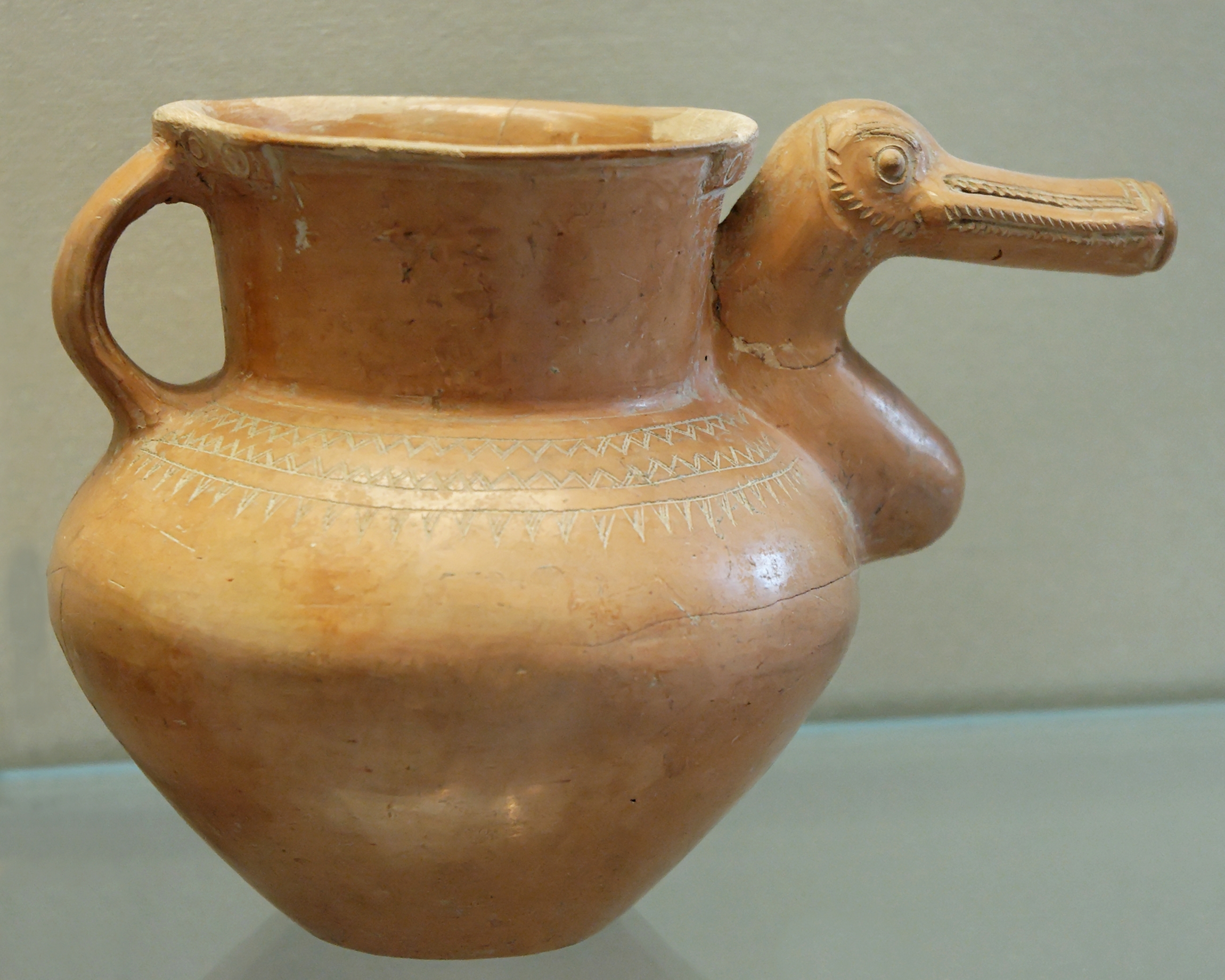
Among the most striking pieces are gold necklaces engraved with mythical creatures, a gold rhyton shaped like a ram's head, golden plaques likely sewn onto royal garments, bracelets with animal-head terminals, and small gold pieces molded into the shape of human faces. A duck-shaped vase, now in the Louvre, captures the whimsy that could coexist with ceremonial grandeur. Bronze shields, marble bowls, and ram-shaped pottery vessels round out the collection. The range of materials and forms suggests this was not a single person's treasure but possibly the accumulated wealth of a temple or court, gathered over generations. Items attributed to the hoard are now scattered across the Metropolitan Museum of Art in New York, the Louvre in Paris, the British Museum in London, and Iran's own national collections.
The Forgery Question
Nothing about the Ziwiye hoard is simple, least of all its authenticity. Archaeologist Oscar White Muscarella of the Metropolitan Museum spent decades challenging the entire narrative of the discovery. None of the items, he pointed out, were excavated under proper archaeological conditions. Every piece passed through the hands of dealers before reaching museums. Muscarella concluded that "there are no objective sources of information that any of the attributed objects actually were found at Ziwiye, although it is probable that some were." He went further, denouncing several supposed Ziwiye objects as modern forgeries and arguing that the collection has "no historical and archaeological value as a group." Even Muscarella acknowledged, however, that many individual pieces are genuine and represent "exquisite works of art." The controversy mirrors that surrounding the older Oxus Treasure, another unprovenanced collection of ancient gold from the region.
A Crossroads Preserved in Metal
Controversy aside, the Ziwiye hoard illuminates a pivotal moment in Iranian history. Around 700 BC, the old order of the Near East was cracking. The Assyrian Empire, though still powerful, faced mounting challenges from Scythian cavalry raiders sweeping south from the Caucasus. The Medes were consolidating power on the plateau. Within a century, the Achaemenid Persians would build the largest empire the world had yet seen. The objects in the hoard, wherever exactly they were made or found, capture the artistic ferment of that transitional era. Scythian animal energy fused with Assyrian discipline. Local traditions absorbed and transformed foreign influences. The Silk Road, though not yet known by that name, was already channeling goods and ideas across the Iranian plateau. What emerged was not a single style but a conversation in gold and silver, one that would ultimately inform the visual language of the Achaemenid court at Persepolis.
From the Air
Located at 36.26N, 46.69E near Saqqez in Iran's Kurdistan Province, south of Lake Urmia. The site sits at the foot of Ziwiyeh Castle on elevated terrain. Nearest major airport is Saqqez Airport. The terrain is hilly with agricultural valleys. From the air, Lake Urmia's shrinking salt flats are visible to the north. Fly at 8,000-10,000 feet for a view of the rolling Kurdish highlands.