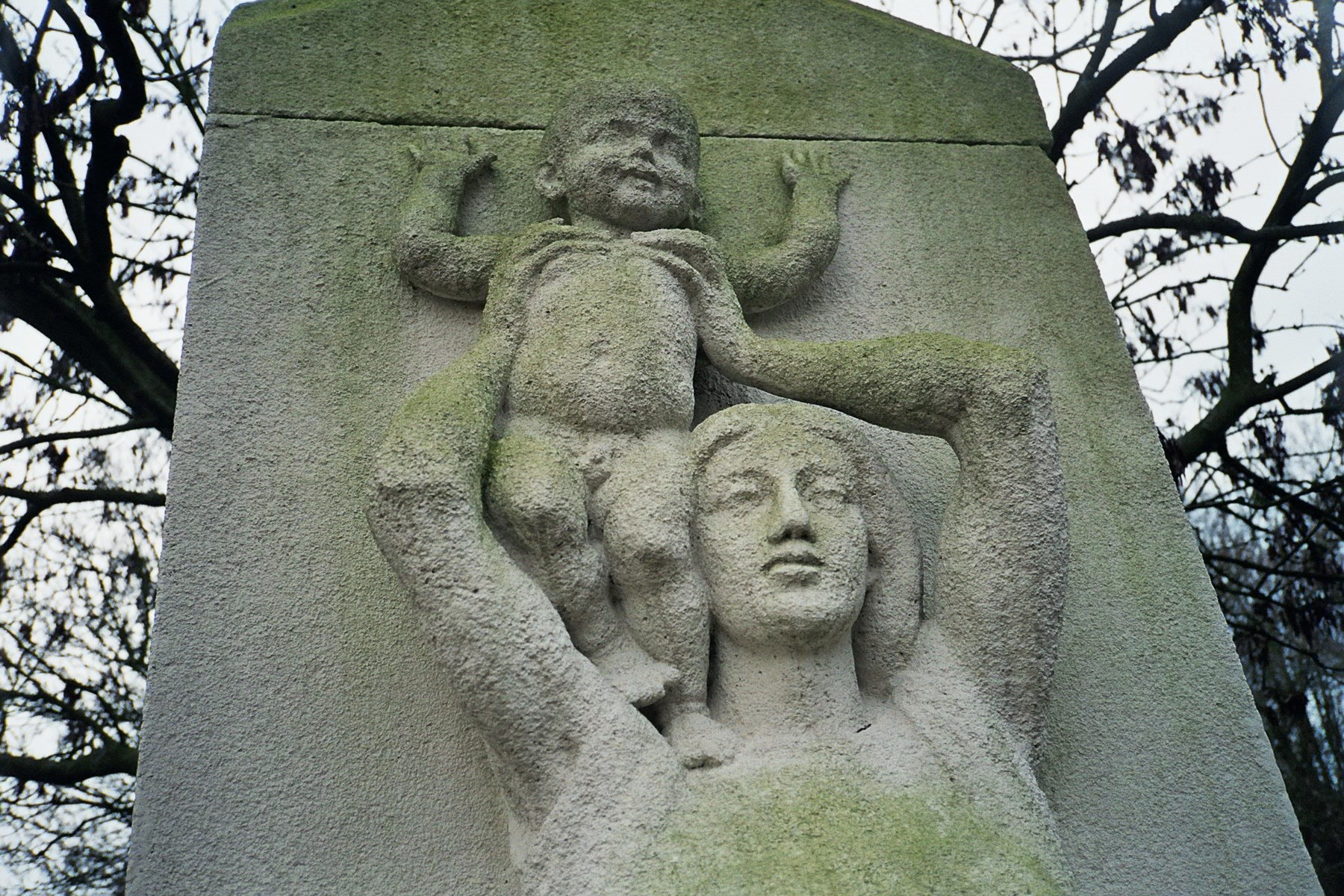
Zorgvlied
In 1994, the owner of a famous Amsterdam gay nightclub was buried at Zorgvlied under a life-sized bronze statue of himself holding a glass of beer. Manfred Langer's monument was not subtle. It was not, in fairness, meant to be. But it changed something about this cemetery on the bank of the Amstel: after Langer, other people started asking for funerary art that looked less like grief and more like a final performance. The Zorgvlied board eventually set aside a special section for monuments of extraordinary appearance or dimensions and called it, with quiet wit, Paradiso, after one of the city's better-known clubs.
A Garden for the Dead
Zorgvlied opened in 1870 on the Amsteldijk, on the left bank of the river Amstel just south of central Amsterdam. The city of Amstelveen founded it and still operates it today, even though a boundary change in 1896 placed the grounds inside Amsterdam's municipal limits. The landscape design came from Jan David Zocher, a member of the dynasty of Dutch landscape architects who imported the English garden style into the Netherlands. Curved paths, mature trees, irregular plantings: the layout makes Zorgvlied feel less like a grid of stones than a private park with names. Zocher's son Louis Paul expanded it in 1892, and further additions followed in 1900, 1919, and 1926, when upper-class Amsterdam families who had previously buried their dead at Westerveld in Driehuis began to migrate here.
The Literary and Theatrical Plot
Of Amsterdam's working cemeteries, Zorgvlied accumulated the highest concentration of Dutch celebrity, particularly from the worlds of writing and the stage. Walk the paths and the headstones read like an index of twentieth-century Dutch culture: Israël Querido, the novelist of the Amsterdam Jewish quarter, who died in 1932; Maurits Uyldert, poet and critic, 1881 to 1966; Jean Ummels, the screenwriter, who died in 2007 at fifty-one; Corry Italiaander, the actress born in 1886 whose remains were later removed, the kind of administrative footnote a long-running cemetery accumulates. Theatre directors, jazz musicians, columnists, painters. The pattern is consistent enough that local guides simply describe Zorgvlied as the cemetery where Amsterdam's artists end up, which is not quite a rule, but close.
Manfred Langer Raises a Glass
Manfred Langer arrived from Austria and built iT, a nightclub in Amsterdam that became famous in the 1980s and early 1990s as a centre of Dutch dance and queer nightlife. When he died of throat cancer in 1994, the monument he received at Zorgvlied was unlike anything the cemetery had seen before: a bronze likeness of Langer, in club clothes, holding up a beer. It was meant as celebration rather than mourning, and visitors started leaving offerings, sometimes drinks, sometimes flowers. A more controversial case followed when the visual artist Peter Giele died and his proposed monument provoked a dispute with the cemetery board. Rather than fight every flamboyant request, Zorgvlied designated a dedicated area where extraordinary funerary art could go up without limit. The Paradiso plot has grown ever since, an outdoor gallery of memorials that refuse to be quiet.
Rijksmonuments and the Routine of Visiting
Not everything at Zorgvlied is theatrical. A number of nineteenth-century family tombs and chapels are protected as national Rijksmonuments, modest neoclassical structures and weathered iron crosses set among the trees. The Amstel runs along the eastern edge of the cemetery, and from many paths you can hear sculling oars and small motorboats in the river. On weekends regulars come to visit specific graves, sometimes the same grave for decades, leaving small objects, a cigarette, a letter, a glass of jenever, and Zorgvlied is the kind of place where the cemetery staff long ago stopped pretending to disapprove. Public tours run through most of the year, and you can buy a printed map at the small office near the entrance that identifies the most-visited stones.
What the Place Asks of You
Cemeteries change personalities. Some are reverent and severe; some are tidy administrative places; some are wild and forgotten. Zorgvlied is one of the rare ones that still functions as a working civic space, with a definite Amsterdam tone. It rewards slow walking and almost no map-reading. The names along the paths are a soft education in modern Dutch culture, especially for visitors who arrive with no knowledge of who Querido or Uyldert was. And occasionally, between two perfectly conventional graves, you will round a corner and find a bronze man raising a beer at you, or a sculpture that refuses to behave, and you will remember that this is also a city that has always liked to make its private feelings public, even at the end.
From the Air
Zorgvlied is at 52.3356°N, 4.9003°E, on the Amsteldijk in southern Amsterdam where the river Amstel widens between the city centre and Amstelveen. From the air, the cemetery reads as a green rectangle of mature trees on the river's west bank, easily picked out from the surrounding sports fields and apartment blocks. Schiphol (EHAM) is roughly 10 km south-west, the natural approach for any visit. The river itself is the cleanest visual landmark: follow the Amstel south from central Amsterdam and the cemetery lies on your right, just before the boundary into Amstelveen. Best viewed at low altitude in clear daylight.