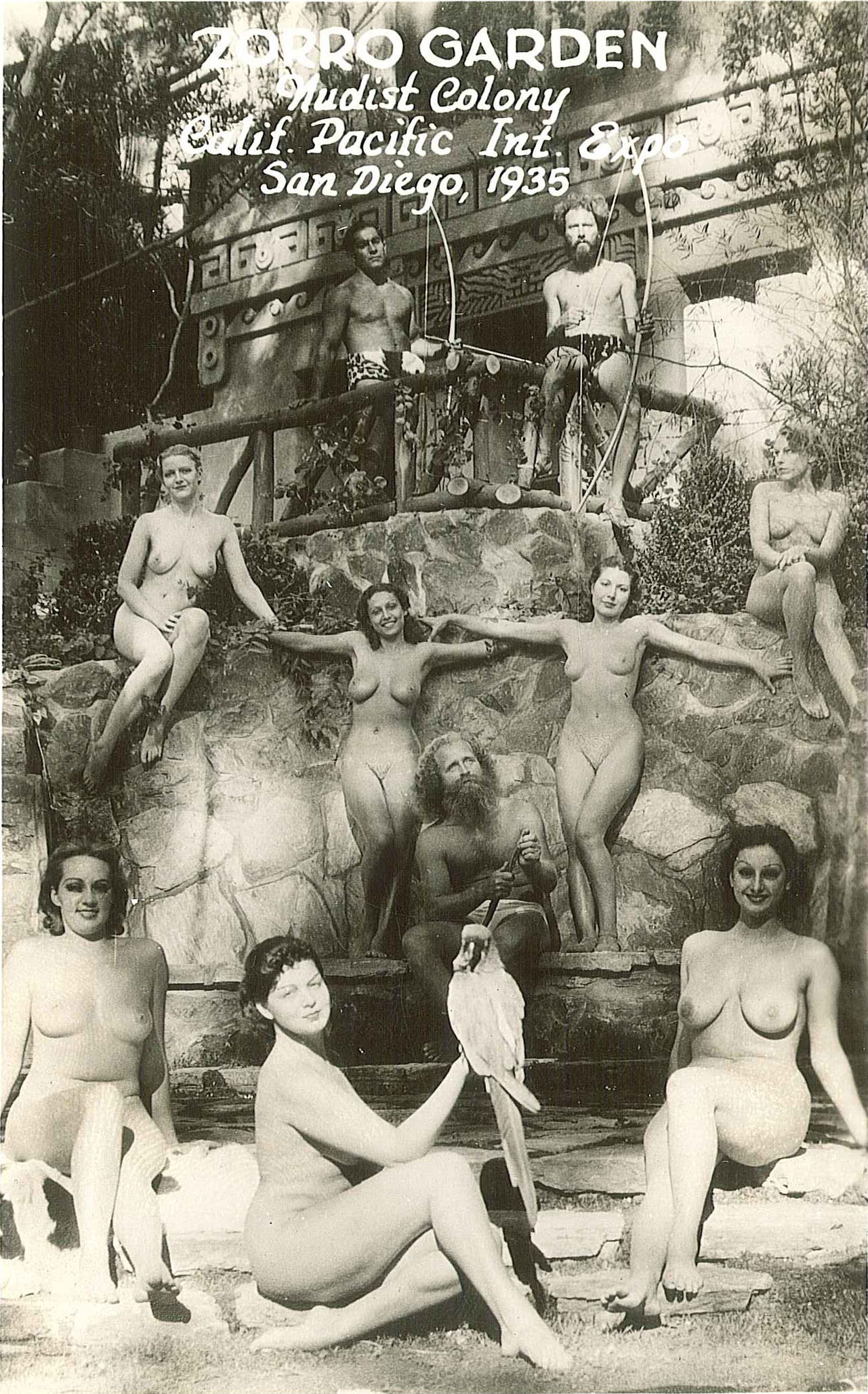
Zoro Garden Nudist Colony
The San Diego County district attorney inspected the Zoro Garden Nudist Colony the day before it opened at the 1935 California Pacific International Exposition and gave his approval. The following month, actual practicing nudists — 'amateur nudists,' as the press called them — demanded that the same district attorney investigate the performers as frauds, because the women in the colony were not, in fact, unclothed. They were wearing flesh-colored bras, G-strings, and body stockings. The district attorney declined to pursue the matter.
A Sunken Garden in Balboa Park
Zoro Garden is a sunken garden in Balboa Park, originally created for the 1915-16 Panama-California Exposition. In 1935, when the California Pacific International Exposition came to the park, the garden was converted into the site of a nudist colony attraction. The colony was 'billed' as nudist — which is to say, it was marketed and presented as a genuine naturist community — but was staffed by hired performers rather than actual practicing nudists. The women wore G-strings; the men wore loincloths or trunks. Fair attendees could pay for admission to bleacher-style seating around the sunken garden, or they could peek through knotholes in the wooden fence for free.
The Daily Program
The performers at Zoro Garden had a schedule. They lounged in their 'colony,' played volleyball and other games, and performed a quasi-religious ceremony called the 'Sacrifice to the Sun God' five times a day. Whether this ritual had any actual meaning beyond entertainment is not recorded. The entire enterprise was a theatrical production dressed as authentic naturism — a performance of transgression designed to draw paying crowds while maintaining enough deniability to satisfy civic authorities. The district attorney's pre-opening inspection was the kind of regulatory theater that matched the colony's own theatrical nature.
Objections, Overridden
Protests came from several quarters: the San Diego Council of Catholic Women, the Women's Civic Center, and, unusually, the San Diego Braille Club. The city manager announced that there would be no 'indecent' shows in Balboa Park during the second season of the exposition, which opened in February 1936. The nudist colony was there anyway. One of the female performers rode through the fairgrounds at Gold Gulch on a burro and was arrested. She was acquitted and rode again under police supervision. The colony ran through both seasons of the exposition and became one of its more discussed attractions — which was, presumably, the point.
What Remains
Zoro Garden is still in Balboa Park. The sunken garden that hosted the colony is today a butterfly garden — a quiet, shaded enclosure where native plants attract native insects. The bleacher seats are gone. The wooden fence with its knotholes is gone. The performers, the volleyball games, the Sacrifice to the Sun God — all gone. What the garden looked like in 1935, with crowds pressing against its fences to catch a glimpse of performers lounging in an approximation of nudism, is now genuinely difficult to picture in the same space where monarchs and swallowtails drift among the plantings. The exposition itself lasted two years. The garden has lasted longer.
From the Air
Located at 32.731°N, 117.148°W in Balboa Park, within the central cultural complex near the Spreckels Organ Pavilion. The sunken garden is small and not distinctly visible from altitude, but the broader Balboa Park landscape — its Spanish Colonial buildings, its central mesa, its surrounding canyons — is one of San Diego's most recognizable aerial features. San Diego International Airport (KSAN) lies approximately 2 miles to the northwest.