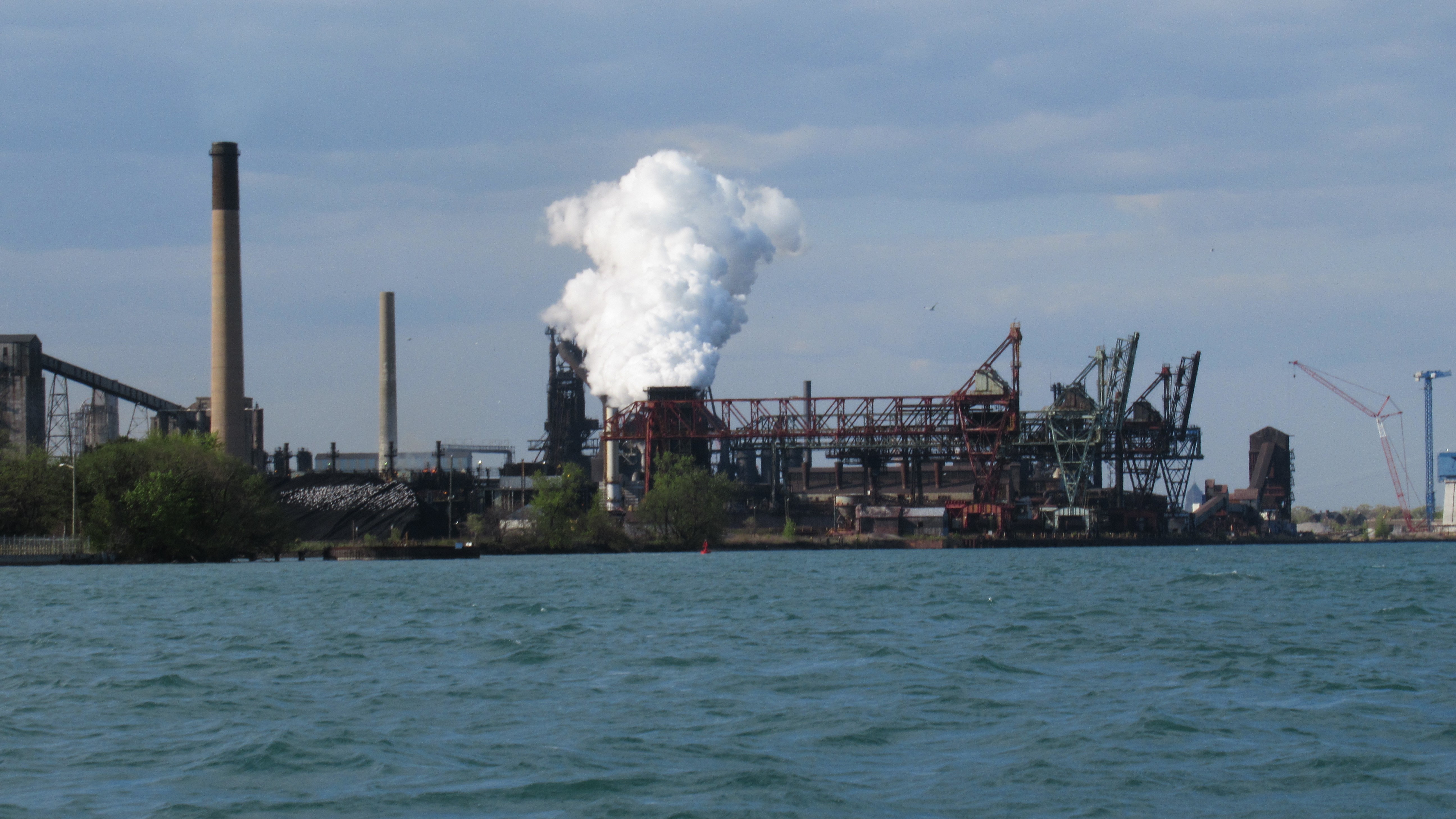
Zug Island: The Forbidden Furnace That Hummed Across the Border
For years, residents of Windsor, Ontario, complained of a deep, rhythmic vibration shaking their homes. The sound was so persistent and so maddening that the Canadian government spent over a million dollars trying to find its source. Scientists deployed pentangular microphone arrays. Ontario's Ministry of Natural Resources launched formal investigations. The culprit, everyone suspected, was a small island in the Detroit River that no one was allowed to visit, where cameras were prohibited, and where blast furnaces had been melting iron since 1902. They called it 'The Hum,' and it plagued hundreds of people until April 2020, when U.S. Steel shut down operations on Zug Island and the vibrations finally stopped.
Iron Since 1902
The Detroit Iron and Steel Company built the first blast furnace on Zug Island in 1902. The M.A. Hanna Company of Cleveland purchased the works in 1904 and added a second furnace in 1909. At that time, the island's two furnaces were reportedly the largest of their kind in the world, producing pig iron for foundry companies across the region. The operation expanded steadily through the early 20th century, becoming part of the Great Lakes Steel Corporation in late 1931 as a key component of a fully integrated steel mill within the larger National Steel Corporation. A third blast furnace was added in early 1938. For decades, thousands of workers crossed the bridge to the island each day, and a large percentage of the downriver communities of River Rouge and Ecorse depended on the steel producer for their livelihoods. Ships fed ore docks along the north and east shores while coal, coke, and ore storage fields covered the south and west.
The Edmund Fitzgerald's Last Cargo
On November 10, 1975, the SS Edmund Fitzgerald sank in Lake Superior during a ferocious storm, killing all 29 crew members. It became the most famous shipwreck in Great Lakes history, immortalized by Gordon Lightfoot's ballad. What is less commonly known is where the Fitzgerald was headed: the massive ore freighter was laden with 26,116 tons of taconite pellets destined for Zug Island's blast furnaces. The cargo that went to the bottom of Lake Superior was meant to become molten iron in the furnaces visible from the Detroit River. This connection ties Zug Island to one of the defining tragedies of Great Lakes maritime history, linking the island's industrial appetite to the dangerous work of the ore boats that fed it.
The Windsor Hum
In 2011, Canadian scientists and Ontario's Ministry of Natural Resources identified the Zug Island area as the probable source of mysterious rumblings felt across the border in Windsor. Residents described cyclical vibrations that could be felt in the ground up to fifty miles away. The city of River Rouge eventually reported it could not afford to spend any more money investigating, claiming its council had already spent over a million dollars helping Windsor and Ontario trace the noise. A 2013 Canadian study using sound-level meters and a portable pentangular array of cameras and microphones attempted to pinpoint the exact source. When the results were released in May 2014, the findings actually stated that 'the most probable source of the Hum points well to the South of Zug Island,' and that the bulk of observations did not support the hypothesis that the Hum emanated from the island. Regardless of the scientific ambiguity, reports of the Hum ceased entirely when U.S. Steel's operations on Zug Island shut down in April 2020.
Falcons on the Cranes
Despite being one of the most heavily industrialized patches of land in Michigan, Zug Island harbors unexpected wildlife. Peregrine falcons, once endangered, nest on the massive gantry cranes at the ore docks, hunting from the steel girders that tower over the river. Foxes roam the undeveloped strips along the south and west shores. Beneath the surface of the Detroit River, a man-made bed of coal cinders serves as a rare spawning site for lake sturgeon, a threatened species that has adapted to the industrial sediment. The neighborhoods surrounding the island tell a grimmer ecological story: according to the Detroit Free Press, the zip codes around Zug Island include six of the ten most polluted in Michigan, with residents reporting air quality samples containing lead, high levels of methyl ethyl ketone, and 'sparkly' dust.
The Island Nobody Enters
Zug Island remains off-limits to the public. Cameras are prohibited on the premises, making photographs of its interior genuinely rare. This secrecy has fueled urban legends: one persistent story claims the island houses a prison, though no such facility has ever existed there. Another claims scenes from the 1987 film RoboCop were shot on the island. U.S. Steel announced in December 2019 that it would idle all Zug Island operations by April 2020. Primary steelmaking shut down on schedule, and the hot strip mill followed in June. By January 2021, around 500 employees remained at reduced operations. The island that once employed thousands and hummed loud enough to rattle windows in another country now sits largely quiet, its blast furnaces cold, its cranes still, its future uncertain.
From the Air
Located at 42.283°N, 83.111°W at the confluence of the Rouge River and the Detroit River, approximately 5 miles south-southwest of downtown Detroit. The island is clearly visible from altitude as a distinct industrial landmass connected to the mainland by bridges, with large ore docks, storage fields, and blast furnace structures. Nearest airports: Detroit Metropolitan Wayne County Airport (KDTW, 14 miles southwest), Detroit City Airport/Coleman A. Young International (KDET, 8 miles northeast). The Ambassador Bridge and Canadian border at Windsor, Ontario are 3 miles to the north. Best viewed at 2,000-4,000 feet AGL. The contrast between the industrial island and the residential neighborhoods of River Rouge and Ecorse immediately adjacent is striking from above.