Zuiderkerk (Enkhuizen)
The old village of Oostdorp lay outside the protective ring of the West Frisian dyke, and one day in the early 1400s the sea came in and took it. The villagers walked east into Enkhuizen carrying what they could carry, including the right to build a new church. In 1422 John III, Duke of Bavaria, granted them permission to dismantle what remained of their drowned parish and start over. They chose a patch of reed beds. They had to raise the ground before they could lay the stones - and a chronicler later noted that the walls rose as high above the new earth as the foundations sank below it. The result is the Zuiderkerk of Enkhuizen, dedicated to Saint Pancras, and it still dominates the skyline of one of the great Zuiderzee port towns.
The Reformer and the Pastor
In 1555, the pulpit went to a man whose name is largely forgotten outside Dutch ecclesiastical history but whose nickname is not. Cornelis Cooltuyn became pastor of the Zuiderkerk - the larger congregation in Enkhuizen - while Balthazar Platander, still loyal to Rome, served the city's smaller Westerkerk. Cooltuyn is remembered, when he is remembered, as the 'father of the Dutch Reformation', a man who preached an early version of the Protestant message before the country was ready for it. The reckoning came quickly. By 1557 his orthodoxy had been questioned by the authorities, and he was forced to leave Enkhuizen and find a new pulpit in Alkmaar. The Reformation he had argued for arrived anyway, two decades later, and rolled across Holland with iconoclastic fury. The Zuiderkerk passed into Protestant hands and has remained Protestant ever since.
The Hidden Vault Paintings
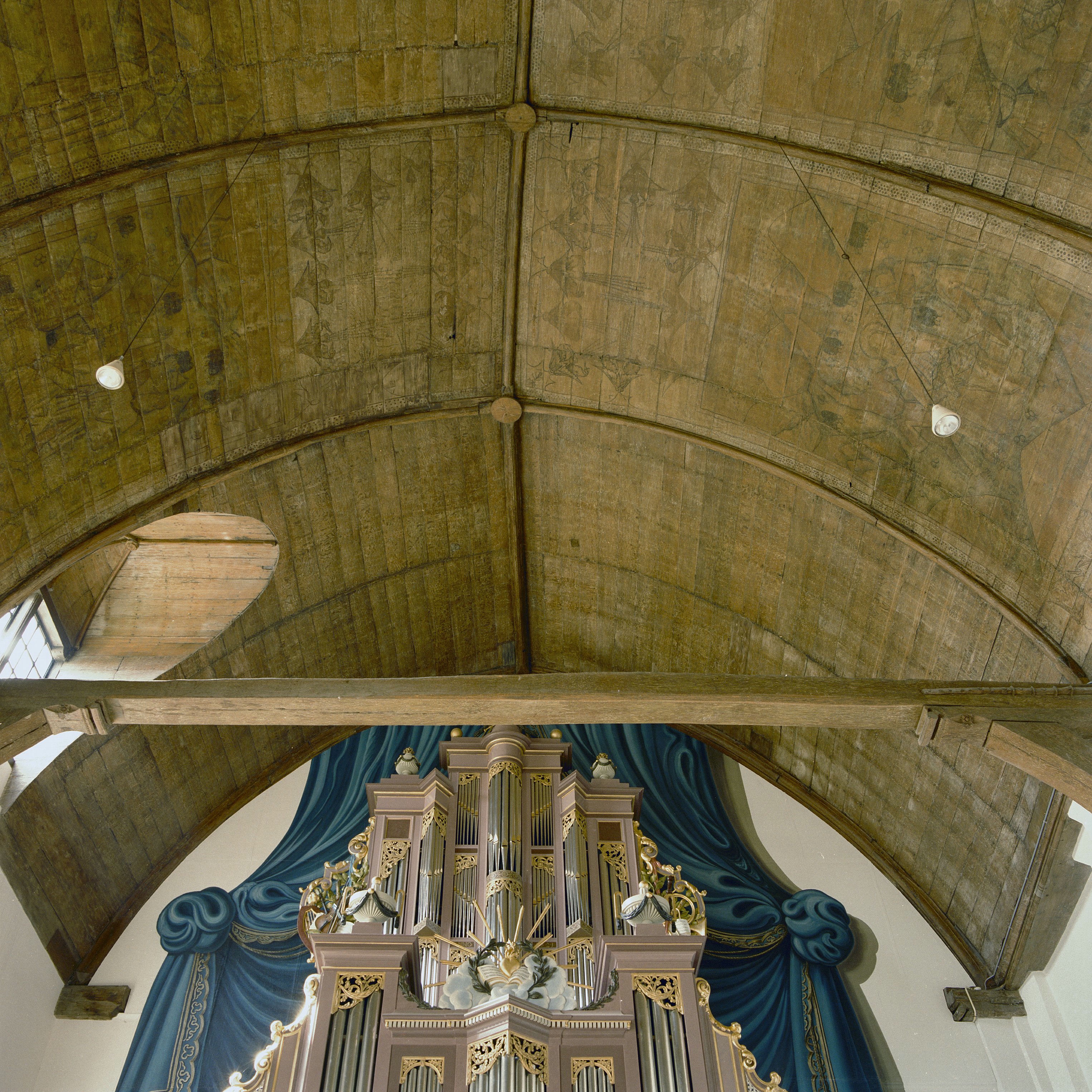
Look up. In 1484 a painter or workshop covered the vaults of the Zuiderkerk with biblical scenes - the kind of pictorial gospel that gave illiterate worshippers the stories of their faith in colour and gesture above the rafters. When the church became Protestant in 1609, the new congregation considered the paintings idolatrous and had them whitewashed. There they slept for more than three centuries, sealed under the puritan paint. In the twentieth century, restorers picking carefully at the vaults rediscovered the medieval images and uncovered them again. The colours are softer than they were, and some of the panels remain incomplete, but the originals are back where they began. To stand in the nave and tilt your head back is to look up at four centuries of theological argument frozen on the ceiling - made, hidden, made visible again.
Salvator and the Hemonys
Two bells live in the Zuiderkerk's tower, and they have stories. The larger, tuned to C, was cast in 1509 by Geert van Wou - the most celebrated bell-founder of the medieval Low Countries. Its Latin inscription reads SALVATOR IS MYN NAEM, MYN GHELUIT SY GODE BEQUAEM - 'Saviour is my name, may my sound please the Lord' - and it has been ringing for more than five hundred years. Cast originally for Enkhuizen's other church, the Westerkerk, it was moved to the Zuiderkerk in 1653 and connected to the carillon. The smaller bell, tuned to A, came in 1648 from the workshop of Pieter and François Hemony, the brothers from Lorraine who effectively invented the modern, in-tune carillon and based their workshop in the Dutch Republic. Until 1936 the Hemony bell doubled as the town fire alarm. The Hemony brothers also cast the carillon proper - 52 bells when it was new, 54 now, with around 20 of the originals from before 1800 still hanging. The carillon is tuned to meantone temperament, the standard of the 17th century, and on a quiet morning it sounds like nothing else in Europe.
The Organ That Climbed Back to 1799
The organ in the Zuiderkerk has been growing in place for more than four centuries. Fragments of its 16th-century pipework still sit inside the case. Work was done in 1593. The major rebuild came in 1621, when the casing was constructed - the carved wooden housing the organ has worn ever since. Johannes Duyschot added a three-register pedalboard in 1688. Pieter de Nicolo expanded the casing in 1737. The famous Northern Dutch organ builder Heinrich Hermann Freytag oversaw a substantial renovation in 1799, after which the instrument essentially froze - until between 1988 and 1990 the Flentrop firm of Zaandam restored it not to its current state, but to its 1799 condition. The reasoning is itself a piece of history: nineteenth-century alterations had pulled the organ in directions that didn't suit its bones. The Flentrop restorers gave the Zuiderkerk back the organ Freytag intended.
Enkhuizen from the Tower's Shadow
The Zuiderkerk's tower is owned by the city, not the parish - a Dutch peculiarity that means the municipality maintains the masonry while the congregation worships beneath it. The most recent restoration was completed in 1992; in 2024 the church secured a 16,500-euro provincial subsidy from North Holland for further work. The tower still defines the cityscape: rise above Enkhuizen by air or by inland sea and the Zuiderkerk and the Westerkerk pin the old port between them, with the IJsselmeer stretching out east. The town below was once one of the wealthiest in the Republic, an outpost of the VOC, a herring port, a centre of West Frisian power. Some of that wealth paid for the Hemonys' bronze. Some paid for Geert van Wou's bell. The drowned village of Oostdorp paid for the building itself, in a long arc of consequence that began with a flood and ended in stone.
From the Air
Coordinates: 52.7036°N, 5.2926°E. Located in central Enkhuizen on the western shore of the IJsselmeer (the former Zuiderzee), North Holland. From above the Zuiderkerk's hall-church silhouette and tower stand to the south of Enkhuizen's old harbour, with the larger Westerkerk visible to the northwest. Nearest airports: Schiphol (EHAM) about 50 km southwest, Lelystad (EHLE) about 25 km south across the IJsselmeer. Best appreciated from low cruise over the IJsselmeer in clear conditions.