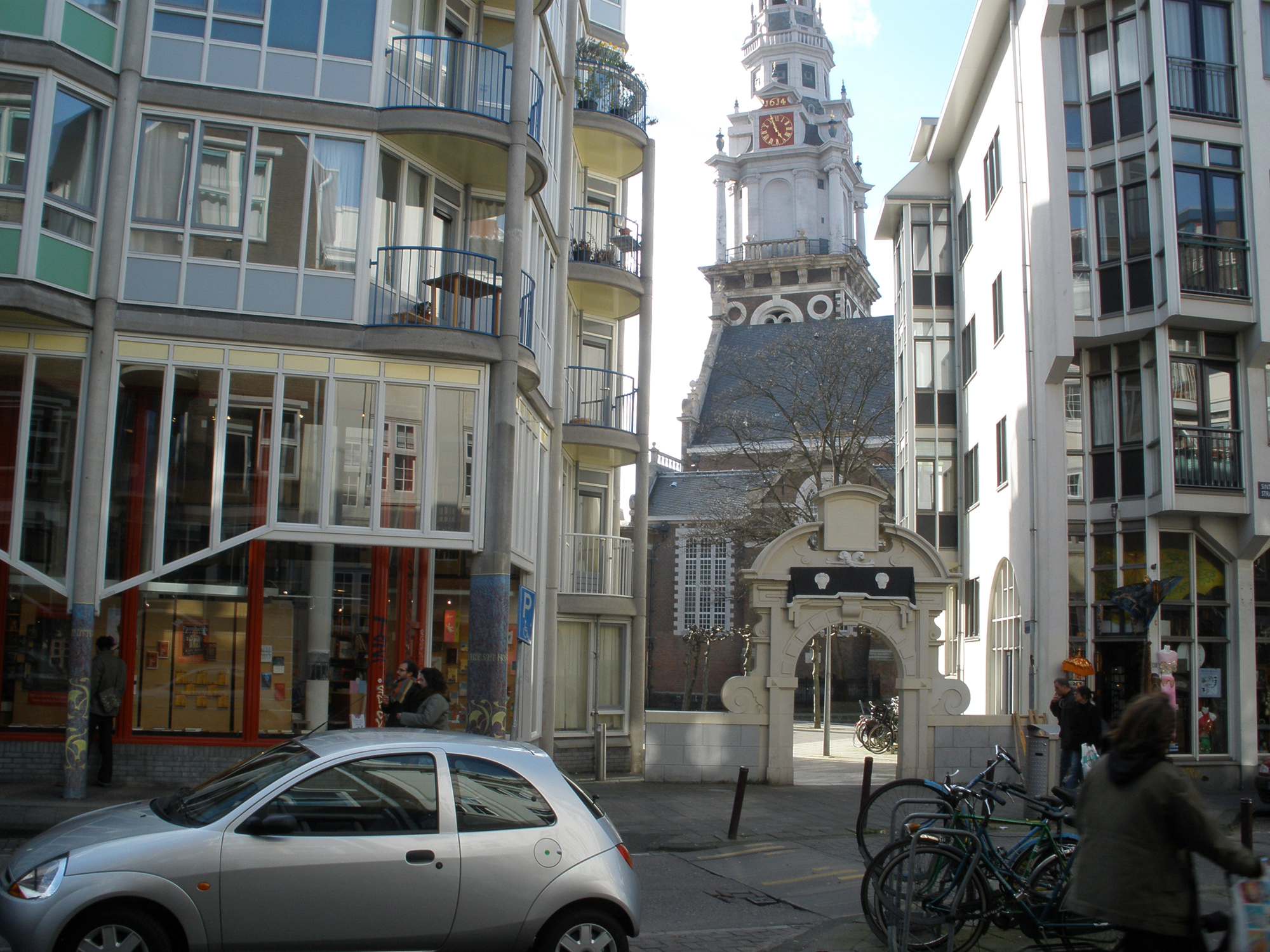
Zuiderkerk
Claude Monet stood on the Groenburgwal canal in 1874 and painted what he saw - a slim octagonal tower lifting above the water, blocky reflections of houses set down in yellow brushstrokes with no detail, an Amsterdam reduced to colour and light. The painting hangs in the Philadelphia Museum of Art now, and the tower he painted is still here. It is the Zuiderkerk, the Southern Church, finished in 1611 by Hendrick de Keyser. It was the first church in Amsterdam built from the ground up for Protestant worship - and almost from the day it opened, it became one of the most familiar shapes in the city skyline.
A New Style for a New Church
Before the Zuiderkerk, Amsterdam Protestants had been worshipping in former Catholic churches - buildings stripped of their altars, statues, and saints, but still shaped by medieval Catholic intent. The Zuiderkerk was different. Hendrick de Keyser designed it as a pseudo-basilica with a central nave and two lower side aisles, six bays long, with Tuscan columns and timber barrel vaults overhead. The plan was Gothic in spirit but the detailing was new - what the Dutch came to call Amsterdam Renaissance, a synthesis of northern proportions and Italian classical ornament. Construction began in 1603; the main building was finished by 1611. The tower took longer - it was not completed until 1614 - but when it was done it gave Amsterdam something it had not had before: a spire designed by Protestants, for Protestants, looming over a Protestant city. De Keyser himself died in 1621 and was buried in the church he had drawn.
Rembrandt's Quarter
Rembrandt van Rijn lived a few hundred metres away on the Jodenbreestraat, in the house that is now the Rembrandt House Museum. The Zuiderkerk was his neighbourhood church, and three of his children are buried inside it. Rembrandt outlived them all. Ferdinand Bol, one of his most accomplished pupils, was buried here in 1680. Look at Rembrandt's drawings of Amsterdam and the Zuiderkerk's tower appears in the background again and again - he sketched it from canals, from rooftops, from across the IJ. It was the visible centre of the city he lived in, the shape on the horizon for the artists who walked these streets.
Bells from the Hemonys
In 1656 the tower received its voice. The brothers Pieter and François Hemony, the great bell-founders of the 17th-century Low Countries, cast a carillon for the Zuiderkerk along with four large bells that still ring monthly. The Hemonys had figured out something the rest of Europe had not: how to tune bells so that their overtones harmonised, producing chords rather than the dissonant clangour that older carillons threw out. Their bells defined the sound of Dutch cities for generations - the Zuiderkerk's spire was one of their early platforms, and the carillon they hung here has rung over Amsterdam for nearly four centuries.
The Hunger Winter
Church services in the Zuiderkerk stopped in 1929. The building stayed standing but unused, slowly going to ruin. Then came the final winter of the Second World War. In the western Netherlands, German occupation authorities cut off food shipments after a Dutch rail strike, and what the Dutch now call the hongerwinter set in - the hunger winter of 1944 to 1945. People starved. Tulip bulbs were eaten. In Amsterdam, the bodies of the dead piled up faster than they could be buried, and the closed-up Zuiderkerk was reopened as a temporary morgue. The church that had been built to celebrate Protestant worship became the place where Amsterdam laid out the people it could not save. By the time the Allies arrived in May 1945, approximately twenty thousand had died of starvation across the western Netherlands — historians estimate between eighteen and twenty-two thousand. The Zuiderkerk's role in that winter is one of the quiet, unpleasant facts the building carries.
The Long Afterlife
The Zuiderkerk was closed in 1970 because it was on the point of collapse, then restored carefully between 1976 and 1979. Since 1988 it has served as a municipal information centre for the city, hosting rotating exhibitions on housing and urban planning - a city talking to its citizens inside the building that used to mediate between the city and God. The carillon still plays. Tourists climb the tower for a view that takes in the canal rings, the IJ, and the rooftops Rembrandt knew. And when Monet's painting is occasionally lent back to Amsterdam, visitors can stand on the Groenburgwal at the same angle the French painter chose, and check his colours against the real spire still rising at the end of the canal.
From the Air
Coordinates 52.370 N, 4.900 E. The Zuiderkerk's tower rises just east of Amsterdam's central canal ring, near the Nieuwmarkt and a short walk from Rembrandt's house on the Jodenbreestraat. The spire - a square stone base, an octagonal sandstone middle section with corner columns, a wooden lead-covered top - is one of the most distinctive in the central skyline. Recommended viewing altitude 1000-2000 feet AGL. Nearest airport: Amsterdam Schiphol (EHAM), 12 km southwest. Best light is the low evening sun that Monet caught from the Groenburgwal.