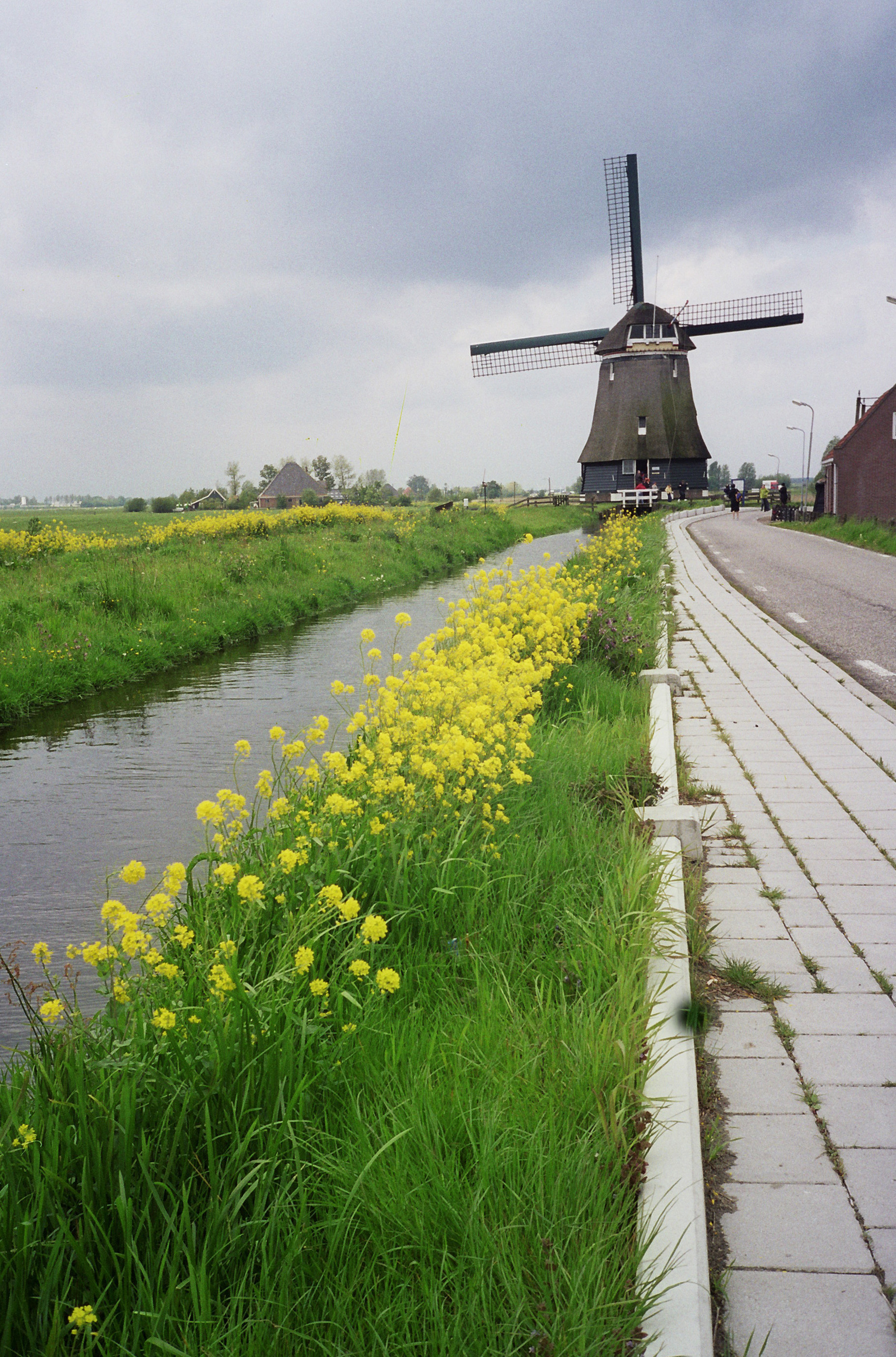
Zuidpoldermolen, Edam
Stand on the south side of Edam and look across the flat green fields and you are looking at a polder - land that used to be water, kept dry only because someone made it so and someone else maintains it now. The Zuidpoldermolen, the South Polder Mill, sits at the edge of that bargain. Its thatched octagonal body and slow-turning sails were the engineering that made the fields possible. Built sometime between 1626 and 1635, it is older than most of the buildings in the town it serves and older than the country called the Netherlands in its modern form.
The Bargain with Water
Edam grew up on a dam built across the small River E in the 12th century, by farmers who were tired of the North Sea ruining their crops. The town's name is literally a contraction of that origin: E-dam. From the start, life here meant moving water - not metaphorically, not occasionally, but every day, with the wind that blew in off the Zuiderzee. The land sits below sea level. Without active drainage, it floods. Without continuous wind power, in the 17th century, there was no agriculture and no town. The Zuidpoldermolen was one of dozens of such mills along this coast, each assigned a piece of the work.
An Octagon, Thatched
The mill is what Dutch millers call a binnenkruier - an internal-turning smock mill. The body is an octagonal wooden frame, sheathed in thatch on its sloping sides, with a rotating cap on top that carries the sails. "Smock" is an English term for the shape, which is said to resemble a peasant's smock hanging on a frame. The thatch is not decoration - it sheds rain, insulates the wooden gears against rot, and breathes in a way that painted boards do not. The whole machine, sails to scoop, was built to convert wind into a single useful motion: lifting water from the polder, a few inches at a time, up over the dike and out.
How It Worked
Inside, the sails turn a horizontal shaft, which through a series of gears drives a vertical shaft running down the center of the building. At the bottom, that shaft turns a scoop wheel - a paddle wheel set in a channel - that lifted water from the lower polder ditches into the higher discharge canal. From there, it drained out to the Zuiderzee. The miller's job was to read the wind, set the sails to it, and feather them back when storms threatened. It was skilled, dangerous work. Sails turning unchecked in a high wind could tear the whole cap apart. The miller's family typically lived in the mill itself, in the cramped warm rooms below the running gear.
Steam and the Slow Goodbye
The Zuidpoldermolen did its work alone, more or less, for two and a half centuries. Then the math changed. In 1875, a steam-powered screw pump was installed to supplement the windmill - more reliable than wind, faster, indifferent to calm afternoons. By the 20th century, electric pumps had replaced steam, and the wind-driven mechanics here finally fell silent in 1949. The mill itself survived because someone decided it should. The Dutch Windmill Society - De Hollandsche Molen - now owns it. The building is closed to the public, but it remains in place, sails intact, body thatched, exactly where it has stood since the reign of the early Dutch Republic.
What It Means to Keep It
There are more windmills in the Netherlands than in any other country, and most of them, like the Zuidpoldermolen, no longer pump anything. They are kept because they say something the modern country still believes about itself: that the land underfoot is not natural but made, and that the making was hard, slow, and collective. Edam is famous for its cheese. The cheese exists because the cows have grass. The grass exists because the polder is dry. The polder is dry because mills like this one moved water for three hundred years. Pull on any thread of life here and you arrive, eventually, at a wooden octagon turning slowly in the wind.
From the Air
The Zuidpoldermolen stands on the southern edge of Edam at 52.51N, 5.06E. Amsterdam Schiphol (EHAM) lies 25 km southwest, Lelystad (EHLE) is 30 km east across the IJsselmeer. From altitude, look for the dense old core of Edam with its star-shaped polder ditches radiating south; the mill reads as a small thatched cone at the polder's edge.