Zuigan-ji
Somewhere inside Zuigan-ji, behind the 161 paintings on gold-leaf sliding doors, past the Momoyama-era woodwork brought from a thousand kilometers away, there is a room called the Kamijodan no Ma. It contains a raised platform. According to one theory, Date Masamune -- the one-eyed lord of Sendai Domain -- built that room so the Emperor could place his throne there, once Masamune overthrew the Tokugawa shogunate. He never did. The shogunate outlasted him by two centuries. But the room remains, and so does the temple he lavished five years and vast resources rebuilding between 1604 and 1609: a Zen monastery that doubles as a monument to unchecked ambition, set among the pine-covered islands of Matsushima Bay.
A Founding That Never Was
Zuigan-ji claims an origin date of 828, ordered into existence by Emperor Junna and established by the monk Jikaku Daishi during the Heian period. The story appears in the Tendai-ki, a chronicle written centuries later during the Nanboku-cho period. It is a compelling foundation myth. It is also almost certainly false. Archaeological excavations at the temple site have revealed that during the Heian period, this particular patch of Matsushima was occupied by a salt furnace -- an industrial operation incompatible with monastic life. Whatever temple Jikaku Daishi may have founded in the region, the evidence says it was not here. The Tendai-ki also claims patronage by the Northern Fujiwara clan and describes meetings between Zuigan-ji priests and legendary figures like Minamoto no Yoshitsune, but these too rely on sources written long after the fact.
Converted at Swordpoint
In the Kamakura period, the temple underwent a transformation that both Tendai and Zen records describe in unusually dramatic terms. Under the authority of regent Hojo Tokimune, Zuigan-ji was converted from a Tendai sect temple to Rinzai Zen, with the Chinese-born monk Rankei Doryu installed as head priest. The conversion was not peaceful. According to the historical accounts, it involved military force and the violent expulsion of the Tendai monks who had occupied the temple. The new Zen establishment earned ranking among the Kanto Jissetsu -- the ten most important Zen temples in the Kanto region. But fire eventually consumed the buildings, and by the end of the Sengoku period of civil war, Zuigan-ji lay in ruins. It would take a warlord with extraordinary resources and even more extraordinary ambitions to bring it back.
Masamune's Grand Reconstruction
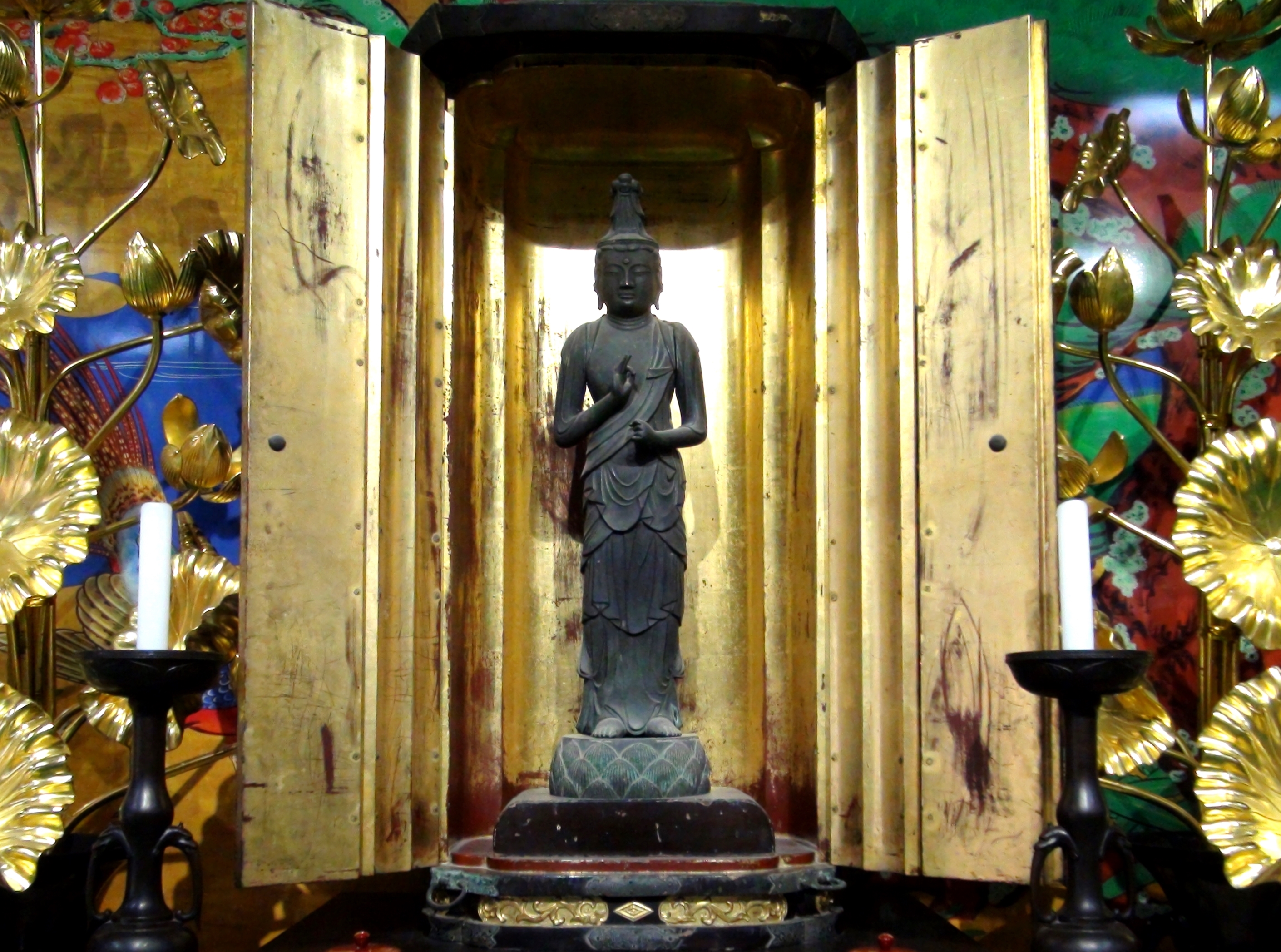
Date Masamune was not a man who did things modestly. When he decided to rebuild Zuigan-ji beginning in 1604, he imported lumber from Mount Kumano in distant Wakayama Prefecture and brought skilled craftsmen from Kyoto and Kii Province. The reconstruction took five years and produced buildings in the flamboyant Momoyama style -- rich with gold-leaf fusuma paintings, ornate carvings, and a Main Hall that would be designated a National Treasure in 1953. The 161 sliding door paintings that survive in the Main Hall depict scenes on gold backgrounds with raised motifs floating on golden clouds. The temple also houses hidden Buddha statues -- hibutsu -- that are revealed to the public only once every 33 years. Carved from single blocks of keyaki wood during the Heian period, these five figures include a seated Fudo Myoo with wide-open eyes and seven ties in his pigtail.
Survival and Sacred Ground
The Meiji Restoration stripped the temple of most of its territory and income, and many buildings crumbled beyond saving. But Zuigan-ji endured. The Crown Prince visited in 1918; Emperor Hirohito came in 1947. A museum opened in 1974 to house approximately 30,000 artifacts, including objects unearthed during excavations. Major repairs ran from 2008 to 2018. When the 2011 Tohoku earthquake and tsunami struck, the same Matsushima Bay islands that inspired centuries of poetry also broke the wave's force, sparing the temple from severe structural damage -- though the gardens sustained some harm. Today, Zuigan-ji sits five minutes on foot from Matsushima-Kaigan Station, its gate opening onto a cedar-lined path. Each November, the Basho Festival commemorates the haiku poet's 1689 visit, connecting the temple to the literary pilgrimage that helped make Matsushima famous.
From the Air
Located at 38.37N, 141.06E in the town of Matsushima, Miyagi Prefecture, on the shore of Matsushima Bay. The temple compound is set back slightly from the waterfront and is not individually distinguishable from altitude, but the bay with its 260 islands is unmistakable. Nearest major airport: Sendai Airport (RJSS), approximately 20nm south. The temple lies roughly 14km northeast of Sendai city center along the JR Senseki Line rail corridor. Approach from the east over the Pacific for the best view of the island-studded bay. The cedar-lined temple grounds are adjacent to the waterfront promenade and ferry pier.