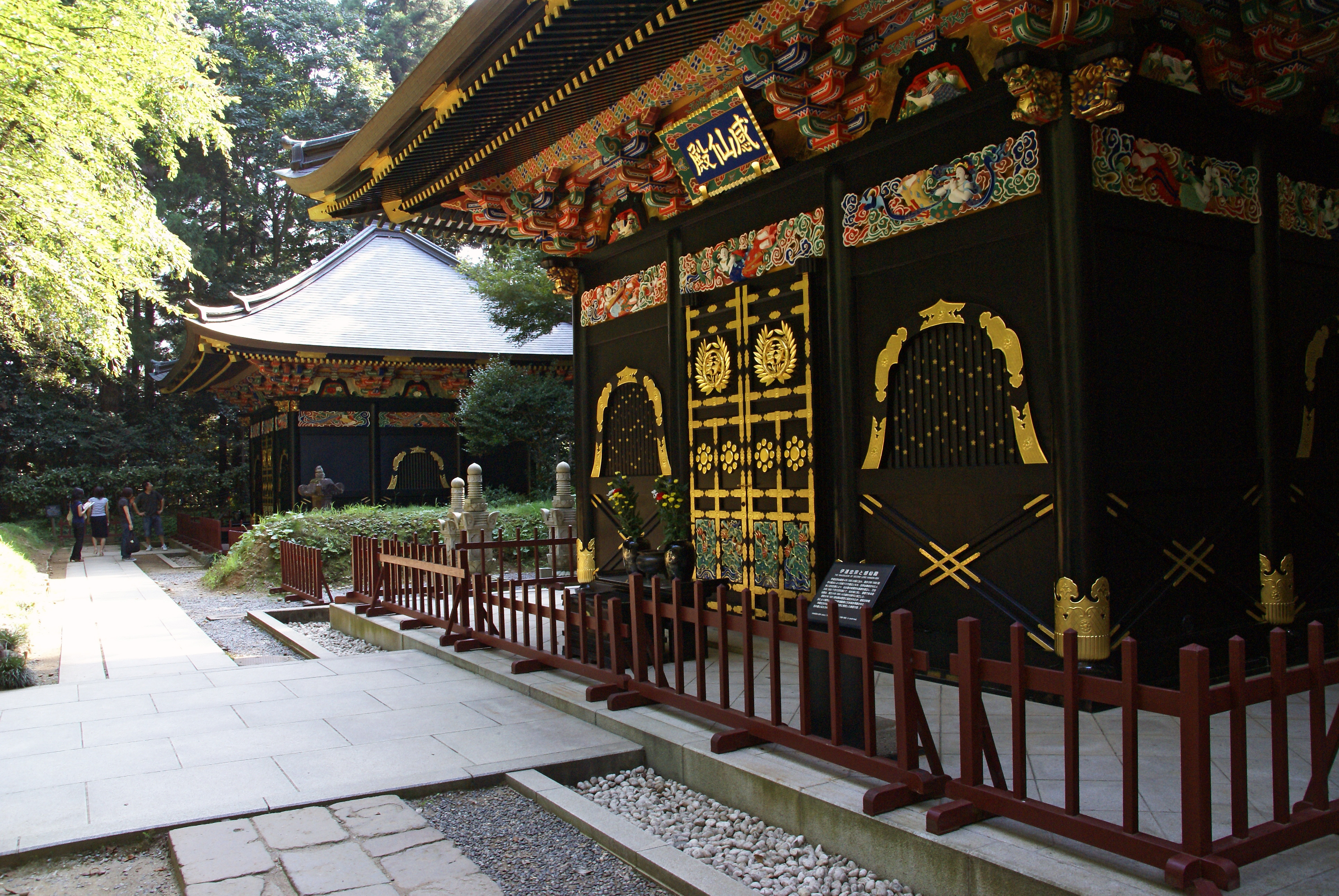
Zuihoden
Smallpox took the sight in his right eye when he was a child, but Date Masamune saw further than most men of his age. The warlord who would earn the nickname 'One-Eyed Dragon' built the city of Sendai from a fishing village, dispatched a diplomatic mission to the Pope in Rome, and ruled a domain ranked third in all of Japan for its wealth. When he died in 1636, he left instructions for a mausoleum befitting that vision. Zuihoden, erected the following year on a wooded hillside in Sendai, is that final statement, a blaze of gold, lacquer, and carved phoenixes rendered in the ornate Momoyama style that defined Japan's most exuberant artistic era.
The Dragon's Domain
Date Masamune was born in 1567 into one of northern Japan's most powerful clans, and by the time he was seventeen he had assumed leadership of the Date family. Childhood illness cost him his right eye, but his ambitions were boundless. After allying with Tokugawa Ieyasu at the decisive Battle of Sekigahara in 1600, Masamune was awarded the lordship of the Sendai Domain, which would grow to a value of 620,000 koku, making it the third wealthiest domain in Japan. In 1604, he arrived in what was then a small coastal settlement with 52,000 vassals and their families, and set about transforming it into one of the country's great cities. Masamune's vision extended far beyond military strength. He fostered culture, trade, and agriculture, and in 1613 sent his retainer Hasekura Tsunenaga on a seven-year diplomatic voyage to Spain and Rome, one of the first Japanese missions to reach Europe.
Carved in Gold and Fire
Zuihoden was completed in 1637, one year after Masamune's death at the age of 68. Built in the Momoyama style, which flourished in the late sixteenth century and prized bold color and intricate ornamentation, the mausoleum was a riot of carved phoenixes, floating celestial beings, and shishi lion-dogs, all set against a palette of vermilion, gold, and deep lacquer. The structure was so prized that it was designated a National Treasure in 1931. But history had other plans. On July 10, 1945, American firebombing raids devastated Sendai, and Zuihoden burned along with much of the city. For more than three decades, the mausoleum existed only in photographs and memory. In 1979, after extensive archaeological excavation of the original site, Zuihoden was painstakingly reconstructed. During the excavation, Masamune's remains were recovered and studied, confirming details of his physical appearance, including evidence of his lost eye.
Momoyama Reborn
The 1979 reconstruction faithfully reproduced the lavish ornamentation of the original, but further refinements came in 2001. That year, to commemorate the 400th anniversary of Sendai's founding, the mausoleum underwent major renovations that restored the pillar carvings and roof tiles to even greater accuracy. Today, the complex sits among tall cedar trees on Kyogamine Hill, above the Hirose River. Stone steps lead visitors upward through filtered light to the mausoleum's entrance, where the explosion of color and craftsmanship comes as a deliberate shock against the green quiet of the surrounding forest. Masamune's son Tadamune and grandson Tsunamune are entombed in smaller mausoleums nearby, each designed in the same Momoyama style. Together the three structures form a generational portrait of the Date clan's power and aesthetic sensibility.
The Date Legacy in Sendai
The Date clan ruled the Sendai Domain for the entire Edo period, from Masamune's arrival in 1604 until the Meiji Restoration of 1868. Their patronage shaped the city's temples, shrines, and cultural institutions, including the nearby Shiogama Shrine, one of the most important Shinto sites in the Tohoku region. Zuihoden remains the emotional center of Sendai's relationship with its founding family. Each year, the site draws visitors who come to stand before the rebuilt mausoleum and contemplate the ambition of a one-eyed warlord who turned a backwater into a metropolis. The surrounding grounds include a small museum displaying artifacts recovered during the 1979 excavation, including fragments of the original mausoleum's decoration. The forest around the site, largely unchanged in character since the Edo period, offers a rare pocket of stillness in a modern city of over a million people.
From the Air
Zuihoden sits on Kyogamine Hill in central Sendai at 38.251N, 140.866E, on the south bank of the Hirose River. The forested hillside is visible from low altitude as a patch of dense green amid the urban grid. Sendai Airport (RJSS) is approximately 18 km south. The mausoleum is near Sendai's Aoba Castle ruins, which occupy a prominent hilltop to the northwest. Best viewed at 2,000-4,000 feet for the contrast between the wooded shrine grounds and the surrounding city.