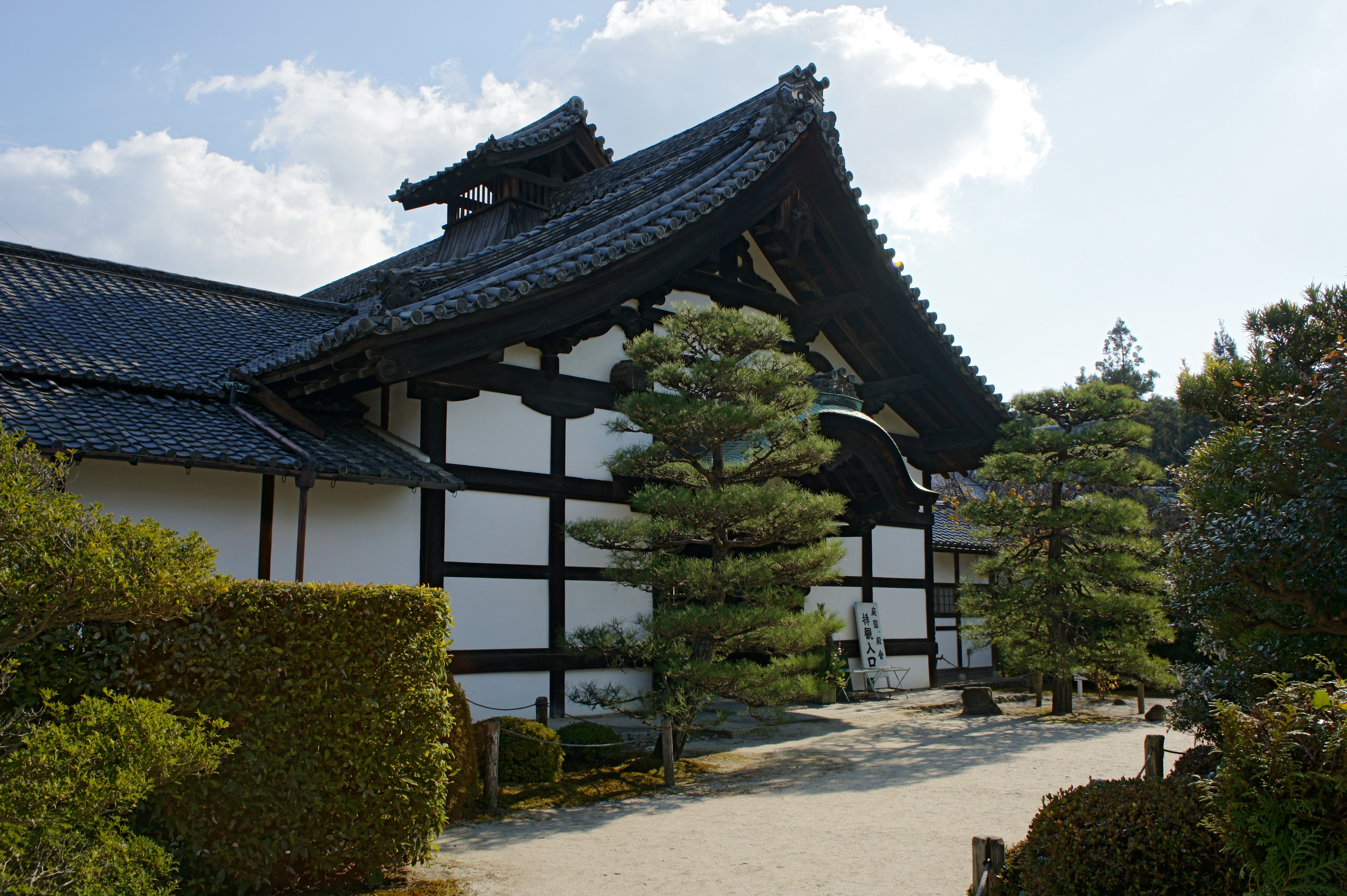
Zuishin-in: The Temple of a Thousand Buried Love Letters
Somewhere behind the main hall of Zuishin-in, beneath a small earthen mound shaded by maples, lie a thousand love letters. Or so the story goes. Ono no Komachi -- the ninth-century poet whose beauty and verse made her one of the Rokkasen, the Six Immortals of Poetry -- is said to have retired to this quiet corner of Kyoto's Yamashina district after leaving the imperial court. She brought with her the accumulated declarations of courtiers who had tried and failed to win her heart, and she buried them all. The fumizuka, the letter mound, still stands in the temple grounds. Nearby, a well called the Make-up Well marks where Komachi is said to have bathed and applied cosmetics. Whether she truly lived here is debated. That her ghost inhabits this place is not.
The Rain Monk and the Painted Cowhide
Zuishin-in began as a sub-temple of a larger complex called Mandala-ji, founded in 991 by the monk Ningai. Ningai was the founder of the Ono school of Shingon Buddhism and had earned the nickname Rain Sojo after praying for rain nine times at the Shinsen-en Garden in Kyoto -- and producing rain every time. Emperor Ichijo, impressed, granted him land beside the Ono family residence. But the temple's founding legend is stranger than its miracles. Ningai dreamed that his late mother had been reincarnated as a cow. He found the animal and raised it, but it died. In his grief, he painted the Mandala of the Two Realms on the cow's hide and made it the temple's principal image, giving the complex its name: Ushiyama Mandala-ji, the Cow Mountain Mandala Temple. An alternate version in the medieval text Kojidan substitutes his father for his mother, but the painted cowhide remains the same.
From Imperial Prayer Hall to Ruins and Return
Zuishin-in itself was formally established during the tenure of the fifth abbot, Zoshun. By the time of the seventh abbot, Shingon, who served simultaneously as head priest of both Toji and Todai-ji, the temple had risen to monzeki status in 1229 by decree of Emperor Go-Horikawa -- meaning only members of the imperial family or the great regent families could serve as abbot. For centuries, members of the Ichijo, Nijo, and Kujo clans took the position. The temple held lands across Yamashiro, Harima, and Kii provinces. Then war came. The Jokyu conflict and the devastating Onin War burned most of the complex to the ground. The temple wandered, relocating multiple times before the twenty-fourth abbot, Masuko of the Kujo family, rebuilt the main hall in 1599 on the original site of Mandala-ji. A daughter of Toyotomi Hideyoshi, Toyotomi Sadako, donated the Omote Shoin reception hall, rebuilt during the Kan'ei era with fusuma sliding doors painted by the artist Kano Eino.
The Hundred Nights of Fukakusa no Shosho
Ono no Komachi's fame rests on her poetry -- crystalline, emotionally precise waka verse that earned her a place among the thirty-six Immortals of Poetry. But it is her legend that draws visitors to Zuishin-in. The most famous story tells of the nobleman Fukakusa no Shosho, who fell deeply in love with Komachi. She set him a challenge: court her for one hundred consecutive nights, and she would accept him. Night after night he came, through rain, heat, and cold, marking each visit by cutting a notch in the shaft of her carriage. On the ninety-ninth night, he collapsed in a snowstorm and died. Each year on the last Sunday of March, young girls from the local school perform the Hanezu Odori at Zuishin-in, a dance set to koto music that retells the tragedy of those ninety-nine nights, their costumes decorated with the pink plum blossoms that bloom across the temple's gardens.
Plum Blossoms and a Poet's Well
The temple grounds hold the traces of Komachi everywhere. The fumizuka letter mound sits behind the main buildings. The Make-up Well is near the main gate. Poetry inscriptions are carved into stone throughout the grounds, and wooden ema prayer plaques bear her image. In early spring, the Ono Plum Garden erupts in hanezu -- a pale pink-orange color that gives the Hanezu Odori its name. The temple's precincts were designated a National Historic Site in 1966. The Sanmon gate, the Kuri refectory, and a Noh stage date to the Horeki era of 1753, donations from the Kujo family. Zuishin-in remains the head temple of the Zentsuji school of Shingon Buddhism, a living monastery three minutes' walk from Ono Station on the Kyoto Municipal Subway Tozai Line. It is a working temple that happens to be haunted by the most beautiful poet in Japanese history.
From the Air
Located at 34.96°N, 135.82°E in the Yamashina district of eastern Kyoto. The temple sits in a residential neighborhood east of the main Kyoto basin, on the far side of the Higashiyama mountain range. From altitude, the Yamashina valley is visible as a distinct basin separated from central Kyoto by forested ridgelines. Best viewed at 2,000-3,000 feet AGL. Osaka Itami Airport (RJOO) lies approximately 18 nautical miles to the southwest. Kansai International Airport (RJBB) is approximately 40 nautical miles to the south.