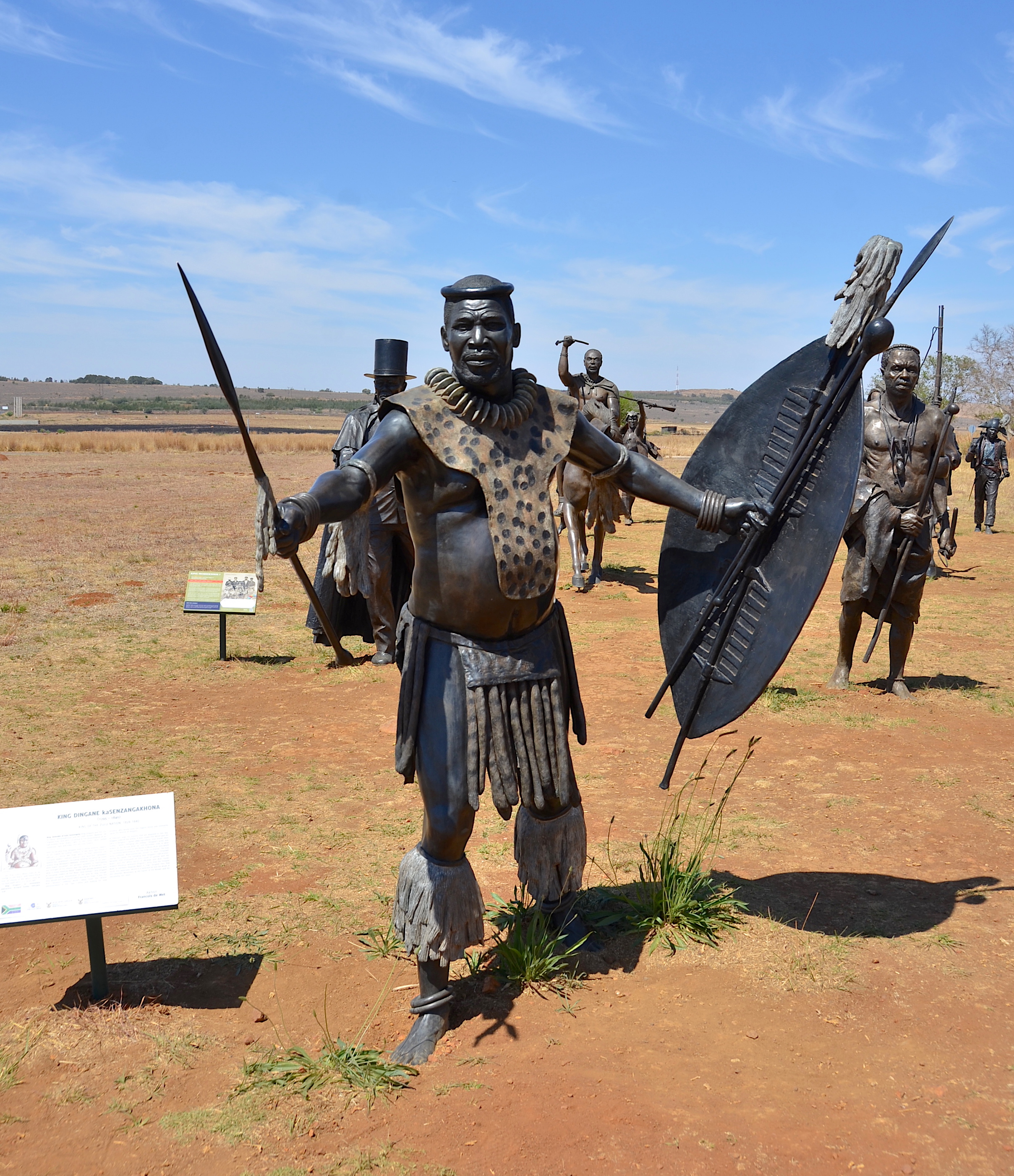
Zulu Kingdom
On 22 January 1879, a Zulu army of roughly 20,000 warriors overran a British camp at Isandlwana and killed more than 1,000 soldiers in a single afternoon. It was the worst defeat the British army had ever suffered at the hands of an African fighting force. The shock reverberated through London drawing rooms and parliamentary chambers, but it would have surprised no one who understood what the Zulu Kingdom had become over the previous six decades -- a state forged in war, held together by discipline, and ruled by a dynasty whose internal rivalries were as ferocious as anything they directed outward.
The Outcast Who Built an Empire
Shaka was born around 1787, the illegitimate son of Senzangakhona, chief of the then-small Zulu clan. Exiled with his mother Nandi, the boy grew up among the Mthethwa people and fought as a warrior under their leader Dingiswayo. When Senzangakhona died, Dingiswayo helped Shaka seize the Zulu chieftaincy. After Dingiswayo's death at the hands of the rival Ndwandwe king Zwide around 1816, Shaka assumed leadership of the entire Mthethwa alliance. His clan numbered only a few thousand, but Shaka's military reforms transformed them into something unprecedented. He replaced long throwing spears with short stabbing assegais, drilled his warriors into disciplined regiments called amabutho, and developed encirclement tactics that crushed larger forces. By 1822, he commanded an empire covering roughly 80,000 square miles along the Indian Ocean coast, from the Tugela River in the south to the Pongola River in the north.
A Continent in Flight
Shaka's conquests did not simply redraw borders -- they emptied entire regions. After he shattered the Ndwandwe alliance at the Battle of Mhlatuze River in 1820, fragments of the defeated confederation launched their own campaigns of displacement against neighboring Nguni peoples. The resulting upheaval, known as the Mfecane or Difaqane, sent waves of refugees cascading across southeastern Africa. The Ngoni people fled as far north as present-day Tanzania and Malawi. The death toll has never been satisfactorily calculated, but vast stretches of territory became nearly depopulated. Into some of these emptied lands, European settlers would later move, claiming the ground was uninhabited -- conveniently ignoring the violence that had cleared it. The Mfecane reshaped the demographic map of southern Africa in ways that still echo through the region's politics today.
Blood River and the Boer Collision
Shaka did not live to face the European threat. In 1828, his half-brother Dingane conspired with allies to assassinate him and seize the throne. Dingane proved a shrewd but ruthless ruler who purged potential rivals -- all except Mpande, another half-brother considered too mild to pose a danger. When Voortrekker leader Piet Retief arrived in 1837 to negotiate a land deal, Dingane signed a treaty ceding territory south of the Tugela, then ordered Retief and his entire party executed. His impis massacred 250 Boer men, women, and children camped nearby -- an atrocity that gave the settlement of Weenen its name, Dutch for "to weep." The Boers regrouped under Andries Pretorius, and on 16 December 1838, a force of 470 settlers fought off 15,000 Zulu warriors at the Battle of Blood River. The river ran red. Dingane's power never recovered.
The Last Stand at Ulundi
Mpande, the "harmless" brother, proved the dynasty's great survivor. He allied with the Boers to overthrow Dingane, then maintained three decades of relative stability by shifting allegiances between the Boers and the British as circumstances demanded. But after Mpande's death, his son Cetshwayo inherited a kingdom under mounting pressure. When the British issued an ultimatum demanding the Zulu army be disbanded in late 1878, Cetshwayo refused. The devastating Zulu victory at Isandlwana in January 1879 stunned the empire, but the British poured in reinforcements. By July, they had marched on the Zulu capital at Ulundi and burned it. Cetshwayo was captured and exiled to Cape Town. The British carved his kingdom into thirteen petty chieftaincies, a deliberate strategy to prevent reunification. Cetshwayo was later allowed to visit Queen Victoria in London before being partially restored, but he died soon after, and the kingdom he knew was already gone.
A Kingdom That Endures
What followed was a slow dispossession. Cetshwayo's son Dinuzulu allied with the Boers to fight rivals, only to see half of Zululand parcelled into settler farms. The British annexed what remained in 1887. When Dinuzulu was implicated in the Bambatha Rebellion of 1906, he was sentenced to ten years' imprisonment on St Helena. Under apartheid, the KwaZulu bantustan became the designated "homeland" for Zulu people -- a cynical construct that denied them South African citizenship while their labor built the country's mines and cities. Yet the Zulu identity persisted. Today, KwaZulu-Natal is one of South Africa's nine provinces, its savanna-covered hills home to the Zululand Rhino Reserve and a thriving tourism economy. King Misuzulu kaZwelithini carries the ceremonial mantle of a dynasty that stretches back more than two centuries. The amabutho regiments are gone, but the nation they built is not.
From the Air
The historic heart of the Zulu Kingdom lies at approximately 28.30S, 31.42E in present-day KwaZulu-Natal, South Africa. From the air, the landscape is characterized by rolling savanna hills, river valleys, and scattered settlements. The Tugela River, the kingdom's historical southern boundary, is visible cutting through the terrain. Isandlwana hill, site of the famous 1879 battle, has a distinctive sphinx-like profile visible from altitude. Nearby airports include Richards Bay Airport (FARB) to the southeast and Ulundi Airport (FAUL) near the former Zulu capital. Best viewed at 5,000-10,000 ft AGL to appreciate the scale of the territory that the Zulu kings once controlled. The Indian Ocean coastline is visible to the east.