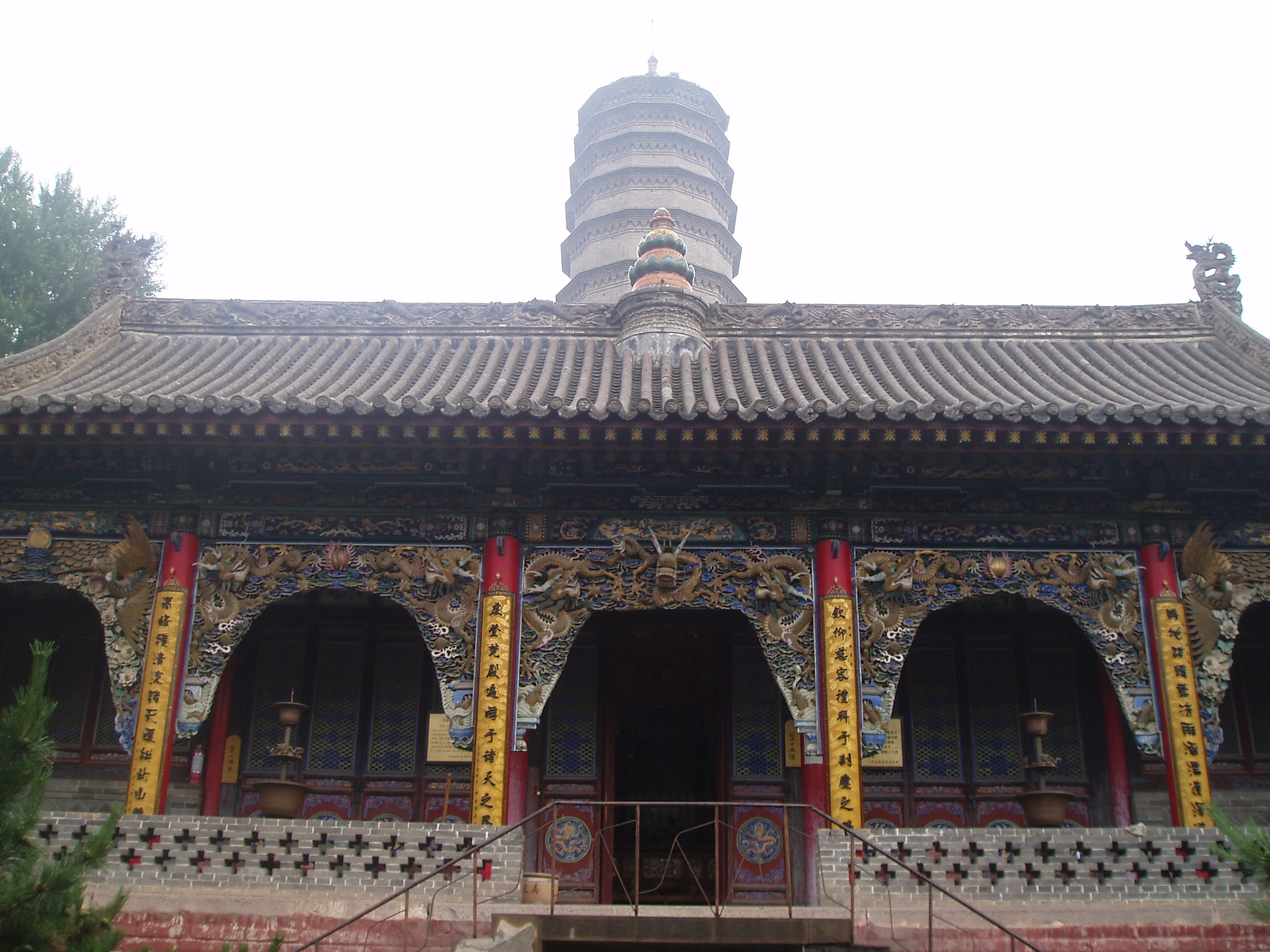
Zunsheng Temple
A temple that has been called three different things across a thousand years tells you something about the instability of names and the persistence of place. Zunsheng Temple sits in Huyangling, about 20 kilometers northeast of the seat of Wutai County in Shanxi Province, positioned on one of the traditional approaches to the sacred Buddhist peak of Mount Wutai. Founded in the Tang dynasty under the name Shan Zhu Ge Yuan, it was rebuilt and rechristened during the Northern Song dynasty, renamed again during the Ming dynasty, and partially renovated under the Qing. Each dynasty left its mark. The current temple reflects the most recent renovation, carried out during the Republic of China era in the early twentieth century.
Four Names, One Place
The temple's name changes trace the shifting currents of Chinese Buddhist culture across a millennium. When it was first established in the Tang dynasty, it was called Shan Zhu Ge Yuan -- a name that evoked its character as a modest hermitage or cloister. In the fourth year of the Tiansheng reign of the Northern Song dynasty, the temple was rebuilt and given the more elevated name Zhen Rong Chan Yuan, signaling its incorporation into the Chan (Zen) Buddhist tradition. Then in the nineteenth year of the Wanli reign of the Ming dynasty, it was renovated and renamed Zunsheng Temple -- the name it carries today -- a title meaning Temple of Supreme Victory. The Qing dynasty contributed a partial renovation during the seventh year of the Tongzhi reign, and a stele erected in the twenty-fourth year of the Kangxi reign recorded the temple's accumulated history.
Gateway to the Sacred Peak
Zunsheng Temple's location is its most significant feature. Mount Wutai, one of the Four Sacred Mountains of Chinese Buddhism and a UNESCO World Heritage Site, has drawn pilgrims for more than a millennium. The mountain is associated with the bodhisattva Manjushri, the embodiment of wisdom, and its temples represent one of the densest concentrations of Buddhist architecture in China. Zunsheng Temple, positioned along the northeastern approach to the mountain, served as a waystation and spiritual threshold for pilgrims making the journey. Before the modern era of paved roads and tour buses, the approach was an arduous trek through mountainous terrain, and temples along the route offered shelter, food, and a place to prepare for the devotional experience ahead.
Scale and Survival
At more than 32,000 square meters, Zunsheng Temple is not a small complex. Its grounds encompass multiple halls and courtyards arranged in the formal axial layout typical of Chinese Buddhist monasteries. But what gives the temple its quiet dignity is the contrast between its physical scale and its relative anonymity. Mount Wutai's most famous temples -- Xiantong, Tayuan, Luohou -- attract the lion's share of visitors and scholarly attention. Zunsheng Temple, further from the mountain's core, operates in relative solitude. Its current appearance dates primarily from the Republic of China era renovations, making it architecturally less ancient than its neighbors but historically continuous with a site that has been consecrated ground since the Tang dynasty more than a thousand years ago.
Layers of Stone and Memory
The Kangxi-era stele that still stands in the temple courtyard serves as a physical history book in stone, recording the successive building campaigns and patronage that sustained the temple across the centuries. Steles like these are common at Chinese Buddhist sites, functioning as both historical records and assertions of legitimacy. Each dynasty that rebuilt or renamed the temple affirmed its importance -- and its own authority -- through the act of renovation. The temple that pilgrims approach today is the product of all these accumulated interventions, a structure where Tang dynasty foundations support Song dynasty plans rebuilt under Ming dynasty supervision and repaired by Qing dynasty artisans. No single dynasty can claim it. All of them did.
From the Air
Located at 38.79N, 113.38E, approximately 20 km northeast of Wutai County seat, Shanxi Province, on the approach to Mount Wutai. The temple's 32,000 square meter grounds are visible in the mountain landscape. Nearest airport is Xinzhou Wutaishan Airport (ZBXZ). The sacred peaks of Mount Wutai are visible to the east. Standard mountain flying precautions apply.