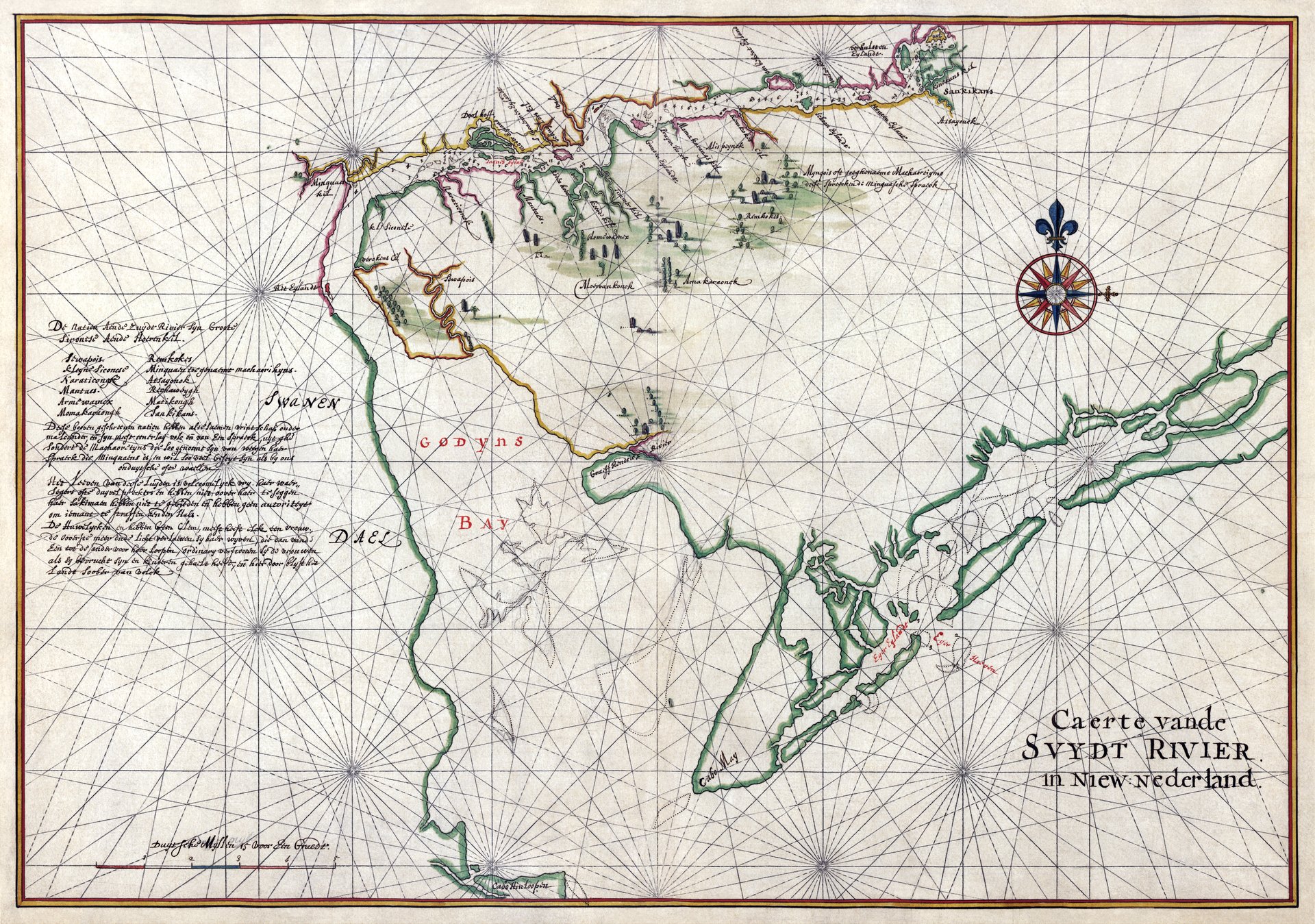
Zwaanendael Colony
It started with a piece of tin. A chief took it from a wooden column outside the Dutch fort -- the one with the arms of Holland painted on it -- wanting to fashion tobacco pipes. He had no idea the metal carried meaning beyond its material worth. The Dutch commanders reacted with outrage so severe that other Natives, seeking to appease them, killed the chief and brought proof of the deed. The Dutch told them they had overreacted, that they should have simply brought the man to be scolded. But vengeance has its own logic. The murdered chief's kin gathered their allies, and within months, twenty-eight Dutch colonists lay dead on the shore of what they had called Zwaanendael -- the Valley of the Swans. It was 1631, and Delaware's first European settlement had lasted barely a year.
The Oldest Deed in Delaware
The story begins in Amsterdam. In 1629, two directors of the Dutch West India Company -- Samuel Blommaert and Samuel Godyn -- bargained with the local inhabitants for a vast tract of land stretching from Cape Henlopen to the mouth of the Delaware River. This was three years before the charter of Maryland, making it the oldest deed for land in what would become Delaware. The purchase was ratified in 1630 by Peter Minuit and his council at Fort Amsterdam. The investors assembled a formidable group: Blommaert, Godyn, Kiliaen van Rensselaer (the Patroon of Rensselaerswyck), the geographer Joannes de Laet, and the navigator David Pietersen de Vries. They fitted out the Walvis -- a ship of eighteen guns -- to carry colonists, defend the coast, and pursue whaling to help offset expenses.
The Red Lion, Rampant
Twenty-eight colonists sailed to a spot on Blommaert's Kill -- now Lewes Creek -- a little north of Cape Henlopen. Their governor was Gillis Hosset. They built a palisaded fort and fixed the red lion rampant of Holland to its gate. The colony they planted was the first European settlement in what would become Delaware, predating any in Pennsylvania by several years. They named the country Swaanendael -- swan valley, for the birds that graced the waterways -- while the bay itself was christened Godyn's Bay, now known as Delaware Bay. The little settlement defined the shape of an entire future state. Most of Delaware's territory was included in the original purchase, and the colony at Lewes practically laid the foundation for the singularly narrow state that would eventually emerge.
A Catastrophe of Misunderstanding
The massacre, when it came, unfolded with a terrible cascade of miscommunication. A chief took the tin bearing Holland's arms to make pipes. The Dutch overreacted. Natives killed the chief to restore peace. The Dutch said they wished it had not happened. The chief's relatives, following their own code of justice, planned revenge. They watched the colonists at their daily routines, noting that only one man remained inside the house -- a sick man -- along with a large mastiff, chained. Three warriors approached carrying bear skins for trade. The commander went inside with them to barter. When he descended the stairs from the loft, one of the warriors seized an axe and split his skull. They killed the sick man next, then turned twenty-five arrows on the chained dog before he died. They went among the remaining colonists working outside, approaching with the appearance of friendship, and struck them down one by one.
De Vries and the Charred Remains
David Pietersen de Vries arrived on December 5, 1632, already knowing the colony was gone -- reports of the slaughter had reached Europe before he departed. He found charred ruins where the fort had stood. He negotiated a treaty with the local Nanticoke people, then sailed up the Delaware River attempting to trade for beans and corn. Failing there, he sailed to Virginia and obtained provisions before returning with fifty new colonists. But the massacre had convinced the Dutch to pull back. De Vries soon removed the settlers to New Amsterdam. The Zwaanendael claims were resold to the Dutch West India Company. Later, Blommaert helped outfit the first Swedish expedition to New Sweden in 1637, hiring Peter Minuit -- who by then was no longer Governor of New Netherland -- to command it.
Utopia on the Bay
The story of European settlement on this shore did not end with the massacre. In 1663, just before the British takeover in 1664, a remarkable experiment began near the site of old Zwaanendael. Franciscus van den Enden drafted a charter for a utopian community: equal education for all classes, joint ownership of property, and a democratically elected government -- radical ideas for the seventeenth century. Pieter Corneliszoon Plockhoy attempted to establish this society on Delaware Bay, but the British destroyed the settlement in 1664. Two and a half centuries later, in 1909, a monument called the De Vries Palisade was dedicated on the site of the original colony. The Zwaanendael Museum opened in 1931, its architecture modeled on the town hall of Hoorn in the Netherlands. Today the town of Lewes occupies the ground where twenty-eight colonists once built a fort, flew the Dutch lion, and lost everything over a piece of tin.
From the Air
Located at 38.78°N, 75.14°W near the modern town of Lewes, Delaware, at the mouth of Delaware Bay. The colony site is on the shore near Lewes Creek (historically called Blommaert's Kill), a short distance north of Cape Henlopen. From altitude, look for the town of Lewes along the bay shore, with Cape Henlopen State Park and its distinctive sandy point to the southeast. The Delaware Breakwater and its lighthouses are visible offshore. The Zwaanendael Museum in downtown Lewes has a distinctive Dutch-style tower. Nearest airports: Sussex County Airport (KGED) approximately 12nm west; Delaware Coastal Airport (KGYX) approximately 18nm south. Cape May, New Jersey is visible across the bay to the northeast. The Cape May-Lewes Ferry terminal provides a visual landmark along the shore.