
2008 Nouakchott Israeli embassy attack
It was 2:20 in the morning when the shooting started. A car had dropped several men near a nightclub in Nouakchott, the desert capital of Mauritania, and they walked the short distance to the Israeli embassy on foot. Dressed in turbans and robes, they opened fire and shouted as they did. Mauritanian guards at the embassy shot back at once, and the night that had been quiet was suddenly a gunfight. The attackers fled in a waiting vehicle. The whole episode lasted only minutes, but it would ripple far beyond this one street corner.
The Night of the Attack
Accounts placed the attackers at between three and six men, armed with rifles and grenades. Their target was the embassy of Israel, but the people they wounded were bystanders. Three were injured in the exchange of fire, among them a French woman caught at the nearby nightclub, an ordinary person out for an ordinary evening who found herself in the path of someone else's war. Observers later called the raid militarily inconsequential, a description true of the damage to the building but cold comfort to those hit by the gunfire. The embassy guards held; the attackers escaped into the dark.
A Claim and a Context
Within a short time, Al-Qaeda in the Islamic Maghreb claimed responsibility, issuing a statement titled "At your orders, Gaza" and naming the Israeli ambassador directly as a threat. The attack did not come from nowhere. It followed a grim stretch for Mauritania: the murder of four French tourists weeks earlier and an assault that killed three Mauritanian soldiers in December 2007. A jihadist network was testing a country that had long prided itself on stability, and a foreign embassy made a deliberate, symbolic target.
A Rare and Fragile Tie
The embassy itself was the point. Mauritania was one of only a handful of Arab League states ever to establish full diplomatic relations with Israel, having done so in 1999, a bold and contentious step in the region. The 2008 attack struck at that connection. Israeli embassies around the world were placed on heightened alert and a defence official flew to Nouakchott to assess security. The ambassador, Boaz Bismuth, spoke on the radio in the aftermath. Within a year the relationship would fray badly; amid the Gaza war of late 2008 and early 2009, Mauritania expelled the Israeli ambassador, and the embassy this attack had targeted would not long survive the diplomatic rupture.
The Reckoning
The pursuit was swift. The day after the shooting, Mauritanian authorities said they had detained three suspects roughly 150 kilometres from the capital. By 8 February, officials announced that eight people had been arrested in connection with the attack, among them an Algerian national, a reminder that the threat moved easily across the region's porous desert borders. For Mauritania the episode was a warning: a sparsely populated country at the western edge of the Sahara, it sat on the front line of a violence that respected no boundary, and the choices it made about its alliances carried real and immediate risk.
From the Air
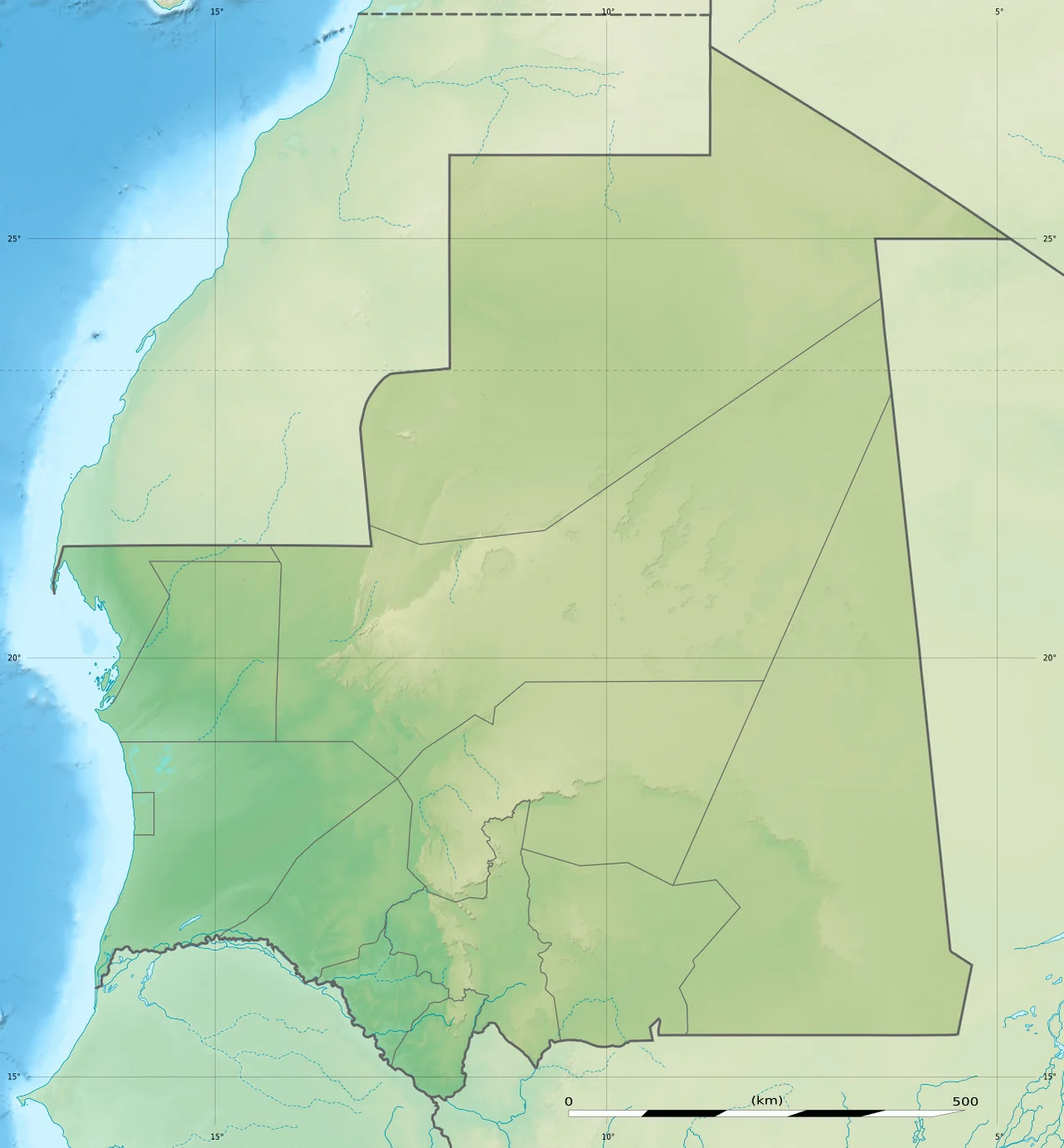
The attack occurred in Nouakchott, Mauritania, at approximately 18.10 N, 15.98 W, in the capital's diplomatic district. The nearest airport is Nouakchott-Oumtounsy International (GQNN). From the air, Nouakchott appears as a low, pale grid pressed between the Atlantic shoreline to the west and the Sahara to the east, a planned capital with few tall structures. There is no monument or memorial to mark the site. Clear desert skies and excellent visibility are typical, with blowing dust the main hazard; this is a place to understand from history rather than to view as a landmark.
Nearby Stories
- Emirate of Trarza 28 km away
- Portendick 36 km away
- Boutilimit 97 km away
- Nouamghar 117 km away
- Erg Amatlich 185 km away
- Brakna region 234 km away
- SS Noemijulia 248 km away
- Dakar 354 km away