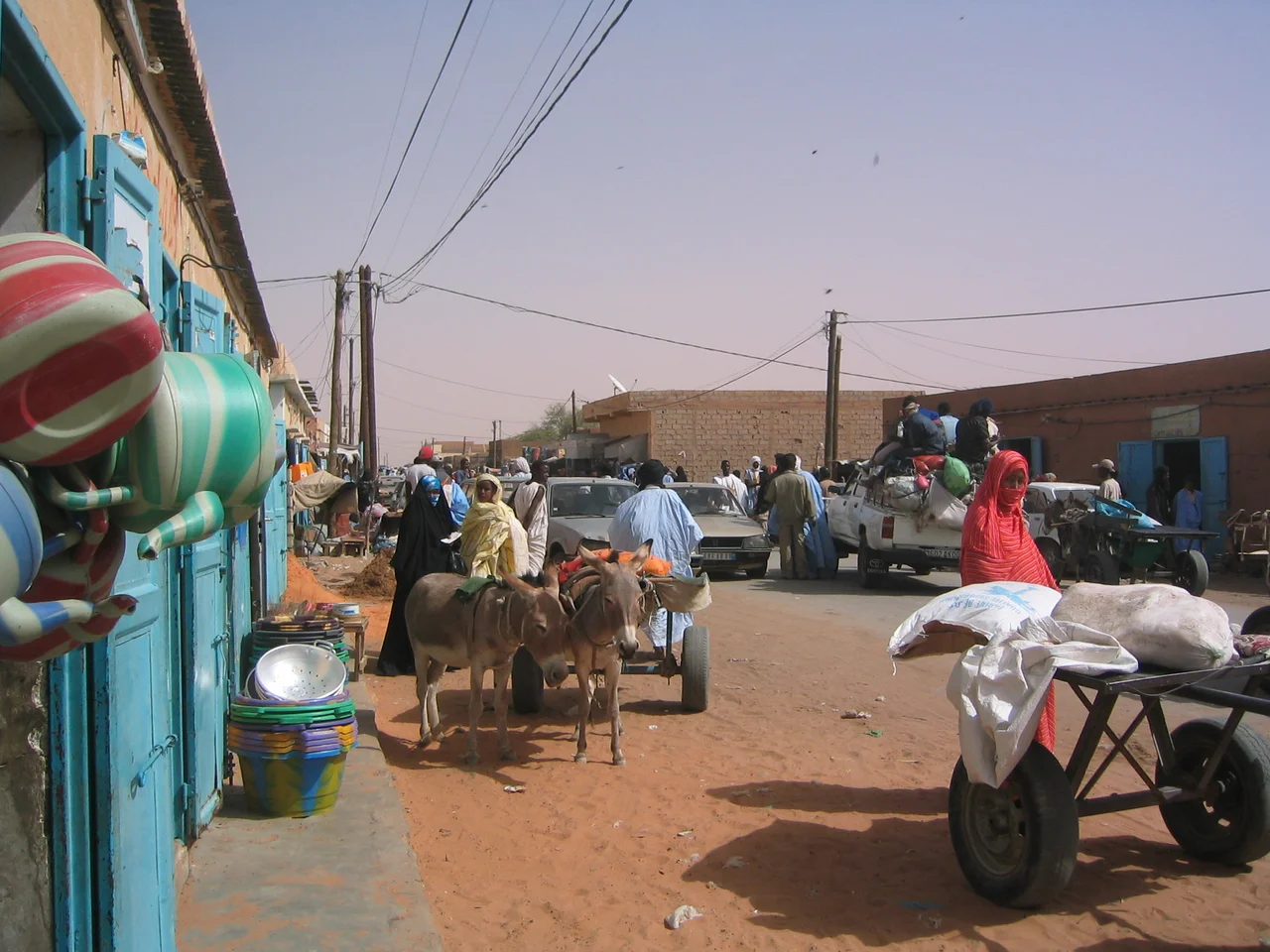

Boutilimit
The most valuable thing in Boutilimit was never visible from the street. Behind the walls of one family compound in this dusty town of the Trarza desert lay a library: thousands of handwritten Arabic manuscripts, the accumulated learning of a dynasty of scholars, gathered and copied and guarded across four generations. In a country where so much knowledge traveled by camel and memory, Boutilimit became a place where it was written down and kept. The town's modern footprint is small, around 27,000 people as of 2013, sitting 164 kilometers southeast of the capital, Nouakchott. Its reputation, though, has always run far ahead of its size.
The Scholar Who Settled Here
Boutilimit's standing as a seat of learning traces back to Shaykh Sidiyya al-Kabir, born in 1775, one of the most influential religious figures the western Sahara produced. As a young man he journeyed to the region of Timbuktu to study under the renowned Kunta masters, Sidi al-Mukhtar al-Kunti and his son, and returned in the 1820s carrying the prestige of the Qadiriyya Sufi order and a deep command of Islamic law and learning. He made his base at Boutilimit, well placed to spread influence across the nomadic societies of southern and central Mauritania. From him descended a line of scholars, and from that line came the town's enduring identity. When the French later sought allies among the desert clerics, it was his grandson, Shaykh Sidiya Baba, whose authority across Trarza and its neighbors carried real weight.
A Library in the Desert
The Sidiyya family library is one of the most complete scholarly collections ever reconstructed anywhere in the West African Sahel. Built up from the lifetime of Sidiyya al-Kabir, who died in 1868, and extended by his sons, grandsons, and great-grandsons, it spans the early 19th century to the 1960s. Its shelves held literary works, religious treatises, legal opinions, and the family's own correspondence, an archive of how a scholarly household thought, argued, and taught across more than a century. So significant was the collection that it was microfilmed in the 1980s and copies preserved at the University of Illinois, ensuring that words written by lamplight in a Saharan town would survive even the dryness and dust that threaten manuscripts across the region.
The Town That Raised a President
Boutilimit's influence reached into the modern nation as well as the medieval one. The town was the birthplace of Moktar Ould Daddah, who became the first president of independent Mauritania when the country broke from France in 1960 and led it for nearly two decades. It is no coincidence that a town steeped in scholarship and the prestige of the Sidiyya lineage should produce the man who would build a state; in Moorish society, learning and leadership were never far apart. Boutilimit has gone on to send writers, poets, and public figures into Mauritanian life, among them the contemporary scholar and poet Mohammad al-Hasan al-Dido, born here, whose religious teaching reaches well beyond the country's borders.
Wool, Silver, and the Living Craft
Scholarship is not the only thing Boutilimit is known for. The town has long been a center for handicrafts, and its name carries weight in the region's markets. Rugs woven from camel and goat hair come out of Boutilimit, dense and hard-wearing, the product of a craft tradition shaped by nomadic life. So does worked silver, the bracelets, pendants, and ornaments that are among the most distinctive things a traveler can carry away from Mauritania. These are not relics in a museum case but a working economy, the skills passed down in households much as the manuscripts were, hand to hand across generations.
A Crossroads on the Road of Hope
For all its fame, Boutilimit can be easy to pass through. It sits on the Route de l'Espoir, the Road of Hope, the long paved artery that runs more than a thousand kilometers from Nouakchott across the country to Néma in the far southeast. Travelers bound for the interior roll through, stopping for tea or to buy a rug, often unaware of the scholarly weight the town carries. But that is fitting for a place like this. Boutilimit never advertised itself with grand monuments; its monuments were words, written in ink on paper and kept against the desert. To understand it, you have to know what lies behind the walls, and that the quiet town on the road southeast of the capital was, for generations, one of the places where Mauritania did its thinking.
From the Air
Boutilimit sits at 17.548°N, 14.694°W in Mauritania's Trarza region, about 164 km southeast of Nouakchott. The nearest international gateway is Nouakchott–Oumtounsy International Airport (ICAO: GQNN), to the northwest. The town lies along the Route de l'Espoir (Road of Hope), the trans-Mauritanian highway, which appears from the air as a thin paved line crossing otherwise open Saharan terrain of gravel plains and low dunes. There are no major landmarks for navigation beyond the road and the small cluster of the town itself; the surrounding landscape is sparse semi-desert. Saharan dust commonly reduces visibility, so the clearest views are in the cooler, calmer months.
Nearby Stories
- Brakna region 24 km away
- Emirate of Trarza 37 km away
- Nouakchott Raid (1976) 96 km away
- Nouakchott 152 km away
- Ksar el Barka 208 km away
- Maaden El-Irvane 285 km away
- Dakar 376 km away
- Koniakary Tata 492 km away