
Nouakchott Raid (1976)
On the morning of 8 June 1976, shells began falling on the grounds of the president's residence in Nouakchott. For about half an hour, the heart of Mauritania's planned, peaceful capital came under bombardment. The attackers were fighters of the Polisario Front, a guerrilla movement from neighboring Western Sahara, and they had driven across hundreds of miles of open desert to reach a city that had no real defenses, because nearly all of Mauritania's army was stationed far to the north. The raid lasted only minutes by the time it counted, but its consequences would outlast the war itself.
Why a Guerrilla Army Came South
The raid grew out of the Western Sahara conflict. When Spain withdrew from its Saharan colony in 1975, Morocco and Mauritania moved to partition the territory between them. The Polisario Front, fighting for an independent Sahrawi state, rejected that partition and went to war against both. Mauritania, a young and lightly armed nation, was the more vulnerable target. To strike at the government of President Moktar Ould Daddah, the country's first leader since independence, Polisario's commanders conceived an audacious plan: not a border skirmish, but a strike at the capital itself, more than a thousand kilometers from their bases. The objective was the president's residence, and the hope was to topple the regime in a single blow.
The Long Drive Across the Desert
In early June, a force of several hundred fighters set out from the Polisario rear base at Tindouf, in Algeria, led by the movement's secretary-general, El-Ouali Mustapha Sayed. The column was a small mechanized army on wheels: roughly a hundred vehicles, including trucks loaded with ammunition, fuel, communications gear, and supplies, hauling 120mm mortars and recoilless cannons. The desert is hard to hide in. On 5 June, a Mauritanian pilot spotted the convoy near the northern mining town of Zouérate, and the government grasped, perhaps for the first time, what the column was really after. Lt.-Col. Ahmed Ould Bouceif was dispatched with some 400 troops to intercept it before it could reach Nouakchott. He did not stop it in time. By 8 June the raiders had reached the outskirts of the capital.
Thirty Minutes and a Retreat
The bombardment of the presidential grounds lasted roughly thirty minutes. But the element of surprise was already gone, and Mauritanian defenses had been reinforced in the days since the convoy was sighted. The attackers could not press their advantage, and the assault that was meant to bring down a government became, instead, a fighting withdrawal. The raiders turned back into the desert with Mauritanian troops in pursuit, the raid's bold ambition collapsing into the far more dangerous problem of getting home alive across hundreds of miles of hostile ground.
The Cost of the Retreat
The withdrawal proved deadlier than the raid. Near the settlement of Bennichab, about 100 kilometers north of Nouakchott, a group that had split from the main column was cornered by Mauritanian forces on 9 June. Among the dead was El-Ouali himself, killed by shrapnel as he tried to make his way back, along with his military deputy. The man who had co-founded and led the Polisario Front was gone at 27 or 28. Polisario suffered more than 200 killed and nearly as many taken prisoner; on the Mauritanian side, four soldiers died and around ten were wounded. For both sides, the losses were real and the families left behind were real, whatever the politics that sent these young men into the desert.
A Raid That Changed the War
The raid failed in its stated aim. Moktar Ould Daddah remained in power, and the capital held. Yet the attack exposed how fragile Mauritania's position in the war had become, and the loss of El-Ouali, far from breaking the Polisario, gave the movement a founding martyr around whom it would rally for decades. Mauritania would launch further operations and endure more raids before finally withdrawing from the war and renouncing its claim to Western Sahara in 1979. The events of June 1976 are remembered very differently on each side: as a desperate assault repelled, or as a daring strike that cost a movement its leader. Both memories are true, which is often the way with the wars that get fought across deserts.
From the Air
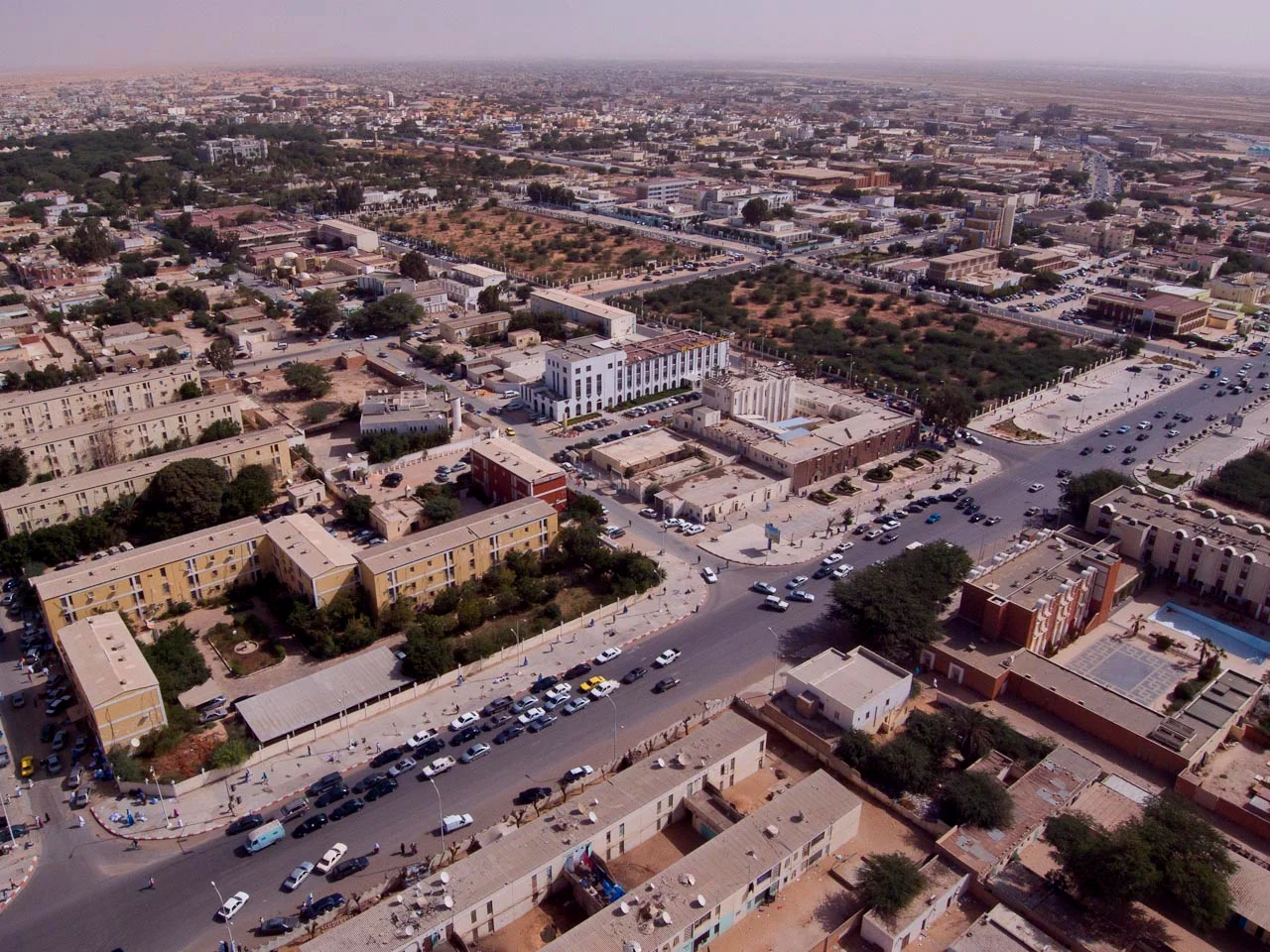
The raid struck Nouakchott at roughly 18.10°N, 15.95°W, on Mauritania's Atlantic coast. The key sites lie along the corridor north of the city: the capital itself, served today by Nouakchott–Oumtounsy International Airport (ICAO: GQNN), and the settlement of Bennichab roughly 100 km to the north, where the column was cornered on 9 June 1976. The terrain is flat coastal Sahara, the same open desert the convoy crossed from Tindouf in Algeria, far to the northeast. From altitude, the landscape is a featureless expanse of dune and gravel plain broken only by the coastline and the city's pale grid. Saharan dust often reduces visibility over the region.
Nearby Stories
- Emirate of Trarza 28 km away
- Portendick 36 km away
- Boutilimit 97 km away
- Nouamghar 117 km away
- Erg Amatlich 185 km away
- Brakna region 234 km away
- SS Noemijulia 248 km away
- Dakar 354 km away