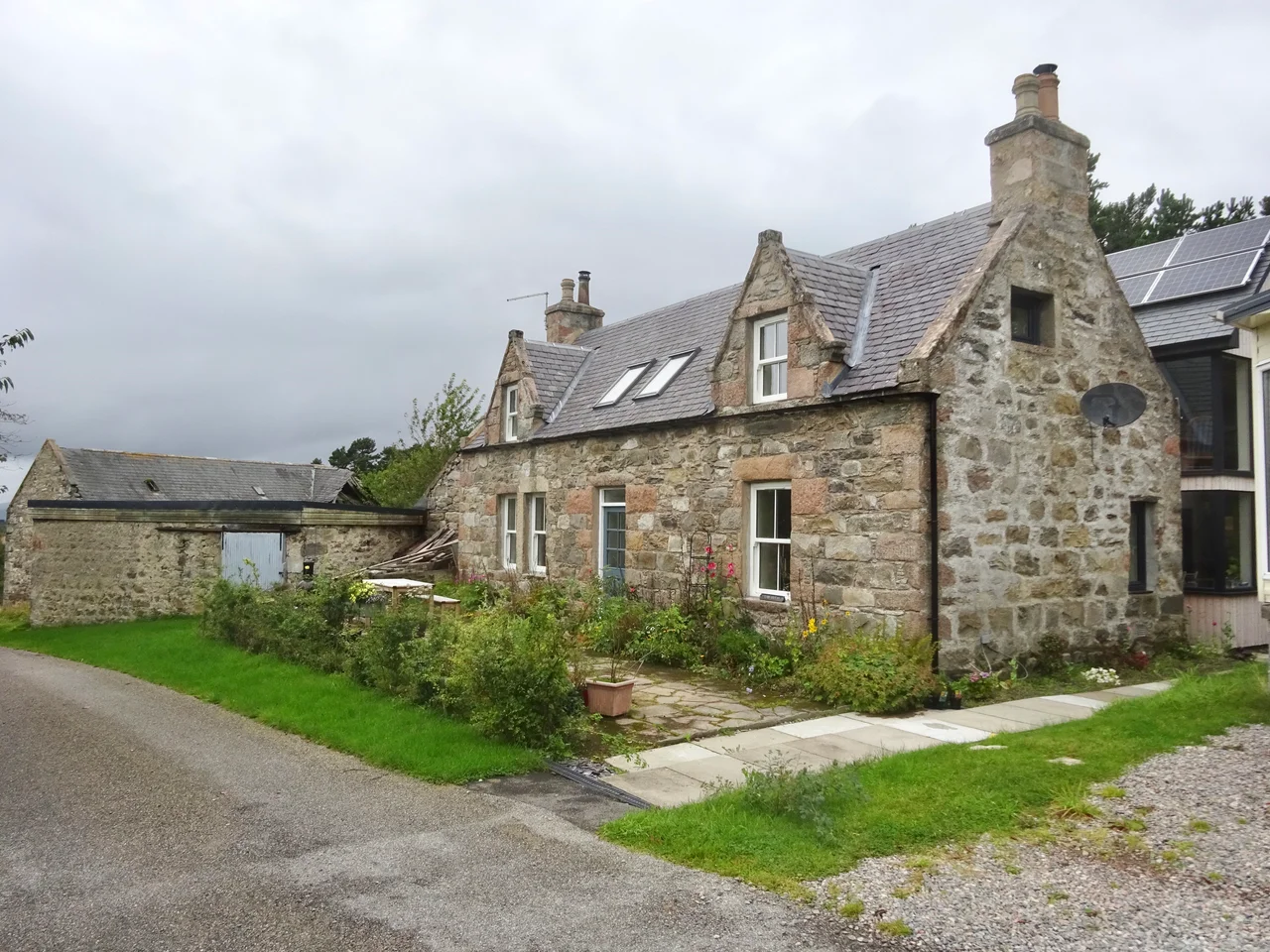

Aberlour Distillery
When James Fleming died in June 1895, his will included an unusual instruction. He had set aside five hundred pounds for a footbridge across the River Spey at Aberlour, to be sited as close as possible to the mouth of the Lour Burn so that the village of Charlestown could connect to the parish of Knockando. People had drowned trying to cross the fast water in his lifetime. He had spent his final years making sure the next ones would not have to. The bridge - delayed by a stubborn landowner - finally opened in 1902. Locals called it the Penny Bridge. Fleming is buried in the cemetery directly opposite the distillery he founded, where the spirit he started still ages in oak. The bridge, the hall, the hospital and the whisky are all still there.
A Tenant Farmer's Son
James Fleming was born on 1 June 1830 at Tomfarclas on the Ballindalloch estate, the only son of a tenant farmer. He worked the family land into manhood, then left for the wider Speyside grain trade as a commission agent. In the mid-1860s he took a ten-year lease on the Dailuaine distillery at Carron, which gave him an apprenticeship in single malt and the connections of the spirit market. By the 1871 census he had moved to Aberlour itself. In 1874 he founded the local branch of the North of Scotland Bank, the first in the village. Within a few years he had become an elder of the parish church, chairman of the School Board, county councillor, and town Provost. He had also decided what he wanted to do with the rest of his life: build a distillery.
Christmas 1880
In 1879 Fleming secured a feu - a long lease in Scottish land tenure - from the Earl of Fife on a stretch of ground at the confluence of the Lour Burn and the River Spey. The location was almost ideal. Speyside's particular combination of soft water, surrounding barley, and cool aging climate had been producing distinguished malts for generations. Ben Rinnes loomed to the south. The Spey ran cold and fast past the door. Fleming's distillery produced its first spirit in December 1880. The site has operated, with interruptions, ever since. In 1920, after the founding family had sold on, the distillery passed to W.H. Holt and Sons - a brewing family near Manchester - and eventually into the long line of corporate ownership that has marked nearly every Speyside distillery's modern history. Today Aberlour is part of Chivas Brothers, owned by Pernod Ricard.
Hall, Hospital, Bridge
Fleming's distillery made him wealthy, and he poured the wealth back into Aberlour. In 1889 he built the village's first public meeting place - the Fleming Hall. In 1900 came the Fleming Cottage Hospital, providing isolation accommodation specifically to limit infectious disease in a village that had repeatedly been devastated by epidemics. James Thomson's 1902 book Recollections of a Speyside Parish quoted local memory of those years: 'I can well remember more than one epidemic that devastated many a home in the village. Had there been at the time such an institution in the place, many lives might have been saved.' The footbridge he funded in his last weeks completed the trio. Hall, hospital, bridge - the infrastructure of a community Fleming had not been born into but had decided, deliberately, to belong to.
Sherry Casks and 58 Gold Medals
Modern Aberlour is known above all for its double-cask maturation - spirit aged in American bourbon casks then finished in oloroso sherry casks from Spain. The technique was pioneered in part to appeal to the French market, where Aberlour has been the best-selling single malt for decades. The results have been heavily decorated: since 1986, Aberlour has won 58 Gold awards and 8 Trophies in the tasting categories of the International Wine and Spirits Competition and the International Spirits Challenge. The A'Bunadh expression - cask-strength, no chill filtration, bottled batch by batch - has acquired cult status among single malt drinkers. None of this was visible when James Fleming dug the foundations in 1879. But the patience he set in motion - the slow conversation between spirit and oak that takes a decade to deliver an answer - is the same one Aberlour conducts today.
From the Air
Coordinates 57.4672N, 3.23W. Elevation approximately 130 m (430 ft) at the confluence of the Lour Burn and the River Spey. The distillery sits on the eastern edge of Aberlour village in Strathspey, near the foot of Ben Rinnes (840 m), one of the prominent Speyside summits. Recommended viewing altitude 3,500-5,500 ft AGL. From the air, look for the cluster of distillery buildings near the riverbank with their pagoda kiln roof, and the Victoria Bridge spanning the Spey just to the north. Ben Rinnes makes an unmistakable landmark to the southwest. Nearest ICAO: Aberdeen (EGPD) 45 nm east; Inverness (EGPE) 45 nm west; Lossiemouth (EGQS) 25 nm north. The Speyside valley channels northerly winds and is prone to early-morning fog in autumn and spring.
Nearby Stories
- Spynie Palace 3.6 km away
- Findlater Castle 4.7 km away
- Battle of Slioch 6.6 km away
- Battle of Lumphanan 6.6 km away
- Tomatin distillery 9.8 km away
- Nigg Stone 11 km away
- Balmoral Castle 12 km away
- Highland Folk Museum 16 km away