
Nigg Stone
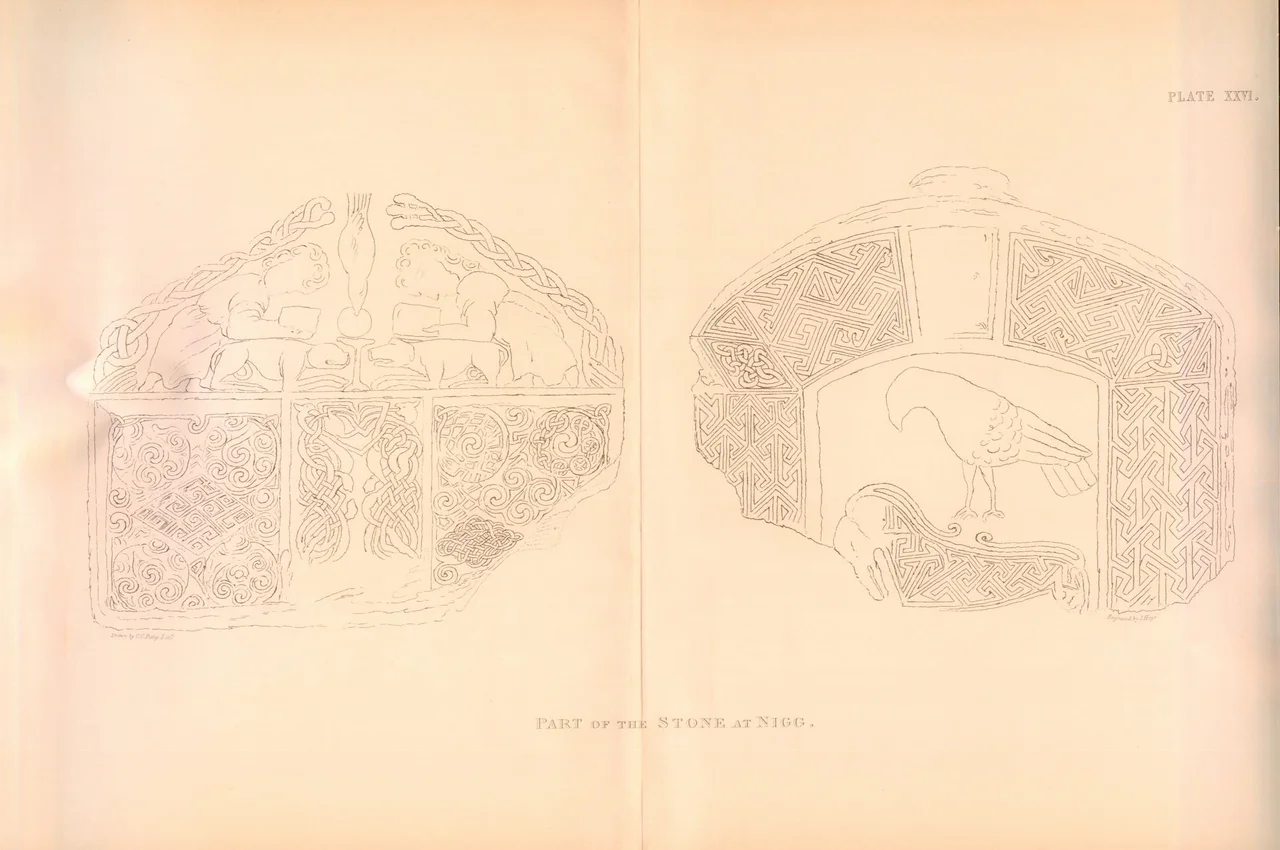
In 1998, Niall M Robertson found a piece of stone in the stream that runs below the churchyard at Nigg. It was a small fragment of red sandstone, weathered but unmistakably carved - showing most of a Pictish Beast symbol. For at least two hundred years, the fragment had lain in the streambed, probably thrown there by whoever had attempted to patch the Nigg Stone back together after it shattered in the eighteenth century. The Pictish Beast - that elusive, dolphin-like creature that nobody has identified to a known species - was once again attached to the slab it belonged to. The restoration was completed in 2013, more than a thousand years after the carving was made.
A Stone of the First Rank
The Nigg Stone is among the finest surviving Pictish carved stones - one of the most elaborate carved monuments of early medieval Europe, period. It was carved at the end of the eighth century CE, originally placed at the gateway to the grounds of Nigg parish church in Easter Ross. The front bears a high-relief cross, intricately decorated, with carvings closely related in style to the contemporary high crosses of Iona. The connection is no coincidence: scholars believe the same school of carvers may have worked at both sites, traveling between religious centers and serving different patrons. The reverse - the so-called secular side - is more complex, more crowded, and more cryptic.
The Eagle, the Beast, and the Harp
Two Pictish symbols dominate the reverse: an eagle, carved above a Pictish Beast. There is also a sheep, hunting scenes, and what scholars consider the oldest evidence of a European triangular harp - a depiction that pushes back the documented history of that instrument by centuries. The entire scene is read as a story of the biblical King David, the harpist-king of Israel, who was a popular subject in Pictish Christian art. But the figural composition has been deliberately defaced, and the damage makes the scene difficult to interpret in detail. Someone - probably in a later century, possibly during the Reformation - chipped at the figures with intent. What survives, despite that vandalism, is still extraordinary.
Broken in the Eighteenth Century
Something happened to the Nigg Stone in the 1700s and the record does not say exactly what. The slab shattered into pieces. Someone - perhaps a parishioner, perhaps a stonemason, perhaps the minister himself - tried to put it back together with metal staples through the upper and lower portions. The shattered intervening section, however, was discarded - tossed, almost certainly, down the bank into the stream that runs below the churchyard mound. The Pictish Beast fragment lay there from then until 1998, two and a half centuries of moss and current and freeze and thaw, before Niall M Robertson lifted it out and carried it to Tain Museum. In 2013, conservators reattached it to the main slab during a comprehensive restoration.
Where to Find It
The stone is displayed today inside Nigg Old Church, restored to something close to its original proportions. The church opens in summer; outside that season, the key is kept locally. It is a scheduled monument, given the highest level of protection under Scottish heritage law. Standing in front of the slab, you can pick out the joins where the staples were - removed during conservation but the marks remain - and the lighter cementing around the recovered Pictish Beast fragment. The carving is older than most cathedrals in Europe. It survived shattering, neglect, defacement, two centuries in a stream, and now stands almost whole again, with its eagle and beast and king-harpist still legible in red sandstone.
From the Air
Nigg Stone is housed inside Nigg Old Church at 57.72°N, 4.01°W on the Nigg peninsula, between the Cromarty Firth and the Moray Firth in Easter Ross. Best viewed at 1,500-2,500 ft AGL for the peninsula and surrounding firths. Nearest ICAO airport is Inverness (EGPE) approximately 20 nm south. The stone itself is indoors and not visible from above; the church is a small white parish building near the centre of the peninsula. Look for the contrast between the Cromarty Firth's industrial north shore and the quieter Moray Firth coastline to the east.
Nearby Stories
- Moray Firth 1.1 km away
- Culloden Viaduct 1.2 km away
- Cardhu Distillery 9.5 km away
- Clynelish Distillery 10 km away
- Alladale Wilderness Reserve 15 km away
- Corrimony Chambered Cairn 18 km away
- Ardvreck Castle 31 km away
- Hill o' Many Stanes 40 km away