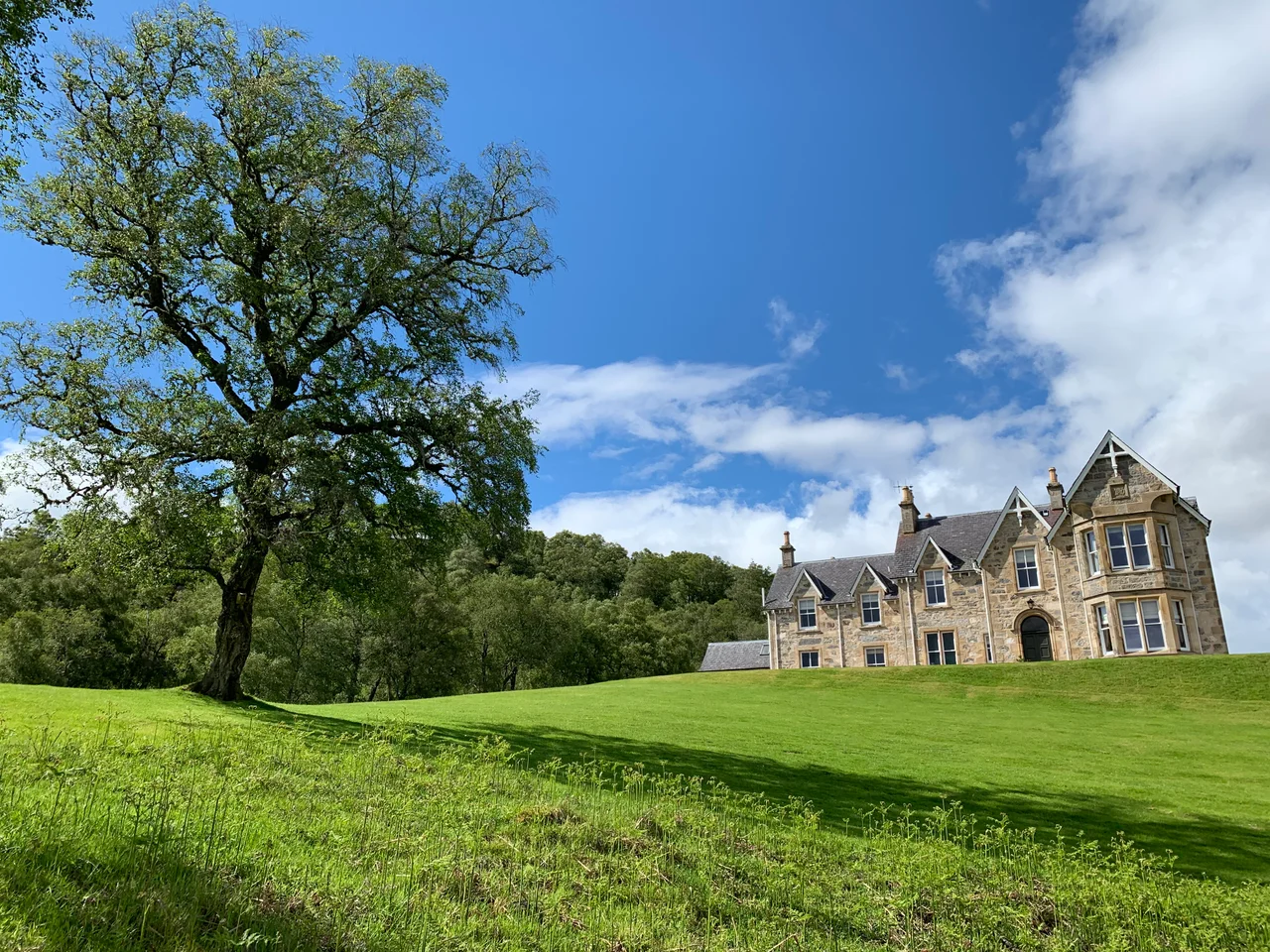

Alladale Wilderness Reserve
The last wolves in Scotland disappeared in the early 1700s. Paul Lister bought 23,000 acres of Sutherland in 2003 with a plan to put them back. The idea sounds simple stated that way and ferociously controversial in practice, because Britain has not contained a wild apex predator larger than a fox in three hundred years, and reintroducing one would mean fences, permissions, court cases, and a shift in what the word wilderness is allowed to mean on a small, crowded island. Alladale is where that argument is being staged on the ground.
What a Highland Estate Looks Like
Drive into Glen Alladale north of the Dornoch Firth and the landscape opens into something both magnificent and stripped. Glacial mountains roll up to 845 metres at Carn Ban. Rivers run clean over peat-stained gravel. Lochs collect at every bend. The trouble is what is missing. Like much of the Scottish Highlands, Alladale was deforested over centuries by axe, plough, and finally by sheep and red deer. The Caledonian Forest that once covered the country survives now only in remnants. Between 2009 and 2012 the reserve planted 800,000 native trees inside protected enclosures - Scots pine, birch, rowan, willow, alder, aspen, holly, hazel, oak, and juniper - because a fenced young tree is a tree that might survive, and an unfenced one is generally lunch.
The Wolf Question
Lister's inspiration came from South African game reserves, where overgrazed farmland has been pushed back toward a more natural state through fences, predators, and tourism revenue. The theory at Alladale is that wolves would regulate the red deer population, the deer would stop eating every seedling, and the forest would come back on its own. The model has worked at Yellowstone, where wolf reintroduction in 1995 reshaped the whole ecosystem. The objection, raised loudly by the Ramblers and others, is that wolves on this estate would require enclosure, and that any fence across Scottish hill country contravenes the spirit and possibly the letter of the Land Reform (Scotland) Act 2003, which guarantees a right of responsible access across the open landscape. The estate also doubles as an access route to Carn Ban itself. The debate has not been resolved. The wolves are not yet here.
What Lives Here Now
Even without wolves, Alladale is unusually rich for the modern Highlands. Red deer and roe deer move through the glens. Wild boar root in the woodland enclosures. Otter and pine marten work the rivers and the regenerating scrub. Mountain hare turn white in winter on the higher ground. The reserve harbours two of Britain's most threatened mammals, the water vole and the European wildcat, the latter so reduced in the wild that a captive breeding programme with the Royal Zoological Society of Scotland is now part of the estate's work. Three species of grouse hold the moors. Golden eagles and white-tailed eagles ride the thermals above the corries, and on a calm summer morning you might see osprey on the lochs, peregrine over the cliffs, and merlin chasing pipits across the heather. A fold of Highland Cattle grazes the lower ground as part of a conservation grazing project, doing the slow vegetation work that wolves and deer once managed between them.
Living and Working the Land
The reserve pays its bills by hosting people. Guests book Alladale Lodge with its seven en-suite rooms and private chef; two smaller cottages take four and eight guests respectively; Deanich Lodge, one of the most remote buildings in Scotland, sleeps groups up to sixteen. Activities range from guided hiking and angling to mountain biking, clay pigeon shooting, whisky tasting, and wildlife safaris in off-road vehicles. The British adventurer Bear Grylls runs a survival academy on the estate, teaching trapping, shelter-building, and fire lighting. In 2018 the reserve ended commercial deer stalking, putting the cull entirely in the hands of its own rangers; by 2020 deer density had fallen to five or six per square kilometre, low enough for young trees to have a fighting chance. An aquaponics garden was completed the same year. The Willow Centre, a new education building, opened in 2023. The wolves remain a proposal. The forest, slowly, is becoming a fact.
From the Air
Located at 57.87 N, 4.63 W in Sutherland, roughly 28 nm northwest of Inverness Airport (EGPE), the nearest major ICAO field. The reserve sits inland from the Dornoch Firth coast, in glacial terrain rising to 845 m at Carn Ban - keep terrain awareness high and respect the rapid weather changes typical of the eastern Highlands. Best viewing 3,000-5,000 ft AGL to take in the glen system, the planted forest enclosures, and the surrounding ridge lines. Loch Glass and Loch Morie to the southeast make useful visual references.
Nearby Stories
- Cape Wrath Trail 6 km away
- Skibo Castle 7.3 km away
- Stoer Head Lighthouse 9.8 km away
- Fortrose Cathedral 9.9 km away
- Achiltibuie 12 km away
- Castle Leod 14 km away
- Assynt 18 km away
- Caithness and Sutherland Peatlands 22 km away