_v2.jpg)
Skibo Castle
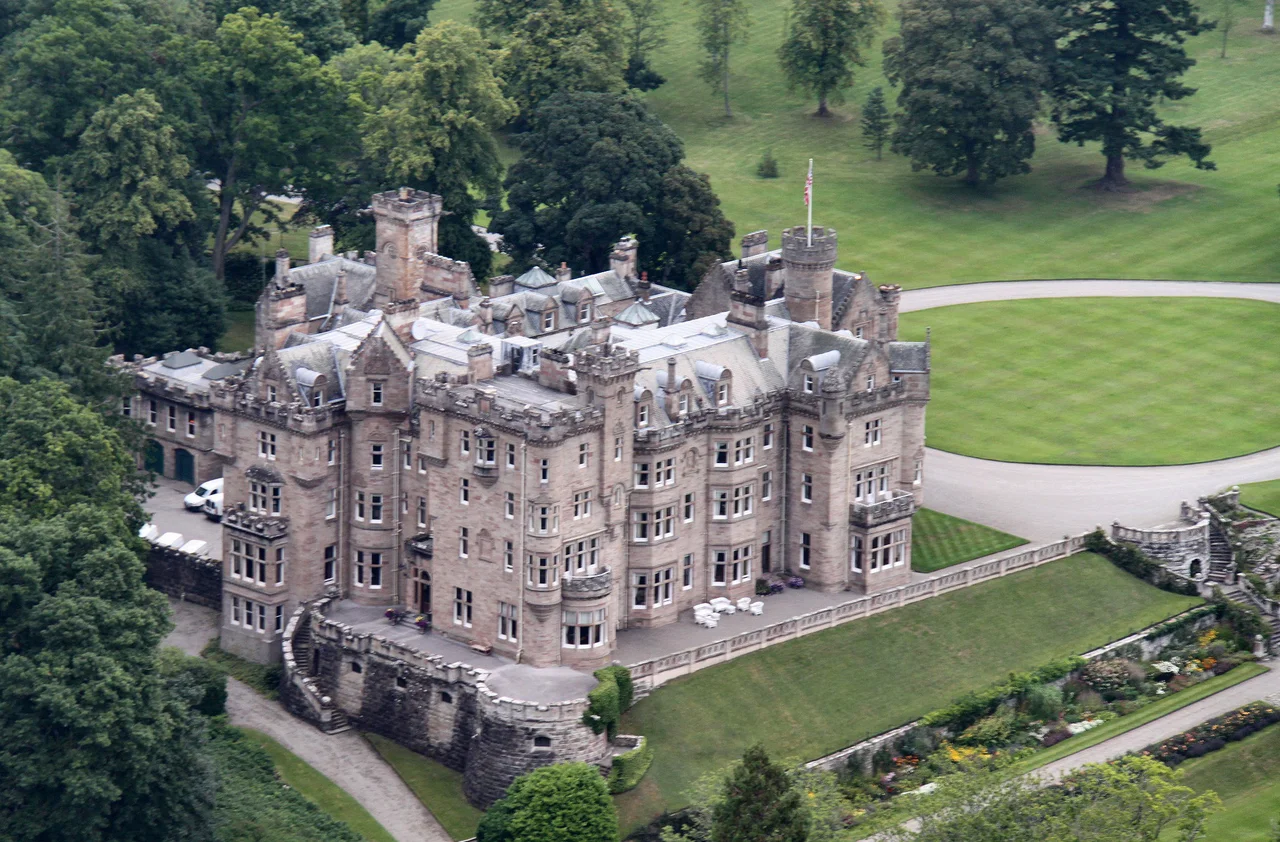
Andrew Carnegie bought Skibo because he wanted Scotland back. He had left Dunfermline a poor weaver's son in 1848, made his fortune in American steel, and by the late 1890s was already engineering the great divestment that would turn him into the most consequential philanthropist of his age. He could have lived anywhere. He chose this turreted pile above the Dornoch Firth, twenty thousand acres of Sutherland, and a private rail platform on the Carnegie Causeway so he could come and go without leaving the estate.
Bishops on a Firth
Skibo's name is anglicised from the Gaelic Sgìobal, itself drawn from an Old Norse name meaning either firewood-steading or Skithi's steading. The first written record is a charter from 1211, when the castle was already a residence of the Bishops of Caithness. It stayed in church hands until 1545, when the bishopric handed the estate to John Gray as a tactical alliance with a powerful family - the Reformation was creeping north, and the church needed local muscle. Robert Gray surrendered Skibo in 1745, the year of the rising. A relative bought it back and built a modern house before 1760. Layer by layer, the building absorbed each century's ambitions.
Carnegie's Improvement
When Carnegie bought Skibo in 1898, he found a comfortable but unremarkable country house. He set out to rebuild it as the dream version of itself - turrets, gables, the full Scots baronial vocabulary, all wrapped in good Sutherland sandstone. He installed indoor plumbing, electric light, a heated swimming pool. He filled it with the rituals he loved: bagpipes at dawn, his American flag and Scottish flag flying together over the gatehouse. He brought guests including Kipling and the future King Edward VII. He died in 1919, but the Carnegie family kept Skibo until 1982. The Burnett family, multi-generational tenants on the estate's farms, were evicted in 2000 - a story BBC's Landward covered in 2006.
Madonna and the Carnegie Club
Today Skibo operates as The Carnegie Club, a members-only residential club. The fees and accommodation revenue go back into estate upkeep. The club has hosted a string of high-profile weddings: golfer Sam Torrance to actress Suzanne Danielle in 1995, Robert Carlyle to Anastasia Shirley in December 1997, and most famously Madonna to Guy Ritchie on 22 December 2000. The Madonna-Ritchie wedding turned Skibo briefly into a tabloid pilgrimage site - photographers staked out the gates in the rain, helicopters tried for aerial shots, and the local hotels filled overnight.
The Carnegie Links
A new eighteen-hole course opened in 1995, designed by Donald Steel and his young assistant Tom MacKenzie. MacKenzie was called back in 2023 to oversee a redesign with David Thompson and Gary Gruber, adding eight new holes and using sand-capping, returfing, and top dressing to bring out the essential links character. The course plays out on a peninsula surrounded by Loch Evelix and the Dornoch Firth. In National Club Golfer's 2026 Top 100 Scottish ranking, The Carnegie Links sits at number 14 - serious praise in a country where the competition includes Old Tom Morris's masterpieces.
Lake Louise and the Designed Landscape
The grounds include Lake Louise, a small artificial lake - and one of only a handful of bodies of water in Scotland that anyone still calls a lake rather than a loch. The whole estate is listed on the Inventory of Gardens and Designed Landscapes in Scotland, the national register of significant designed landscapes. From the lawns above the loch you can see across the Dornoch Firth toward the dunes of Royal Dornoch and on a clear day to the hills of Easter Ross beyond. Carnegie's great gift to Skibo was not just the building. It was the careful framing of every view.
From the Air
Coordinates 57.87 N, 4.13 W on the north shore of the Dornoch Firth, just west of Dornoch. Inverness Airport (EGPE) lies about 30 nm south. From cruising altitude on the corridor between Inverness and Wick, the castle and its grounds read as a green peninsula thrusting into the firth, with the Carnegie Links wrapping around Loch Evelix. The bright turrets and gables of the castle itself can sometimes catch sunlight from a long way off. A useful landmark is the Dornoch Firth Bridge to the east-southeast, carrying the A9.
Nearby Stories
- North Coast 500 5.8 km away
- Pluscarden Abbey 7.7 km away
- Fort George, Highland 8.2 km away
- Conon Hydro Scheme 12 km away
- Caithness and Sutherland Peatlands 19 km away
- Moray Firth 19 km away
- Hill o' Many Stanes 24 km away
- Kylesku Bridge 28 km away