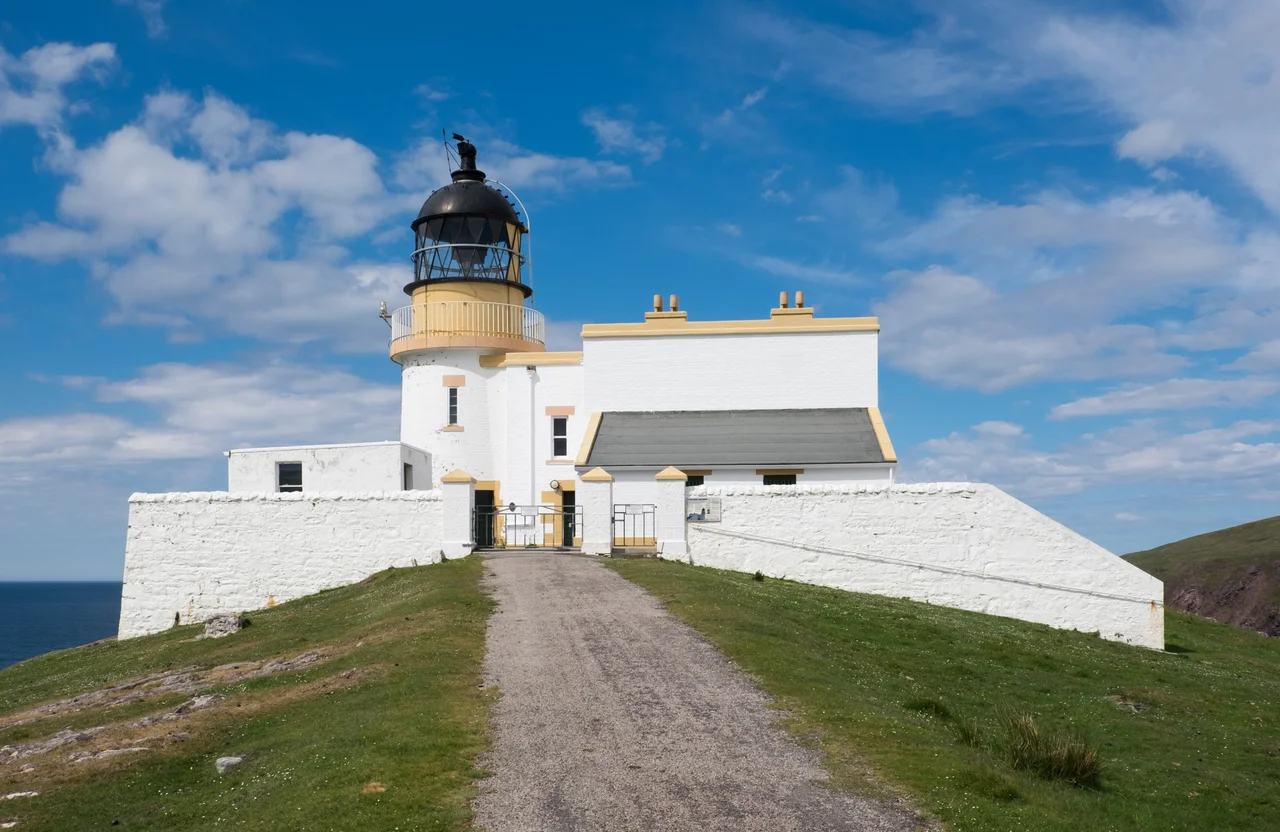

Stoer Head Lighthouse
The lighthouse is only 45 feet tall - a stubby tower that looks almost domestic next to the soaring cylinders most people picture when they think of Scottish lighthouses. But the cliff it sits on does the work the height won't. The beam reaches 24 miles out to sea, flashing white every fifteen seconds, because the keepers' fathers and grandfathers in the Stevenson engineering family understood something elemental: a small light on a tall cliff outperforms a tall light at sea level. The Stevensons built 45 of these around Scotland's coast in the 1870s. Stoer Head was one of them, completed in 1870 by David and Thomas, two of the family who would also produce Robert Louis Stevenson.
Building It With the Sea
In 1870, no road reached Stoer Head. The materials for the lighthouse had to come by boat. The Stevensons built a jetty about a mile to the southeast of the site, landing stone, lime, ironwork and provisions there before hauling them overland to the headland. That jetty still exists, now in disrepair, at Ordnance Survey reference NC013320. Close to it stands the Stoer Lighthouse Stores bothy, the rough shelter where the building crew lived during construction. Inside, on one wall, is a mural showing the east elevation of the finished lighthouse - probably painted by one of the workers during the 1800s, certainly predating the bothy's sale in the 1960s. The neighbouring Salmon Bothy was used to store fish.
The Keeper's Family
Until 1978, the lighthouse was staffed by a principal keeper and an assistant who lived with their families in two cottages beside the tower. Sutherland in the 1900s was not a forgiving address. The remoteness demanded near-self-sufficiency, and the keepers kept livestock - the foundations of the byre, stable, cow shed, pig house and cart shed are still visible in the grass. The children walked to primary school at the village of Stoer. There was no secondary school anywhere in the county. When they turned twelve, they were sent away to board, returning home only for holidays. This was the rhythm of every keeper's household on the Scottish coast: the parents kept the light, the children left and came back, and the light kept turning whether the family was complete or not.
Automation and the Tourist Cottages
Automation came in 1978. The keepers left. The lighting was converted to sealed-beam electric lamps that switch on and off via a sensor at fixed light levels. Today maintenance is split between a local who visits regularly to clean and check, and Northern Lighthouse Board technicians who come once a year. The two keepers' cottages have been converted to self-catering holiday accommodation, sleeping families who can now drive to the site on a narrow but tarmacked single-track lane. About 10,000 people visit Stoer Head each year - enough that in 2013 the Northern Lighthouse Board built a public toilet, and the BBC reported it as news. The tower itself does not offer tours.
The Old Man Beyond
From the car park, a clifftop path runs north to one of Scotland's most spectacular sea-stacks. The Old Man of Stoer is a 60-metre tower of Torridonian sandstone separated from the headland by a narrow channel of churning Atlantic. Climbers cross by Tyrolean traverse - a rope strung above the gap - and ascend the stack itself, which has been climbed regularly since the 1960s. The walk to viewpoint is two miles each way, about an hour, on a path with no railings and a long drop. The Point of Stoer beyond is the actual headland. From either spot, the view westward is uninterrupted sea: Outer Hebrides on a clear day, weather coming in on most others. The lighthouse beam reaches further than the eye does.
From the Air
Stoer Head Lighthouse stands at 58.24°N, 5.40°W on the headland north of Lochinver. From the air, look for the distinctive white tower on the clifftop with the Old Man of Stoer sea-stack standing offshore to the north. Nearest airport is Inverness (EGPE), 80 nm to the southeast. Recommended viewing altitude 1,500-3,000 ft to take in the clifftop, the stack, and the Minch beyond. The lighthouse's 24-mile range makes it a reliable landmark for coastal navigation in marginal visibility.
Nearby Stories
- Priest Island 6.3 km away
- Tiumpan Head Lighthouse 9.6 km away
- Durness 11 km away
- Battle of Tuiteam Tarbhach 17 km away
- German submarine U-905 19 km away
- Shiant Islands 26 km away
- Loch Shin 30 km away
- The Laki Eruption: The Volcano That Changed World History 895 km away